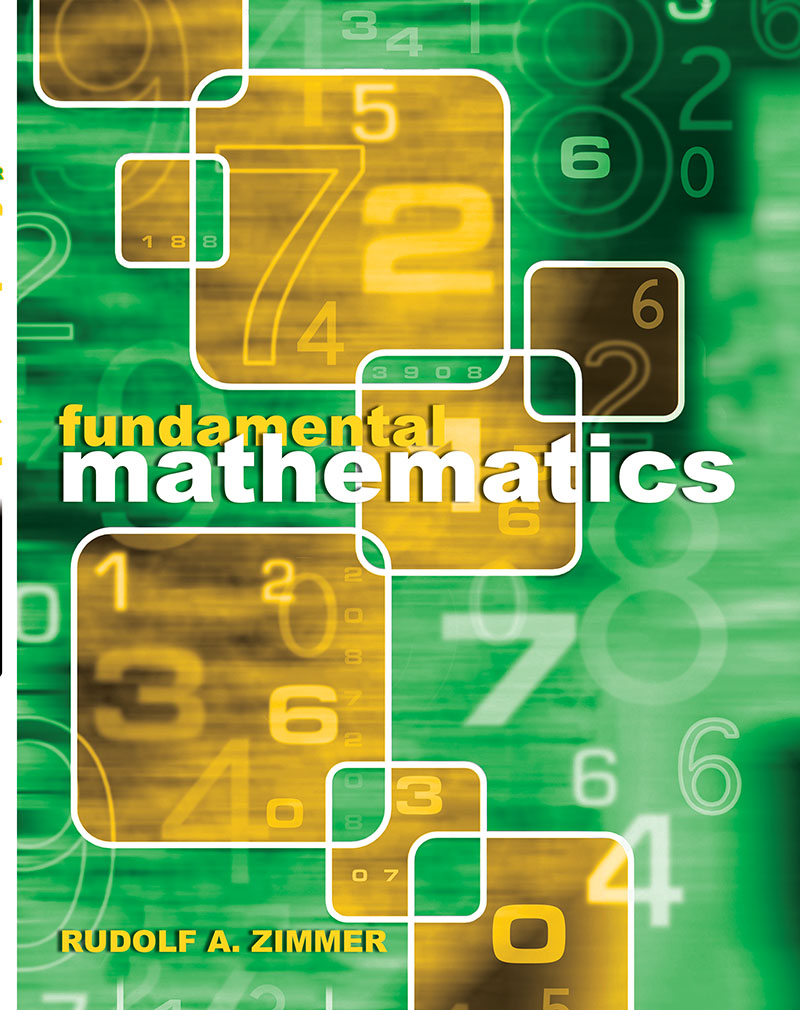
Fundamental Mathematics: A Student Oriented Teaching or Self-Study
Edition: 2
Copyright: 2002
Pages: 566
Edition: 2
Copyright: 2002
Pages: 568
Choose Your Format
Ebook
$82.85 USD
$165.66 USD
Fundamental Mathematics: A Student Oriented Teaching or Self-Study is a comprehensive introduction to the essential concepts of mathematics, designed for both classroom instruction and independent learning. Organized into clear, step-by-step modules, the text provides a solid foundation in arithmetic, algebra, geometry, graphing, and trigonometry while emphasizing practical problem-solving skills and mathematical reasoning.
The book begins with whole numbers, fractions, decimals, percents, integers, and exponents before progressing to algebraic expressions, linear equations, and fractional equations. Students then explore graphing techniques, systems of linear equations, and the fundamentals of geometry and trigonometry, developing the skills needed for success in technical, vocational, and college-level mathematics courses.
Each module builds upon previously learned concepts through carefully sequenced lessons, worked examples, practice exercises, and applied word problems that reinforce understanding and encourage mastery. Additional appendices provide strategies for solving word problems and solutions to selected exercises, making the text well suited for review and self-paced study.
Whether used as a primary course textbook or as a supplemental reference, Fundamental Mathematics: A Student Oriented Teaching or Self-Study equips students with the mathematical knowledge, confidence, and analytical skills necessary for further study in science, technology, engineering, business, and other quantitative disciplines.
Module 1: Operations with Whole Numbers and Fractions
Unit 1: Whole Numbers, Fundamental Operations
Unit 2: Exponents, Roots and Factors, Order of Operations
Unit 3: Fractions, Basic Concepts
Unit 4: Addition and Subtraction of Fractions, Mixed Numbers
Unit 5: Multiplication and Division of Fractions, Complex Fractions
Module 2: Operations with Decimals and Percents
Unit 6: Decimals
Unit 7: Introduction to the Metric System (SI Units of Length)
Unit 8: Introduction to the Metric System (SI Units of Area, Volume and Mass)
Unit 9: Percents, Changing Fractions, Decimals and Percents to Equivalent Forms
Unit 10: The Three Types of Percent Problems
Module 3: Operations with Integers and Exponents
Unit 11: Signed Numbers
Unit 12: Addition and Subtraction of Signed Numbers
Unit 13: Multiplication and Division of Signed Numbers
Unit 14: Variable Expressions and Properties of Exponential Expressions
Unit 15: Working with Exponents, Scientific Notation
Module 4: Linear Equations, Operations with Algebraic Expressions
Unit 16: Addition and Subtraction of Algebraic Expressions
Unit 17: Linear Equations—One Variable
Unit 18: Applied Word Problems Involving Linear Equations
Unit 19: Multiplication of Algebraic Expressions
Unit 20: Division and Factoring of Simple Algebraic Expressions
Module 5: Operations with Fractional Expressions, Solving Formulas
Unit 21: Introduction to Algebraic Fractions, Equivalent Fractions
Unit 22: Multiplication and Division of Algebraic Fractions
Unit 23: Addition and Subtraction of Algebraic Fractions
Unit 24: Fractional Equations
Unit 25: Ratios, Proportions and Conversions
Unit 26: Applied Word Problems Involving Fractional Equations
Unit 27: Working with Formulas
Module 6: Graphing, Systems of Linear Equations
Unit 28: The Rectangular Coordinate System
Unit 29: Graphing Linear Equations
Unit 30: Systems of Linear Equations in Two Variables and Applied Word Problems
Module 7: Basic Geometry and Trigonometry
Unit 31: Measurement Concepts
Unit 32: Basic Geometric Concepts: Angles, Triangles, Pythagorean Theorem
Unit 33: Basic Geometric Concepts: Perimeters, Areas, Volumes
Unit 34: Primary Trigonometric Ratios
Unit 35: Secondary (Reciprocal) Trigonometric Ratios
Unit 36: Applications in Technology of Right Triangular Trigonometry
Appendix 1: Additional Help in Solving Word Problems
Appendix 2: Solutions to Check Points and Answers to Drill Exercises
Index
Rudolf Alois Zimmer was born in 1935 in Germany to pacifist parents as the Nazis rose to power. He survived World War II and the difficult postwar years before leaving a career in Swiss banking in 1957 to immigrate to Canada with his brother and best friend, arriving with nothing but a suitcase.
In Canada, Zimmer worked while pursuing his education, eventually earning a B.A. (Honours) and an M.A. in Mathematics from the University of Western Ontario in 1965. He taught mathematics at King’s College in London, Ontario, and St. Mary’s University in Halifax, Nova Scotia, before joining the faculty at Fanshawe College in London, Ontario, in 1968. In 1972, he established the Mathematics Learning Centre, the first facility of its kind in Canada.
From 1992 to 2000, Zimmer was seconded semi-annually by the Canadian International Development Agency (CIDA) to develop culturally appropriate mathematics learning materials and train teachers in Jamaica and Guyana. He retired from teaching in 1999.