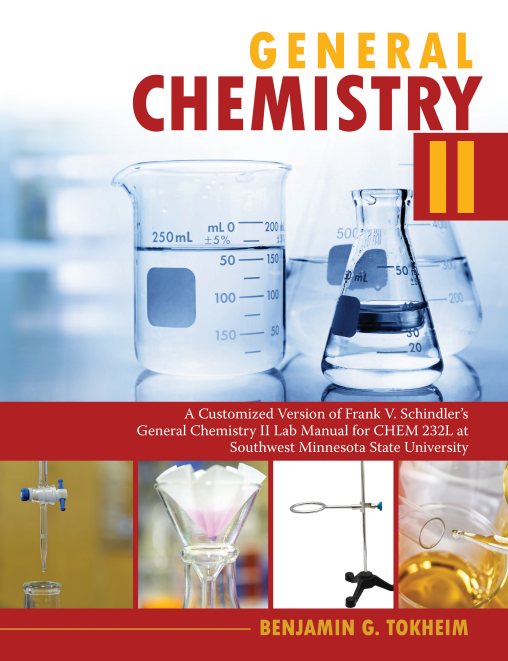
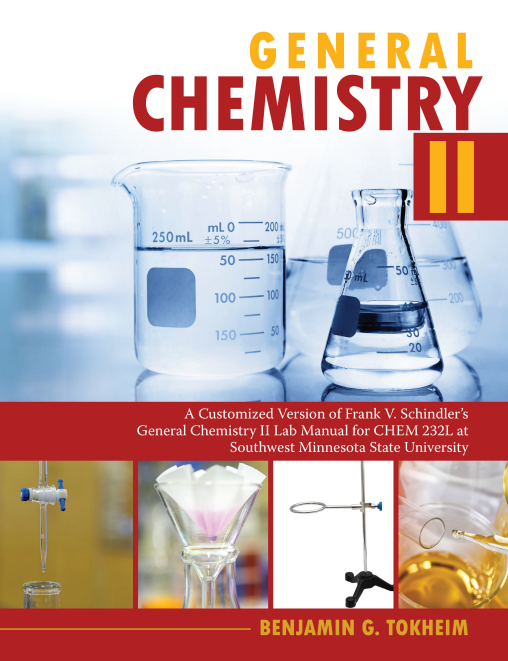
General Chemistry II Lab Manual: A Custom Version for CHEM 232L at Southwest Minnesota State University
Edition: 1
Copyright: 2026
Pages: 108
Edition: 1
Copyright: 2026
Pages: 108
Choose Your Format
Choose Your Platform | Help Me Choose


$60.00 USD
Ebook
$30.00 USD
This laboratory manual provides students with hands-on experience in key areas of general and physical chemistry, including colligative properties, chemical kinetics, equilibrium, acid-base chemistry, thermodynamics, and electrochemistry. Through a series of experiments, students learn to apply quantitative laboratory techniques, collect and analyze data, and connect experimental results to fundamental chemical principles. The manual also emphasizes laboratory safety, proper record keeping through laboratory notebooks, and the use of common laboratory equipment and instrumentation. Supporting appendices provide guidance on notebook preparation, pH meter calibration, and essential laboratory procedures to strengthen scientific skills and professional laboratory practices.
Preface
Laboratory Description
Laboratory Safety
Laboratory Safety Practices
Laboratory Notebooks
Experiment 1 Determining Molar Mass of a Nonvolatile Solute by Freezing-Point Depression
Experiment 2 Chemical Kinetics of Iodide and Persulfate Reduction/Oxidation
Experiment 3 Evaluation of Chemical Equilibria and Formation Constant Using Le Châtelier’s Principle
Experiment 4 Potentiometric Titration of a Polyprotic Acid
Experiment 5 Thermodynamic Evaluation of Ca(IO3)2 Dissolution
Experiment 6 Introduction to Electrochemistry
Appendix 1 Notebook Example
Appendix 2 pH Meter Calibration Procedures
Appendix 3 Common Laboratory Equipment
Appendix 4 Periodic Table of the Elements
Dr. Benjamin Tokheim is an Assistant Professor of Chemistry in the Department of Science at Southwest Minnesota State University. He earned a Doctor of Philosophy from Washington State University and a Bachelor of Arts from Carleton College. As a chemistry faculty member, he teaches and mentors students in the chemical sciences, helping them develop a strong foundation in chemical principles, laboratory techniques, and scientific inquiry through coursework and hands-on learning experiences.