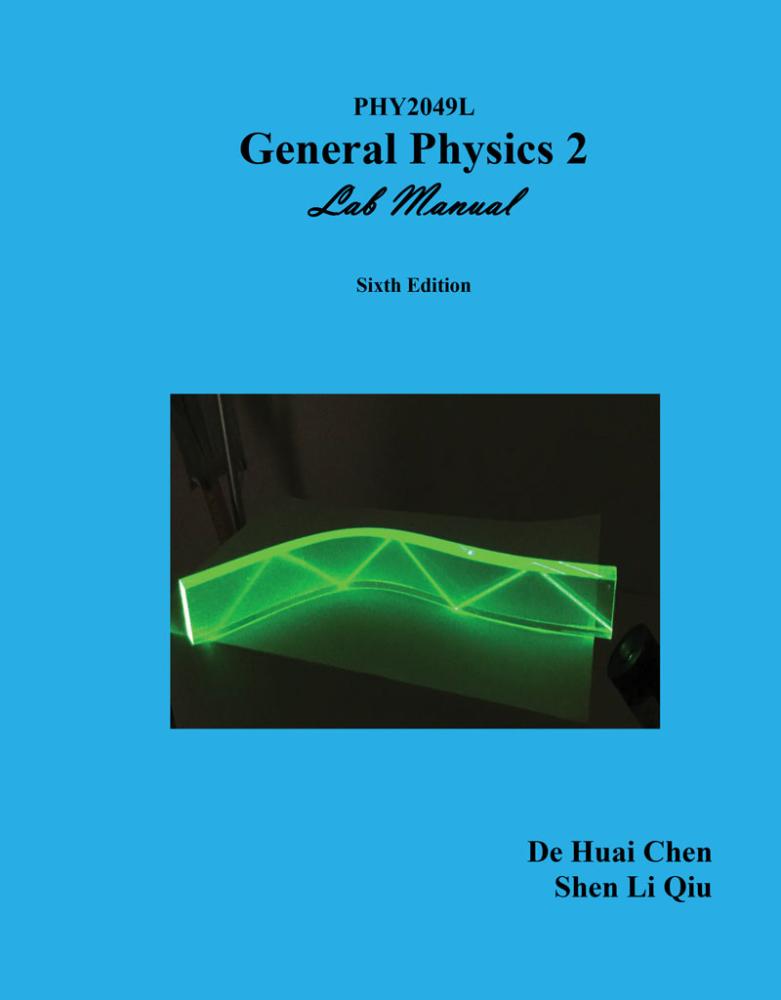
General Physics 2: PHY 2049L Lab Manual
Edition: 6
Copyright: 2022
Pages: 134
Choose Your Format
$26.46 USD
This laboratory manual for General Physics 2 explores the principles of electricity, magnetism, circuits, electromagnetic induction, and optics through experimental investigation. Students develop proficiency in measurement, uncertainty analysis, and scientific data interpretation while conducting experiments on electric fields and potential, resistive circuits, RC circuits, magnetic fields, transformers, resonance, and electromagnetic induction. Additional laboratories examine reflection, refraction, lenses, telescopes, dispersion, and polarization, with computerized experiments reinforcing modern data acquisition and analysis techniques.
Introduction
Experimental error and data analysis
Experiment 1 Electric field and electric potential
Experiment 2 Resistors in series and parallel connections (1)
Experiment 3 Resistors in series and parallel connections (2)
Experiment 4 Voltmeter and ammeter
Experiment 5 RC time constant
Experiment 6.1 Earth's magnetic field
Experiment 6.2 Magnetic field of a solenoid
Experiment 7.1 Induced emf: magnet passes through a solenoid
Experiment 7.2 Transformer
Experiment 8.1 Series LCR resonance
Experiment 8.2 Phase angle ϕ versus frequency f
Experiment 9 Reflection, refraction and total internal reflection
Experiment 10.1 Lenses
Experiment 10.2 Telescope
Experiment 11 Dispersion from a prism and index of refraction
Experiment 12 Polarization of light by absorption and reflection
Computerized experiments
Dehuai Chen, Ph.D., is a Physics Instructor at Florida Atlantic University in Boca Raton. He teaches undergraduate physics courses and laboratories, emphasizing the fundamental principles of mechanics, electricity and magnetism, optics, and experimental physics.
Dr. Shen Li Qiu is Professor of Physics at Florida Atlantic University, where he has served since 1990. He earned a B.A. in Physics from Fudan University in Shanghai, an M.S. in Physics from the City University of New York, and a Ph.D. in Physics from the City University of New York. His research focuses on the electronic structure of metals and alloys, as well as the magnetic structure of transition-metal compounds and thin-film multilayer systems.