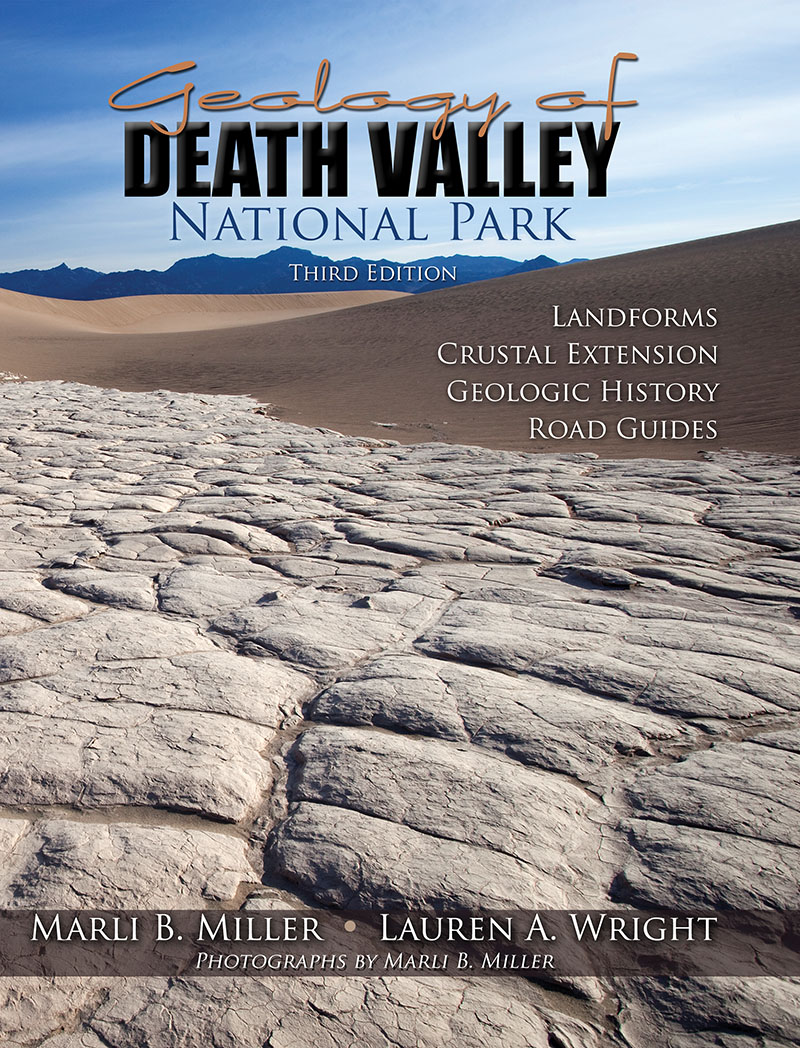
Geology of Death Valley: Landforms, Crustal Extension, Geologic History, Road Guides
Edition: 3
Copyright: 2015
Pages: 140
Edition: 3
Copyright: 2015
Pages: 140
Choose Your Format
Ebook
$21.35 USD
$26.68 USD
Get to know Death Valley National Park in a unique way through amazing photographs and detailed descriptions of its world class geology. New to this third edition are many new photographs and updated information from the latest geologic research in Death Valley. Discover where to go in the park to see specific results of geologic activity. Geologists and non-geologists alike will be impressed by the incredible variety of geologic features and the fascinating history behind the landscape we know today as Death Valley.
Geology of Death Valley National Park is a must for field trips and for those who want to get the most from their visit to this beautiful park.
About the Authors
Preface
Introduction
Chapter One: Death Valley’s Active Geology
Active Faulting Along the Black Mountains Front
Alluvial Fans
Badlands Topography
The Black Mountains and the Basin and Range from Dante’s View
Playa Lakes and the Death Valley Salt Pan
Racetrack Playa
Lake Manly
Young Volcanic Features
Sand Dunes
Springs
Chapter Two: Shaping of the Present Landscape
The Faults
The Ranges
The Basins
The Central Death Valley Plutonic-Volcanic Field
Amount and Style of Crustal Extension in Death Valley
Chapter Three: Geologic History
The Ancient Basement and Prolonged Erosion
The Pahrump Group: Proterozoic Basins and Uplands
The Noonday Dolomite, Ibex Formation and Johnnie Formation: Foreshadowing the Environment of a Passive Continental Margin
The Stirling Quartzite, Wood Canyon Formation, and Zabriskie Quartzite: The Clastic Wedge of a Developing Continental Margin
The Paleozoic and Early Mesozoic Carbonate Shelf
The Closing of the Paleozoic Ocean in Mesozoic Time
The Missing Sedimentary Record and Beginnings of the Basin and Range Event
The Oligocene and Early Miocene Flood Plain and the Bordering Upland
Late Cenozoic Extension
Chapter Four: Death Valley Road Guides
Introduction
Road and Field Guide to the Northern Black Mountains
Road to Dantes View
Road to Ubehebe Crater and Scotty’s Castle (Northern Death Valley)
Beatty Cut-off Road to Start of Titus Canyon Road
Titus Canyon
Western Park Boundary to Stovepipe Wells (Western Death Valley)
Glossary
References
Marli Miller has studied and photographed geology in the Death Valley region since she was introduced to the area by Lauren Wright in 1984. Much of her research focuses on the evolution of the Black Mountains, and she has been especially interested in the turtlebacks and the Amargosa Chaos. She completed her B.A. in geology at Colorado College in 1982, and then her M.S. and Ph.D. at the University of Washington in 1987 and 1992 respectively. Marli lives in Eugene, Oregon where she is a senior instructor and researcher at the University of Oregon.
Lauren Wright began his geological investigations of the Death Valley region in the late 1940’s while working toward his Ph.D. at Caltech. He and his field partner Bennie Troxel were both employed by the California Division of Mines and Geology and cooperated in the preparation of geo- logic maps of much of the southern part of this region. In 1961, Wright moved eastward to teach geology at Pennsylvania State University. He continued his association with Troxel and supervised the Death Valley-oriented research of numerous graduate students. Since his retirement in 1985, he continued to return to Death Valley almost yearly to work in cooperation with Troxel, a number of his former students, and other younger geologists. Lau- ren passed away at the age of 94 during early 2013.