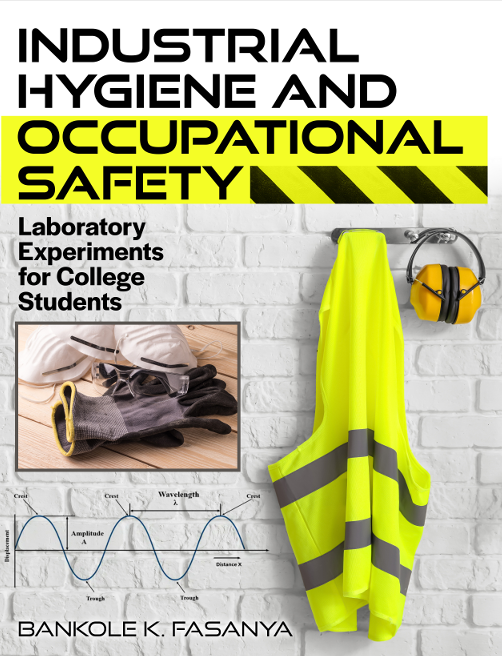
Industrial Hygiene and Occupational Safety Laboratory Experiments for College Students
Edition: 1
Copyright: 2025
Pages: 163
Choose Your Format
Choose Your Platform | Help Me Choose


Ebook
$55.00 USD
Industrial Hygiene and Occupational Safety Laboratory Experiments for College Students is designed for students pursuing degrees in engineering, occupational health and safety, industrial hygiene, environmental health and safety, and technology. It aims to enhance students’ practical and hands-on knowledge in areas such as industrial hygiene measurement, occupational noise evaluation and measurement, sound and hearing conservation, occupational exposure limits, electrical safety, ventilation, principles of occupational safety and industrial hygiene, personal protective equipment evaluation, sound processing and signal detection theory, as well as the impact of specific chemicals on targeted body organs.
Additionally, the book is advantageous for science and other STEM-focused students interested in increasing their understanding of safety in everyday activities. While many excellent laboratory books focus solely on industrial hygiene, this book takes a broader approach, and can be used across different science disciplines.
The content has been developed from the perspective of an individual with extensive academic experience, engineering expertise, and industrial knowledge in the fields of industrial hygiene and occupational health and safety. It reflects the insights of someone who has effectively integrated theoretical knowledge with practical application, thereby supporting student success in both academic and professional settings.
The Industrial Hygiene and Occupational Safety Laboratory Experiments for College Students outlines key concepts in industrial hygiene, occupational health and safety, and workplace safety practices. The book defines important occupational safety acronyms and provides a comprehensive, step-by-step guide for writing laboratory reports, along with essential guidelines to ensure report quality.
A dedicated full page offers detailed explanations of how to write each section of the laboratory report and what is required under each heading. The book also includes thirteen critical points for preparing and delivering effective PowerPoint presentations.
Each laboratory experiment is designed with clearly stated student learning objectives, lab aims, estimated data collection times, required equipment types, and straightforward explanations to support understanding. In addition, the book provides a grading rubric for laboratory instructors and faculty overseeing the exercises.
CHAPTER 1 PRINCIPLE OF INDUSTRIAL HYGEINE AND OCCUPATIONAL SAFETY
Lab 1: Introduction to Occupational Safety and Industrial Hygiene: Commonly Used Acronyms
CHAPTER 2 WORKPLACE SAFETY AND HEALTH PRACTICES
Lab I: Hazard Identification and How to Assess the Risk Associated with Hazards in the Workplace
CHAPTER 3 MEASUREMENTS IN INDUSTRIAL HYGIENE AND OCCUPATIONAL SAFETY LABORATORIES
Lab I: Length Measurement
Lab II: Volume Measurement
Lab III: Mass Measurement of Solid Object
Lab IV: Titration of Acid and Base
CHAPTER 4 INDUSTRIAL HYGIENE (IH) AND OCCUPATIONAL SAFETY PROBLEMS AND EXPOSURES
Lab I: Determination of Interactive Effects of Multiple Chemicals/ Substances on Human Body System
Lab II: Chemical Exposure
Lab III: How to Measure CO2 Concentration (Laboratory Simple Method)
Lab IV: Determination of Sampling and Analytical Error—Lower and Highest Control Levels for Violation Decision-Making
CHAPTER 5 VENTILATION
Lab I: Measurement of Static, Total, Velocity Pressure, and Volumetric Airflow Rate of a Simple Local Exhaust Ventilation System
CHAPTER 6 SOUND AND HEARING CONSERVATION
Lab I: Record Sound Level in Decibels
Lab II: Sound Pressure and Sound Power
Lab III: Noise Control—Bell Alarm Experiment
Lab IV: Demonstration of Inverse Square Law of Sound
Lab V: Determination of Sound Intensity at a Distance Using Inverse Square Law and Sound Interference
CHAPTER 7 PERSONAL PROTECTIVE EQUIPMENT (PPE) EVALUATIONS FOR PROPER USEAGE
Lab I: Experiment on a Simple Method to Select the Best Hand Glove for a Specific Task
Lab II: Glove compatibility
CHAPTER 8 SIGNAL PROCESSING
Lab 1: Analysis and Filtering of a Noisy Signal
CHAPTER 9 SIGNAL DETECTION THEORY
Lab 1: The Impact of SDT of Noise Signal Perception
CHAPTER 10 ELECTRICAL SAFETY EXPERIMENT
Lab 1: Measure the Electrical Resistance of Human Body Using the Ohmmeter Function of the Electronic VOM
Lab 2: Voltmeters and Ammeters Safer Connection Procedure for Circuit Measurement
Dr. Bankole K. Fasanya is currently an Assistant Professor in the Department of Engineering and Industrial Professions at the University of North Alabama (UNA). He earned both his Master’s and Ph.D. in Industrial and Systems Engineering, specializing in Ergonomics and Human Factors, with a minor in Noise and Auditory Processes. Before his tenure at UNA, he served as an Assistant Professor at Purdue University Northwest within the Department of Construction Science and Organizational Leadership, focusing on Environmental Health and Safety. Additionally, he has experience as a Senior Research Associate at the US Army Aeromedical Research Laboratory in the Auditory Protection and Performance Division in Fort Rucker, Alabama, and as a research and teaching faculty member at North Carolina Agricultural and Technical State University.
Dr. Fasanya's teaching and research interests encompass a range of topics, including workplace ergonomics evaluation, applied ergonomics, human factors, occupational health and safety, auditory protection and performance, industrial safety, noise control, design of experiments, industrial hygiene, work physiology, data analysis, STEM education, lean manufacturing, and Six Sigma principles. He has over ten years of experience in noise control and auditory process research, as well as workplace ergonomics. His research focuses specifically on how factors such as noise exposure (intensity, frequency, and duration), stress, time, work activities, and gender differences influence human behavior and performance in various environments, both natural and human-induced. His long-term research goal is to develop a comprehensive model and guidelines aimed at reducing environmental hazards and enhancing safety and health in the workplace.
Dr. Fasanya has published numerous articles and presented his research at various national and international conferences. Notably, one of his research projects received the Outstanding Poster Research Award at the National Hearing Conservation Association (NHCA) annual conference in 2020.
He is an OSHA-authorized trainer, a Certified Occupational Hearing Conservationist, and holds certifications in Six Sigma and lean manufacturing. Additionally, Dr. Fasanya is a Carnegie Africa Diaspora Fellow and has developed and taught several courses in engineering and occupational health and safety programs.