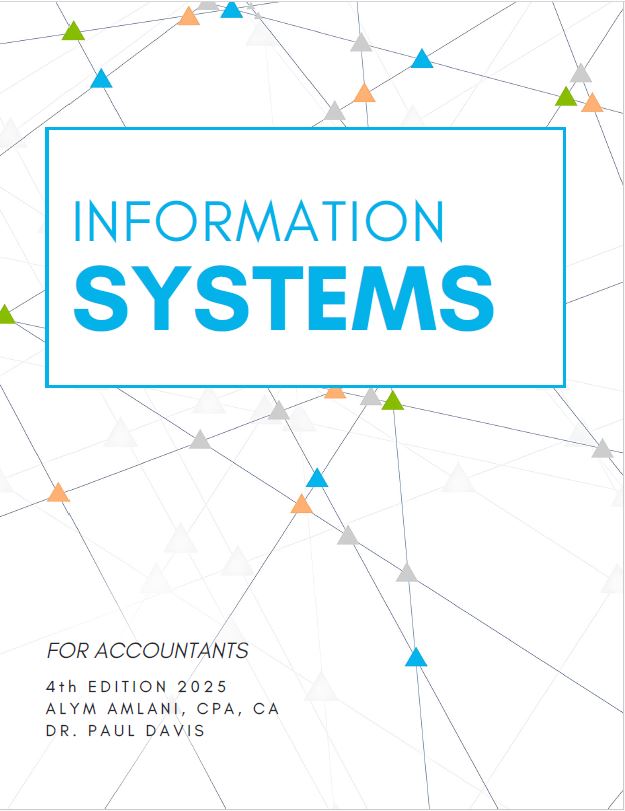
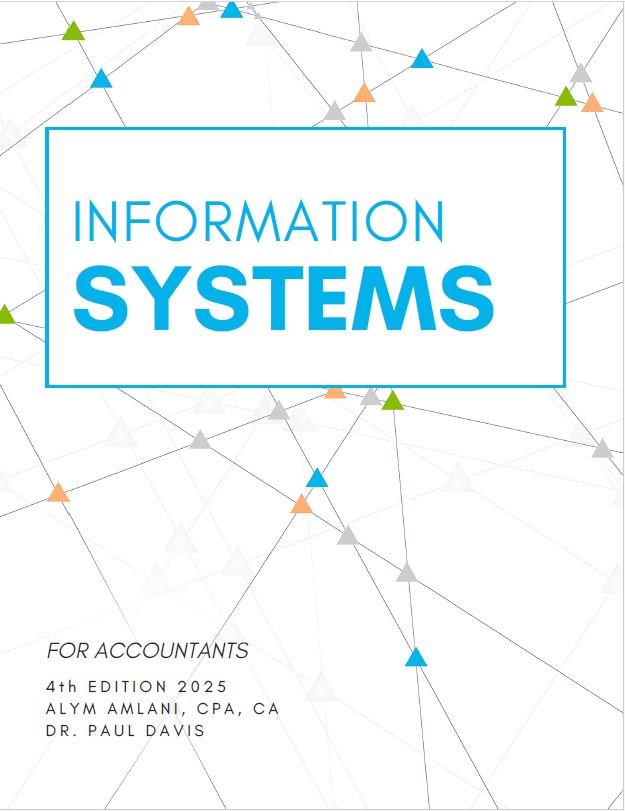
Information Systems for Accountants
Edition: 4
Copyright: 2025
Pages: 335
Edition: 4
Copyright: 2025
Pages: 322
Choose Your Format
Ebook Package
$60.00 USD
Print Package
$100.00 USD
Modern accounting is fundamentally linked to technology. Today, virtually all accounting tasks are accomplished using software. Accountants must:
- understand the systems that underpin their work to improve accuracy, reduce errors, and enhance data security and auditability.
- know how to ensure data integrity, identify vulnerabilities, and present data effectively to support executive decision-making.
- meet legal, professional, and compliance standards.
As emerging technologies transform the profession, technical competence is essential. The market places a premium on accountants who contribute beyond the numbers—those who are technologically literate stand out as top candidates for employment, promotion, and high-value compensation.
The NEW Fourth edition of Information Systems for Accountants delivers a comprehensive introduction to IT, data skills, and accounting software, specifically tailored to the needs of accounting students. Assuming only basic computer knowledge, it builds progressively toward a practical and adaptable skill set. After mastering fundamental concepts, readers are well-prepared for advanced coursework at the diploma, bachelor’s, or professional designation levels—or for immediate business application.
The authors begin with an overview of information systems, including hardware, software, business processes, transactions, reporting, and analytics. Security, privacy, and accountability—critical themes in any business context—are explored in depth, including regulatory compliance, customer data protection, and ethical considerations. Risks and controls, both preventive and reactive, are explained alongside privacy and data integrity issues. A high-level introduction to Accounting Information Systems (AIS) prepares students for real-world exposure as they enter the profession.
Recognizing the role of accountants in systems design and improvement, the book explores the Systems Development Life Cycle (SDLC), integrating change management and continuous improvement. Readers learn how to participate meaningfully in system enhancements and stay current in a dynamic environment.
As technology advances, its role in verifying, analyzing, and detecting anomalies becomes vital. The authors introduce Audit Data Analytics (ADA) and the rapidly expanding impact of artificial intelligence (AI).
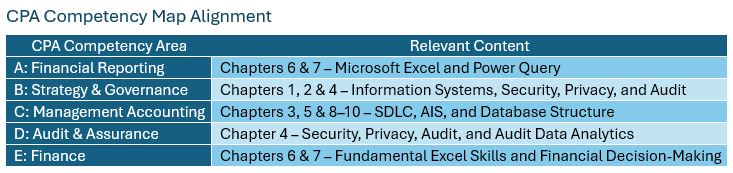
Microsoft Excel remains the accountant’s essential tool. Two chapters cover essential functions, data manipulation, and financial analysis, including the use of Power Query for data extraction and transformation. The authors explain and demonstrate the power of Pivot Tables to support robust financial decision-making.
The book concludes with a practical exploration of databases, using a detailed example of a database system’s evolution.
Alym Amlani is an accomplished educator specializing in accounting and information systems. In 2024, he won the Distinguished Teaching Award at the Melville School of Business, Kwantlen Polytechnic University. He is nominated by the Langara School of Management for the 2025 ACBSP Teaching Excellence Award. He is also a member of faculty at the Sauder School of Business, University of British Columbia. Drawing on his unique background as a professional magician, Alym champions edutainment –combining entertainment with education. His classes are fun; he motivates students to share his fervor for the topics he teaches. His innovative communication techniques make complex topics engaging and accessible. Alym has co-authored several influential journal articles on the Science of Magic which received international acclaim. Recognized twice, in 2020 and 2024, in the Best of the Teaching Professor Conference Proceedings for his forward-thinking approaches to exam-writing and leveraging technology to enhance education, he is dedicated to advancing teaching practices within the educational community.
Dr Paul Davis is a legal, accounting, and teaching professional with a distinguished educational history. Building on a first-class degree in law from King’s College, Cambridge, he has had the privilege of studying at four other universities – Dalhousie, Ottawa, British Columbia, and Hult International Business School. He has enjoyed long periods at the head of international businesses including Canada’s first online currency exchange in the 1980s. In 1994 he was featured by Profit Magazine as the CEO of Canada’s fastest growing company. Paul’s teaching experience started as an Assistant Professor of Law at the University of Ottawa ,though he has also gained certifications as an instructor in aerobics, flying, and English as a Second Language. He is the author of numerous works including Sentencing in Canada and the Canadian Sentencing Digest (Carswell), Barry the Boreray, a children’s book about sheep, You Can!, a technical manual for licensing and managing regulated gaming companies, and over 30 articles in professional and refereed journals.
Modern accounting is fundamentally linked to technology. Today, virtually all accounting tasks are accomplished using software. Accountants must:
- understand the systems that underpin their work to improve accuracy, reduce errors, and enhance data security and auditability.
- know how to ensure data integrity, identify vulnerabilities, and present data effectively to support executive decision-making.
- meet legal, professional, and compliance standards.
As emerging technologies transform the profession, technical competence is essential. The market places a premium on accountants who contribute beyond the numbers—those who are technologically literate stand out as top candidates for employment, promotion, and high-value compensation.
The NEW Fourth edition of Information Systems for Accountants delivers a comprehensive introduction to IT, data skills, and accounting software, specifically tailored to the needs of accounting students. Assuming only basic computer knowledge, it builds progressively toward a practical and adaptable skill set. After mastering fundamental concepts, readers are well-prepared for advanced coursework at the diploma, bachelor’s, or professional designation levels—or for immediate business application.
The authors begin with an overview of information systems, including hardware, software, business processes, transactions, reporting, and analytics. Security, privacy, and accountability—critical themes in any business context—are explored in depth, including regulatory compliance, customer data protection, and ethical considerations. Risks and controls, both preventive and reactive, are explained alongside privacy and data integrity issues. A high-level introduction to Accounting Information Systems (AIS) prepares students for real-world exposure as they enter the profession.
Recognizing the role of accountants in systems design and improvement, the book explores the Systems Development Life Cycle (SDLC), integrating change management and continuous improvement. Readers learn how to participate meaningfully in system enhancements and stay current in a dynamic environment.
As technology advances, its role in verifying, analyzing, and detecting anomalies becomes vital. The authors introduce Audit Data Analytics (ADA) and the rapidly expanding impact of artificial intelligence (AI).
Microsoft Excel remains the accountant’s essential tool. Two chapters cover essential functions, data manipulation, and financial analysis, including the use of Power Query for data extraction and transformation. The authors explain and demonstrate the power of Pivot Tables to support robust financial decision-making.
The book concludes with a practical exploration of databases, using a detailed example of a database system’s evolution.
Alym Amlani is an accomplished educator specializing in accounting and information systems. In 2024, he won the Distinguished Teaching Award at the Melville School of Business, Kwantlen Polytechnic University. He is nominated by the Langara School of Management for the 2025 ACBSP Teaching Excellence Award. He is also a member of faculty at the Sauder School of Business, University of British Columbia. Drawing on his unique background as a professional magician, Alym champions edutainment –combining entertainment with education. His classes are fun; he motivates students to share his fervor for the topics he teaches. His innovative communication techniques make complex topics engaging and accessible. Alym has co-authored several influential journal articles on the Science of Magic which received international acclaim. Recognized twice, in 2020 and 2024, in the Best of the Teaching Professor Conference Proceedings for his forward-thinking approaches to exam-writing and leveraging technology to enhance education, he is dedicated to advancing teaching practices within the educational community.
Dr Paul Davis is a legal, accounting, and teaching professional with a distinguished educational history. Building on a first-class degree in law from King’s College, Cambridge, he has had the privilege of studying at four other universities – Dalhousie, Ottawa, British Columbia, and Hult International Business School. He has enjoyed long periods at the head of international businesses including Canada’s first online currency exchange in the 1980s. In 1994 he was featured by Profit Magazine as the CEO of Canada’s fastest growing company. Paul’s teaching experience started as an Assistant Professor of Law at the University of Ottawa ,though he has also gained certifications as an instructor in aerobics, flying, and English as a Second Language. He is the author of numerous works including Sentencing in Canada and the Canadian Sentencing Digest (Carswell), Barry the Boreray, a children’s book about sheep, You Can!, a technical manual for licensing and managing regulated gaming companies, and over 30 articles in professional and refereed journals.