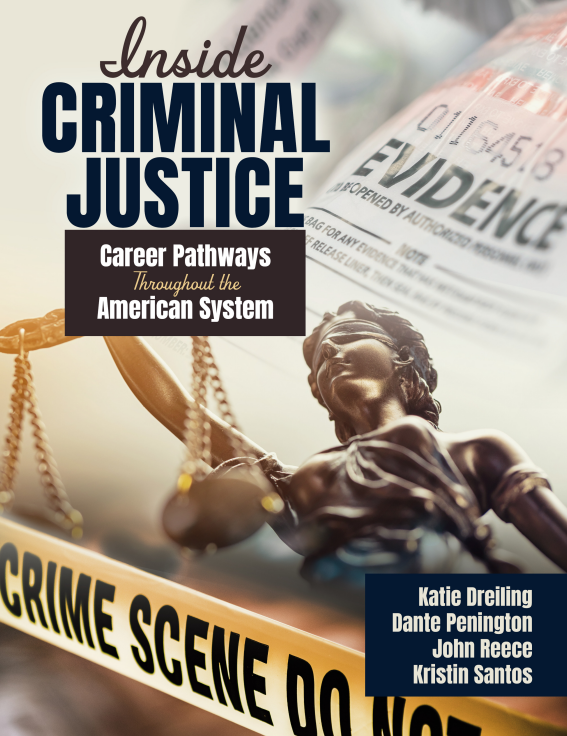
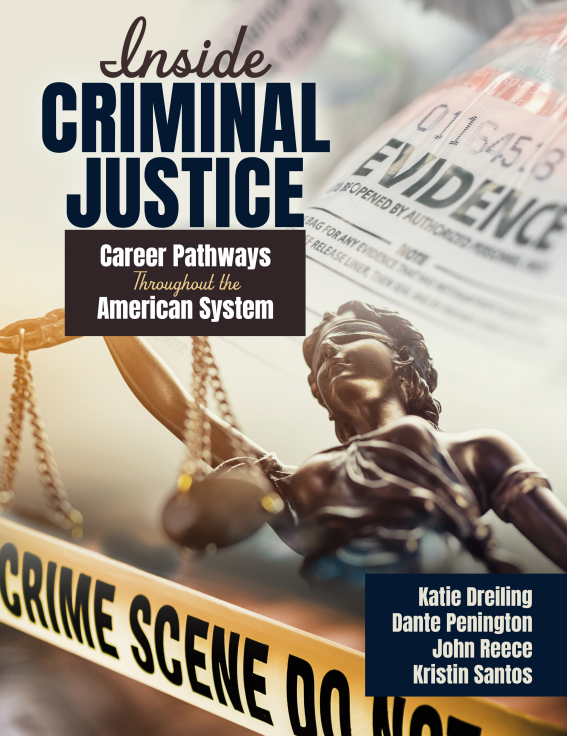
Inside Criminal Justice: Career Pathways throughout the American System
Edition: 1
Copyright: 2026
Pages: 62
Choose Your Format
Choose Your Platform | Help Me Choose


Ebook
$50.00 USD
Criminal justice tends to be among the most popular college majors across college campuses, and there is good reason for this trend. Criminal justice contains a highly diverse range of career paths and specializations for you to consider. Even if you are coming into our program with a clear career plan in mind, make sure you keep your eyes open, as criminal justice may include careers you had not even considered yet. There are police and corrections officers, of course, but also probation, parole, victim advocacy, private security, homeland security, forensics and crime scene analysis, law, park rangers/game wardens, and more. The field is incredibly broad.
CHAPTER 1 Why Choose Criminal Justice?
Introduction
Who Are You? Consider Your Personal Strengths and Weaknesses
Preparing for a Career in Criminal Justice
Discussion Questions
CHAPTER 2 The Policing Career
Career Pathways
Advantages and Challenges of a Policing Career
Discussion Questions
CHAPTER 3 Careers in the Courts
Introduction
Career options
Pathways to the job
Advantages and Challenges
Discussion Questions
CHAPTER 4 Career in Corrections
Introduction
Career Options
Pathways to the Job
Advantages and Challenges
Discussion Questions
CHAPTER 5 Careers in Forensic Investigations
Introduction
Career Options
Pathways to the Job
Advantages and Challenges
Discussion Questions
CHAPTER 6 Careers in Victim Services
Introduction
Career Options in Victim Services
Pathways to the Job
Advantages and Challenges
Discussion Questions
Appendix

Kate Dreiling, PhD, received her Bachelor of Arts and Master of Science in criminal justice from St. Cloud State University and went on to earn her PhD in sociology from South Dakota State University. A professor of criminal justice at Colorado Mesa University, Dreiling teaches Introduction to Criminal Justice, Orientation to Criminal Justice Inquiry, Corrections, Domestic Violence, Women and Crime, Criminology, Comparative Criminal Justice, Community Corrections, and Capital Punishment.
Dreiling enjoys bridging both the practical side of criminal justice and the theoretical side of sociology in her coursework. Her primary goals in the classroom are to not only prepare students for the criminal justice field, but to also prepare them for a diverse and ever changing world. She believes it is essential for future practitioners to understand how the criminal justice system both influences and is influenced by history, individuals, and society.
Dreiling has prior experience in the corrections field, primarily working with juveniles in a variety of settings from detention to community-based sex offender treatment. She is very active on campus and in the local community with the prevention of violence against women, specifically concerning sexual assault and intimate partner violence.

John Reece, PhD, received training at the Colorado Peace Officers Standards and Training Academy and his Bachelor of Arts in Criminal Justice from Colorado Mesa University (CMU). John Reece, PhD, went on to earn his Master of Public Administration from the University of Colorado and his PhD in Public and Business Administration from Northcentral University.
As a Professor of Criminal Justice at Colorado Mesa University, he teaches courses such as Introduction to Criminal Justice, Ethics in Criminal Justice, Police Process, Community Policing, Comparative Criminal Justice, Public Policy Analysis, etc. in both the undergraduate and graduate Criminal Justice programs. His research interests include organizational management, personnel management, public policy, rules of police search and seizure, and effective pedagogy. The purpose and focus of Reece's research is to benefit students, CMU, and the community.
John Reece, PhD, strives to provide students with expanded opportunities to engage in active and service learning and to participate in research. In a pragmatic degree such as criminal justice, Reece, PhD, believes it is important to take learning outside the classroom. He invites a diverse group of guest speakers, representing each component of the criminal justice system, to help engage students in discussions about their careers and job projections/opportunities. Reece, PhD, also facilitates meaningful and effective student internships with a myriad of local and regional agencies. He utilizes a number of innovative teaching techniques and effective pedagogical approaches and embraces distance/online learning formats.
John Reece, PhD, is the former director of the Western Colorado Peace Officers Academy at Colorado Mesa University. He was employed with the Grand Junction Police Department (GJPD) 20 years. During his time at the GJPD, Dr. Reece was a patrol officer, K-9 handler, field training officer, rifle team member, and detective. He was promoted to Police Sergeant and in this capacity was assigned as a patrol supervisor and also served in the Professional Standards Unit, which included training and recruitment and Internal Affairs

Kristin Santos, PhD, earned two Bachelor of Science degrees (criminal justice and psychology) from Lake Superior State University. She earned her Master of Science in criminal justice from the University of Cincinnati, and then went on to the University of Akron for her PhD in sociology with criminology and mental illness concentrations.
An associate professor in the criminal justice program, Santos currently teaches corrections, research methods, criminology, victimology, capital punishment, media and crime, mental illness and crime and deviance. Her research interests include criminology, domestic violence, power differentials and dynamics, stalking, sexual assault, cults, media and deviance.
Santos enjoys combining both theory and practical application in her courses. Her courses engage students' critical thinking skills by encouraging comprehension of the underlying theories and subsequent application to real-world situations.
Santos has practical experience in corrections. She worked as a juvenile corrections officer with minimum to closed (maximum) security clientele, often on sex offender and treatment units, as well as on general population units and in the control center. Santos has also worked in a step-down crisis home for the mentally ill, with newly released clientele from jails and hospitals with mental health units who need additional monitoring and structure before they can be fully released back into society.

Dante Penington, PhD, earned his Bachelor of Science in Criminal Justice and Criminology from the Metropolitan State University of Denver, a Master of Criminal Justice degree from the University of Colorado, Denver, and his Doctorate in Public Safety with an emphasis in Criminal Justice from Capella University.
As an assistant professor, Penington teaches research methods, corrections, crime scene processing and comparative criminal justice. His research interests involve mass violence and cybercrimes.
Penington's experience comes from corrections and investigations involving the supervision of convicted offenders in a halfway house and as a case manager supervising clients on electronic monitoring. His investigations experience is in the private sector conducting background investigations, fraud investigations and workplace violence investigations. In addition, he was a Title IX investigator and the President/CEO of a criminal background investigation and drug testing company.
Criminal justice tends to be among the most popular college majors across college campuses, and there is good reason for this trend. Criminal justice contains a highly diverse range of career paths and specializations for you to consider. Even if you are coming into our program with a clear career plan in mind, make sure you keep your eyes open, as criminal justice may include careers you had not even considered yet. There are police and corrections officers, of course, but also probation, parole, victim advocacy, private security, homeland security, forensics and crime scene analysis, law, park rangers/game wardens, and more. The field is incredibly broad.
CHAPTER 1 Why Choose Criminal Justice?
Introduction
Who Are You? Consider Your Personal Strengths and Weaknesses
Preparing for a Career in Criminal Justice
Discussion Questions
CHAPTER 2 The Policing Career
Career Pathways
Advantages and Challenges of a Policing Career
Discussion Questions
CHAPTER 3 Careers in the Courts
Introduction
Career options
Pathways to the job
Advantages and Challenges
Discussion Questions
CHAPTER 4 Career in Corrections
Introduction
Career Options
Pathways to the Job
Advantages and Challenges
Discussion Questions
CHAPTER 5 Careers in Forensic Investigations
Introduction
Career Options
Pathways to the Job
Advantages and Challenges
Discussion Questions
CHAPTER 6 Careers in Victim Services
Introduction
Career Options in Victim Services
Pathways to the Job
Advantages and Challenges
Discussion Questions
Appendix
Kate Dreiling, PhD, received her Bachelor of Arts and Master of Science in criminal justice from St. Cloud State University and went on to earn her PhD in sociology from South Dakota State University. A professor of criminal justice at Colorado Mesa University, Dreiling teaches Introduction to Criminal Justice, Orientation to Criminal Justice Inquiry, Corrections, Domestic Violence, Women and Crime, Criminology, Comparative Criminal Justice, Community Corrections, and Capital Punishment.
Dreiling enjoys bridging both the practical side of criminal justice and the theoretical side of sociology in her coursework. Her primary goals in the classroom are to not only prepare students for the criminal justice field, but to also prepare them for a diverse and ever changing world. She believes it is essential for future practitioners to understand how the criminal justice system both influences and is influenced by history, individuals, and society.
Dreiling has prior experience in the corrections field, primarily working with juveniles in a variety of settings from detention to community-based sex offender treatment. She is very active on campus and in the local community with the prevention of violence against women, specifically concerning sexual assault and intimate partner violence.
John Reece, PhD, received training at the Colorado Peace Officers Standards and Training Academy and his Bachelor of Arts in Criminal Justice from Colorado Mesa University (CMU). John Reece, PhD, went on to earn his Master of Public Administration from the University of Colorado and his PhD in Public and Business Administration from Northcentral University.
As a Professor of Criminal Justice at Colorado Mesa University, he teaches courses such as Introduction to Criminal Justice, Ethics in Criminal Justice, Police Process, Community Policing, Comparative Criminal Justice, Public Policy Analysis, etc. in both the undergraduate and graduate Criminal Justice programs. His research interests include organizational management, personnel management, public policy, rules of police search and seizure, and effective pedagogy. The purpose and focus of Reece's research is to benefit students, CMU, and the community.
John Reece, PhD, strives to provide students with expanded opportunities to engage in active and service learning and to participate in research. In a pragmatic degree such as criminal justice, Reece, PhD, believes it is important to take learning outside the classroom. He invites a diverse group of guest speakers, representing each component of the criminal justice system, to help engage students in discussions about their careers and job projections/opportunities. Reece, PhD, also facilitates meaningful and effective student internships with a myriad of local and regional agencies. He utilizes a number of innovative teaching techniques and effective pedagogical approaches and embraces distance/online learning formats.
John Reece, PhD, is the former director of the Western Colorado Peace Officers Academy at Colorado Mesa University. He was employed with the Grand Junction Police Department (GJPD) 20 years. During his time at the GJPD, Dr. Reece was a patrol officer, K-9 handler, field training officer, rifle team member, and detective. He was promoted to Police Sergeant and in this capacity was assigned as a patrol supervisor and also served in the Professional Standards Unit, which included training and recruitment and Internal Affairs
Kristin Santos, PhD, earned two Bachelor of Science degrees (criminal justice and psychology) from Lake Superior State University. She earned her Master of Science in criminal justice from the University of Cincinnati, and then went on to the University of Akron for her PhD in sociology with criminology and mental illness concentrations.
An associate professor in the criminal justice program, Santos currently teaches corrections, research methods, criminology, victimology, capital punishment, media and crime, mental illness and crime and deviance. Her research interests include criminology, domestic violence, power differentials and dynamics, stalking, sexual assault, cults, media and deviance.
Santos enjoys combining both theory and practical application in her courses. Her courses engage students' critical thinking skills by encouraging comprehension of the underlying theories and subsequent application to real-world situations.
Santos has practical experience in corrections. She worked as a juvenile corrections officer with minimum to closed (maximum) security clientele, often on sex offender and treatment units, as well as on general population units and in the control center. Santos has also worked in a step-down crisis home for the mentally ill, with newly released clientele from jails and hospitals with mental health units who need additional monitoring and structure before they can be fully released back into society.
Dante Penington, PhD, earned his Bachelor of Science in Criminal Justice and Criminology from the Metropolitan State University of Denver, a Master of Criminal Justice degree from the University of Colorado, Denver, and his Doctorate in Public Safety with an emphasis in Criminal Justice from Capella University.
As an assistant professor, Penington teaches research methods, corrections, crime scene processing and comparative criminal justice. His research interests involve mass violence and cybercrimes.
Penington's experience comes from corrections and investigations involving the supervision of convicted offenders in a halfway house and as a case manager supervising clients on electronic monitoring. His investigations experience is in the private sector conducting background investigations, fraud investigations and workplace violence investigations. In addition, he was a Title IX investigator and the President/CEO of a criminal background investigation and drug testing company.