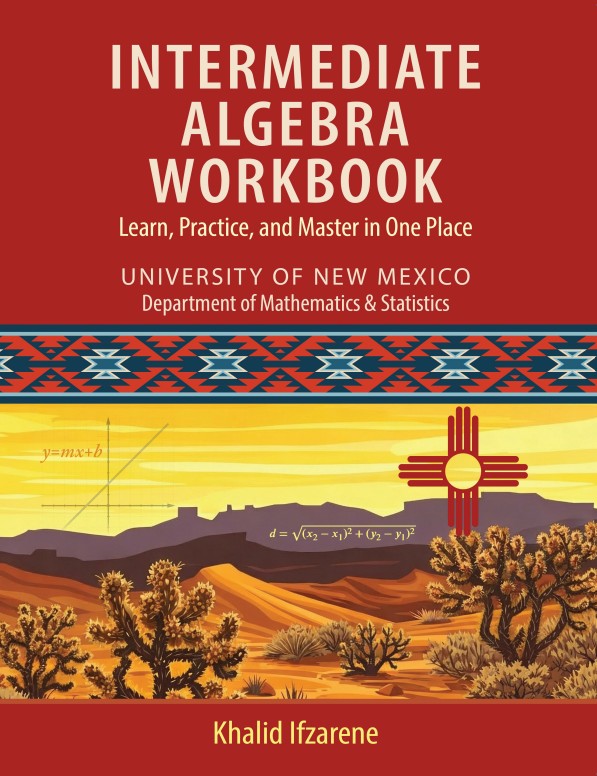
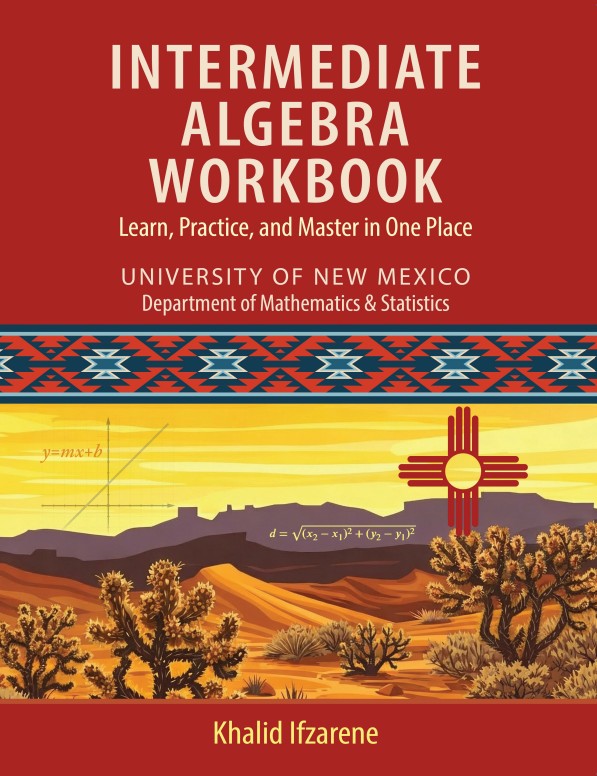
Intermediate Algebra Workbook: Learn, Practice and Master in One Place
Edition: 1
Copyright: 2026
Pages: 288
Edition: 1
Copyright: 2026
Pages: 288
Choose Your Format
Choose Your Platform | Help Me Choose


$105.00 USD
Ebook
$85.00 USD
his workbook is designed to guide students through essential concepts in a clear and structured way while encouraging active participation with their classmates and instructors. The material focuses on helping students understand fundamental concepts that are necessary for success in future mathematics courses and other quantitative disciplines. Each lesson is designed to move students step by step from understanding basic ideas to applying them in meaningful ways. Each lesson generally includes:
Concept Introduction: Important mathematical ideas are introduced clearly and concisely. The emphasis is on understanding the meaning behind the mathematics rather than simply memorizing procedures.
Worked Examples: Examples demonstrate step-by-step solutions to typical problems students may encounter. These examples serve as models to guide students when solving similar problems.
Checkpoints: Short checkpoint problems appear throughout the lesson to encourage students to pause and practice the ideas they have just learned. These exercises are intended to be completed during class and discussed with classmates or reviewed with the instructor.
Practice Problems: Additional exercises allow students to strengthen their skills and build confidence in applying the concepts learned in the lesson.
This workbook is intentionally designed to be simple and focused. Traditional textbooks often serve as detailed references and may contain lengthy explanations and extensive theoretical discussions. In contrast, this workbook emphasizes clarity, essential concepts, and active learning in the classroom environment.
At a Glance
Preface
About This Workbook
How to Use This Workbook
Author’s Perspective
Part I Core Skills and Linear Modeling
Module 1 Real Numbers, Fractions, and Operations
Key Vocabulary
1.1 Sets of Numbers
Number Sets (From Smallest to Largest)
1.2 The Real Number Line and Intervals
1.3 Order of Operations (PEMDAS)
PEMDAS Reminder
1.4 Fractions and Equivalent Forms
Reducing Fractions
Mixed Numbers and Improper Fractions
Terminating Decimals to Fractions
1.5 Operations with Rational Numbers
Adding/Subtracting Fractions
Multiplying/Dividing Fractions
1.6 Evaluating Expressions
1.7 Evaluating Absolute Value
Definition of Absolute Value
Absolute Value on the Number Line
Common Mistake
Practice Module 1
Classify the Number
Intervals
Order of Operations
Fractions
Operations with Rational Numbers
Fill in the Blank
Evaluating Expressions
Absolute Value
Applications
Answer Key (Note: Answers are Simplified)
Classify the Number
Intervals
Order of Operations
Fractions
Operations with Rational Numbers
Fill in the Blank
Evaluating Expressions
Absolute Value
Applications
Module 2 Solving Linear Equations
2.1 Linear Equations with Visual Models
Solutions
2.2 Solving One-Step Linear Equations
2.3 Two-Step Equation
2.4 Distributive Property
2.5 Variables on Both Sides
2.6 No Solution and Infinite Solutions
Practice Module 2
Solve
Applications
Answer Key
Practice Answers
Application Answers
Module 3 Solving Linear Inequalities
Key Vocabulary
3.1 Inequalities, Solution Sets, and Graphing
3.2 Solving One-Step and Two-Step Inequalities
3.3 Inequalities with the Distributive Property
3.4 Variables on Both Sides
3.5 Compound Inequalities (AND/OR)
3.6 Visual Modeling with Inequalities
Practice Module 3
Word Problems
Answer Key
Module 4 Lines and Equations of Lines
4.1 The x–y Coordinate Plane
4.2 Slope: Meaning and Calculation
Slope as “Change in y over Change in x”
Four Common Slope Types
4.3 Equations of a Line
Slope–Intercept Form
Point–Slope Form
Standard (General) Form
Converting from Standard Form to Slope–Intercept Form
4.4 Graphing Lines
Method A: Graph from y = mx + b
Method B: Graph Using Two Points
4.5 Parallel and Perpendicular Lines
4.6 Applications of Linear Equations
Practice Module 4
Answer Key
Module 5 Solving Linear Systems in Two Variables
5.1 What Is a Linear System?
Three Possible Outcomes (Number of Solutions)
5.2 Solving a System by Graphing
Note on Accuracy
5.3 Solving a System by Substitution
Steps for Substitution
5.4 Solving a System by Elimination (Addition/Subtraction)
Steps for Elimination
Special Cases in Elimination
5.5 Applications (Word Problems)
Practice Module 5
Answer Key
Instructor Checkpoint Verification Form
Part II Geometry and Polynomial Expressions
Module 6 Distance, Midpoint, and Circles
6.1 Review: The Coordinate Plane
6.2 Distance on a Real Number Line
6.3 Distance Between Two Points (Distance Formula)
Triangle Example (Perimeter)
6.4 Midpoint of a Segment (Midpoint Formula)
6.5 Circles: Center, Radius, and Standard Form
Special Circle: The Unit Circle
Practice Module 6
Answer Key
Module 7 Exponents and Scientific Notation
7.1 What Does an Exponent Mean?
7.2 Laws of Exponents
7.3 Zero and Negative Exponents
7.4 Simplifying More Exponential Expressions
7.5 Scientific Notation
Practice Module 7
Answer Key
Module 8 Polynomial Expressions
8.1 Polynomial Expressions
8.2 Types of Polynomials
8.3 Degree of a Polynomial
8.4 Combining Like Terms
Common Mistake
8.5 Distributive Property
Practice Module 8
Simplify Each Polynomial Expression
Answer Key
Module 9 Multiplying Polynomial Expressions
9.1 Multiplying a Monomial by a Polynomial
9.2 Multiplying Binomials
9.3 Special Products
Perfect Square Trinomials
Difference of Squares
9.4 Multiplying Polynomials with Higher Degree and Multivariable
Practice Module 9
Multiply Each Expression
Answer Key
Module 10 Factoring Polynomials
Key Vocabulary
10.1 Factoring by Greatest Common Factor
Steps
10.2 Factoring Trinomials When the Coefficient of x2 is 1
10.3 Factoring by Grouping
Common Mistake
10.4 Factoring Trinomials When the Coefficient of x2 is Not 1
AC Method Steps
Try-and-Check Method
10.5 Special Factoring Formulas
A. Difference of Squares
B. Perfect Square Trinomials
10.6 Factoring Higher-Degree Polynomials
Key Idea
Practice Module 10
Answer Key
Module 11 Solving Quadratic Equations
Key Vocabulary
What Does It Mean to “Solve”?
Visual Connection: Solutions and the Graph
11.1 Method 1: Solving by Factoring
Step-by-Step Procedure
11.2 Method 2: Completing the Square
Step-by-Step Procedure
11.3 Method 3: Quadratic Formula
Quadratic Formula
Step-by-Step Procedure
Discriminant and Number of Real Solutions
Choosing a Method
11.4 Real-Life Applications
Practice Module 11
Answer Key
Instructor Checkpoint Verification Form
Part III Functions and Rational and Radical Expressions
Module 12 Rational Expressions and Rational Equations
12.1 Rational Expressions and Domain
To Find the Domain
12.2 Simplifying Rational Expressions (Factoring and Reducing)
12.3 Multiplying and Dividing Rational Expressions
A. Multiplication
B. Division
12.4 Adding and Subtracting Rational Expressions
Steps
12.5 Solving Rational Equations
Steps
12.6 Applications (Real Life)
Practice Module 12
Problems
Answer Key
Module 13 Radicals
Key Vocabulary
Square Root
General nth Root
13.1 Definition of a Radical and Its Components
13.2 Simplifying Square Roots (Reducing Radicals)
13.3 Combining Like Radicals
13.4 Multiplying and Dividing Radicals
13.5 Rationalizing the Denominator (Basic: Square Root)
13.6 Radicals with Variables
13.7 Writing Rational Exponents as Radicals (and Vice Versa)
13.8 Simplifying Higher Roots (Cube Roots and Fourth Roots)
13.9 Solving Radical Equations (Square Root and Cube Root)
Note
General Steps
A. Square-Root Equations
B. Cube-Root Equations
13.10 Real-World Applications
Practice Module 13
Applications
Answer Key
Module 14 Relations and Functions
14.1 Relations
Key Idea
Common Representations
14.2 Domain and Range
Domain and Range from Ordered Pairs
Domain and Range from a Graph
14.3 Functions and the Vertical Line Test
How to Use the Test
14.4 Function Notation
How to Evaluate
14.5 Linear and Quadratic Functions
14.6 Operations on Functions
14.7 Graphing Linear Functions and Quadratic Functions
A. Linear Function
B. Quadratic Functions and Finding the Vertex
Finding the Vertex from Standard Form
14.8 Practical Application of Functions and Evaluating Functions
Practice Module 14
Answer Key
Module 15 Combining Functions and Inverse Functions
15.1 Composition (Doing One Function After Another)
15.2 Inverse Functions
Key Idea
How to Find an Inverse (When It Exists)
15.3 One-to-One and the Horizontal Line Test
Practice Module 15
Answer Key
Instructor Checkpoint Verification Form 3
Part IV Exponential and Logarithmic Expressions
Module 16 Exponential and Logarithmic Expressions
16.1 Exponentials and Logarithms Are Inverses
16.2 Converting Between Log and Exponential Form
16.3 Special Bases: Base 10 and Base e
16.4 Evaluating Logarithms Without a Calculator
16.5 Exponential and Logarithmic Functions as Functions (Graphs and Connection)
16.6 Solving Exponential Equations
A. When Both Sides Share a Common Base
B. When the Bases Are NOT the Same
16.7 Real-World Situations Using Logarithmic Expressions
Practice Module 16
Convert to Exponential Form
Convert to Logarithmic Form
Evaluate
Solve
Answer Key
Module 17 Logarithms: Domains, Properties, Equations, Change of Base, and Applications
17.1 Logarithms and Exponentials (Inverse Relationship)
17.2 Domain of Logarithmic Expressions
17.3 Properties of Logarithms
17.4 Combining Logarithms into a Single Log
17.5 Solving Basic Logarithmic Equations
17.6 Solving Log Equations by Combining Logs First
17.7 How Log and Exponential Functions Cancel
a. Big Idea
b. Why Do ln and Exponential Cancel?
c. General Strategy for ex = b
17.8 Applications
Common Mistakes to Avoid
17.9 Change of Base
17.10 More Applications (Real-World Logarithms)
Practice Module 17
Find the Domain of
Expand Each:
Combine into One Log
Solve:
Change of Base:
Answer Key
Module 18 Exponential Growth and Decay Models
18.1 Discrete Exponential Growth and Decay Model
18.2 Natural Exponential Model
Doubling Time
Half-Life
Practice Module 18
Answer Key
Part V Real-World Applications and Data
Module 19 Money, Interest, and Investment Models
19.1 Simple Interest
Meaning of the Variables
19.2 Compound Interest
What Does n Mean?
19.3 Continuous Compounding
Who Benefits?
Key Idea
19.4 Visual Comparison of Growth Models
Graph Comparison
Table of Values
Practice Module 19
Answer Key
Module 20 Basic Statistics for Intermediate Algebra: Introduction to data, graphs, measures of center, and measures of spread
20.1 What Is Statistics?
20.2 Types of Data
A. Qualitative Data (Categorical Data)
B. Quantitative Data (Numerical Data)
20.3 Organizing Data with Tables and Graphs
Frequency Table
Bar Graph
Histogram
Dot Plot and Scatter Plot
Step 1: Frequency Table
Step 2: Bar Graph Representation
Step 3: Interpretation
20.4 Measures of Center: Mean, Median, and Mode
20.5 Measures of Variation
Interpreting Standard Deviation
Important Remark
Population Variance
Sample Variance
Why Do We Divide by n − 1?
20.6 Quartiles, Five-Number Summary, and Boxplots
Five-Number Summary
Box Plot
What the IQR Tells Us
20.7 Mini Project: Exploring Real-Life Data
Possible Data Ideas
Personal Habits
School-Related Data
Daily Life Measurements
Final Thought
Practice Module 20
A. Mean
B. Median and Mode
C. Range, Variance, and Standard Deviation
D. Frequency, Tables, and Graphs
E. Quartiles, Five-Number Summary, and IQR
F. Applications
Answer Key
Instructor Checkpoint Verification Form 4
Part VI Final Preparation
Comprehensive Final Practice Exam (Approx. 2 Hours)
Practice Final Exam
Answer Key