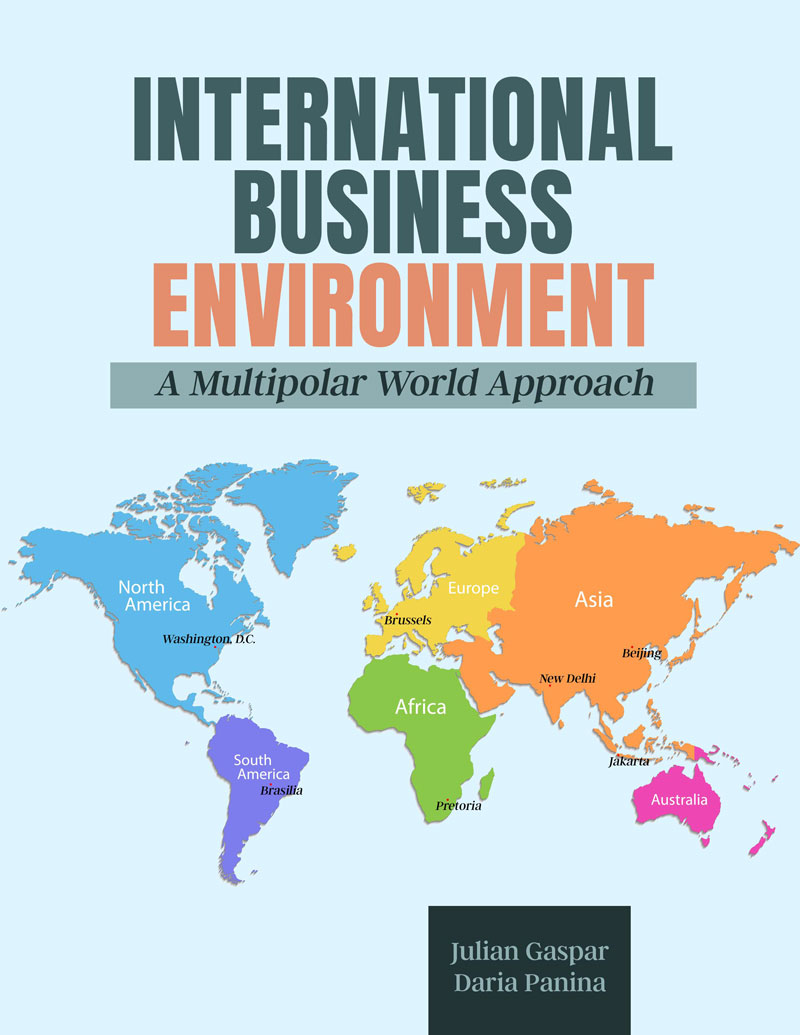
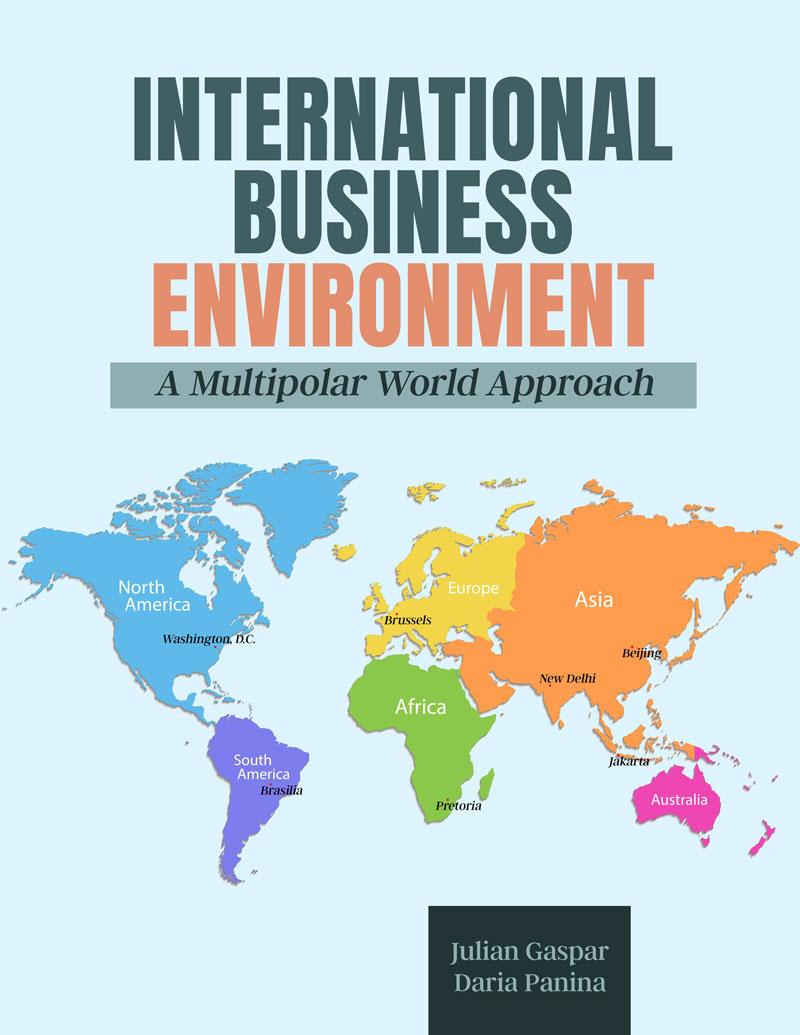
International Business Environment: A Multipolar World Approach

Edition: 1

Copyright: 2025

Pages: 396

Choose Your Format

Ebook

$78.00 USD

ISBN 9798385165322

Details Electronic Delivery EBOOK 180 days

The goal of International Business Environment is to provide instructors and students with an in-depth but concise understanding of the basics as well as the historical and vital geopolitical facts that are driving the new international business environment. The idea is to provide readers with a rewarding analytical, critical, and educational experience that sets the stage for pursuing a successful domestic or international business career. The international business environment is rapidly changing. Therefore, appreciating and understanding the foundations, i.e., the shift in geopolitical alliances, the role of multilateral institutions and regional economic blocs, and advances made by emerging economies are crucial for international business success. Gaspar & Panina International Business Environment, take a multipolar approach to introducing comprehensively the foundational tools that is necessary to better prepare students for the global business situation. The text flows smoothly and clearly from concept to application, asking students to think critically and applying their learning into real-world personal and professional applications.

Preface
About the Authors

Chapter 1 The Origins of Globalization
History of Globalization
1-1 Tracing Globalization and Its Impact on the International Economy
1-2 Globalization’s Role in Facilitating Trade, Foreign Direct Investment, and Economic Growth
1-3 The Macroeconomic Evidence of Globalization
1-4 The Microeconomic Impact of Globalization
1-5 Major International Trade Theories
1-5(a) Wealth Accumulation as a Basis for Trade
1-5(b) Specialization as a Basis for Trade
1-5(c) Factor Abundance as a Basis for Trade
1-6 International Trade Policy
1-6(a) Tariffs
1-6(b) Subsidies
1-6(c) Quantitative Restrictions (QRs)
1-6(d) Exchange Controls
1-7 The Current System of Managed Trade
1-7(a) Socioeconomic Rationale
1-7(b) National Security Rationale
1-8 Foreign Direct Investment: Why do Firms Invest Abroad?
1-8(a) Global Macroeconomic Outlook
1-8(b) Global Industrial Sector Outlook
1-9 The International Flow of Funds and Exchange Rates
1-9(a) The Balance of Payments and Why it Matters
1-9(b) The Role of International Reserves in Balance of Payments
Summary

Chapter 2 The Post World War II Unipolar World Order
From Imperialism to Multilateralism
2-1 Creation of the “Rules-based International Order”
2-1(a) The United Nations (UN) System
2-1(b) The International Monetary Fund (IMF)
2-1(c) The World Bank Group
2-1(d) The World Trade Organization (WTO)
2-1(e) The Washington Consensus for Development
2-2 Regional Economic Integration
2-2(a) Stages of Regional Integration
2-2(b) Does Regional Integration Confound Global Trade?
2-3 The Emergence of Multipolar World Integration Blocs
2-3(a) The European Union (EU)
2-3(b) The Association of Southeast Asian Nations (ASEAN)
2-3(c) The Group of Seven (G7)
2-3(d) United States-Mexico-Canada Agreement (USMCA)
2-3(e) Brazil, Russia, India, China, South Africa+ Group (BRICS+)
2-4 The Decline of Unipolarity and the Rise of Multipolar World Order
Summary

Chapter 3 The Rise of China and the Multipolar World
Making China Great Again
3-1 Understanding Modern China
3-1(a) From Imperial China to the Decline of the Manchus (Qing dynasty in 1912)
3-1(b) From a Century of Humiliation to Mao Zedong’s People’s Republic of China
3-2 China’s Economic Transformation: From Communism to Socialism
3-2(a) China’s Economic Performance Under Chairman Mao’s Regime (1949–1976)
3-2(b) Deng Xiaoping’s Hyper-Growth Economic Reforms and China’s Takeoff (1977–1997)
3-2(c) Economic Rebalancing, Xi Jinping Thought, and the Path to 2049
3-3 China-United States Strategic Competition
3-3(a) The China Model: Socialism with Chinese Characteristics
3-3(b) The United States Model: Capitalism with American Characteristics
3-4 Containing China: Commencing the Fragmentation of the Unipolar World Order
3-4(a) Paranoid Nationalism
3-4(b) The China Containment Policy
3-4(c) Cost of China Containment Policy
3-4(d) Transitioning to a Multipolar World Order
Summary

Chapter 4 The Idea of Europe and NATO Enlargement
The Original Idea of Europe
4-1 The European Union’s Enlargement Process
4-1(a) What is European Enlargement?
4-1(b) Criteria for EU Membership and Benefits
4-1(c) Steps of the Accession Process
4-1(d) History of EU Enlargement
4-2 Breakup of the Soviet Union and EU’s Eastward Enlargement
4-2(a) EU Enlargement Since the Fall of the Soviet Union
4-2(b) New Candidate Countries
4-2(c) Challenges of EU’s Eastward Enlargement
4-3 NATO and Its Eastward Expansion Since the Fall of the Soviet Union
4-3(a) The Purpose and Road to NATO
4-3(b) The Formation of the Warsaw Pact
4-3(c) NATO during the Warsaw Pact Era (1955–1991)
4-3(d) NATO’s Post-Soviet Era Eastward Enlargement
4-4 NATO’s Enlargement Prospects of Georgia and Ukraine
4-4(a) Outlook for Georgia’s NATO Accession
4-4(b) Ukraine’s Instability and Chances for Joining NATO
4-4(c) Ukraine’s Decision to Join NATO and the Lead-up to Russia’s War in Ukraine
4-5 Global Business Implications of the Russia-Ukraine Conflict
4-5(a) The Sanctions on Russia and their Effects
4-5(b) Global Business Implications
4-5(c) The Geopolitical Impact of Sanctions on Russia
Summary

Chapter 5 The Non-Aligned Global South
India’s Legacy of Non-Alignment
5-1 What is the Global South?
5-1(a) The Rise of the Global South
5-1(b) Identifying Potential Leadership of the Global South
5-1(c) Rallying the Global South’s Cause
5-2 India, the Champion of the Global South in a Multipolar World
5-2(a) India’s Balance of Payments Crisis and Economic Reforms
5-2(b) India’s Economic Transformation and Integration in a Multipolar World
5-3 Challenges Facing the Global South in a Multipolar World
5-3(a) Non-alignment and the Global South
5-3(b) Moving the Global South Forward
Summary

Chapter 6 The Middle East and Africa
Unearthing Guinea’s Mineral Riches
6-1 Recognizing Common Challenges and Characteristics of Middle Eastern and African Countries
6-1(a) Common Colonial Past
6-1(b) Demographic Trends
6-1(c) Abundance of Natural Resources
6-1(d) Political Conflict
6-1(e) Challenges of Industrialization
6-1(f) South Africa
6-2 Colonialism and Its Impact on National Development
6-3 Resource Curse and the Impact of Natural Resources on National Economy and Political Systems
6-3(a) Economic Dependence and Lack of Diversification
6-3(b) Dutch Disease
6-3(c) Revenue Management and Public Spending
6-3(d) Institutional Quality and Development
6-3(e) Social and Environmental Impact
6-3(f) Political Conflicts and Instability
6-3(g) Democracy and Human Rights
6-3(h) Differential Impact of Resource Abundance on Countries
6-4 OPEC and Global Oil Markets
6-5 Mapping International Cooperation in the MEA Region
6-6 Globalization Trends in MEA
6-6(a) Strategic Partnership with China
6-6(b) Russia’s Strategic Engagement in Africa
6-6(c) Growing Foreign Direct Investment in Africa from the GCC Countries
Summary

Chapter 7 Latin America and the Caribbean Region
Brazil’s Balancing Act: Oil Ambitions vs. Environmental Protection
7-1 Recognizing Common Challenges and Characteristics of Latin American Countries
7-1(a) Industrialization and Neo-Liberal Reforms
7-1(b) Contemporary Structural Challenges of Latin American Economies
7-2 Brazil—the Anchor of Latin America
7-2(a) Brazil in the Latin American Region
7-2(b) Brazil as a Global Leader
7-2(c) Brazil as a Leader for Global South
7-2(d) Brazil as an Environmental Champion
7-3 The Impact of the United States on the Countries of Latin America
7-3(a) The Monroe Doctrine
7-3(b) The United Fruit Company and Banana Republics
7-4 Impact of China and other BRICS Members on Latin American Economies
7-4(a) Trade
7-4(b) Investment
7-4(c) Latin American Extension of the Belt and Road Initiative
7-4(d) Long Term Implications
7-5 Regional Economic Integration in Latin America
7-5(a) MERCOSUR
7-5(b) Andean Community
7-5(c) Central American Common Market
7-5(d) CARICOM
7-5(e) CELAC
7-5(f) ALBA
7-5(g) The Pacific Alliance
7-6 Treaties with the Triad: US, EU, Asia
7-6(a) US-Latin America Initiatives
7-6(b) EU-Latin America
7-6(c) Latin America and Asia
Summary

Chapter 8 The Future Multipolar World
The End of the Unipolar World
8-1 Making Multilateralism Work for All
8-1(a) Reforming the United Nations
8-1(b) Reforming the International Monetary Fund and World Bank
8-1(c) Resetting the World Trade Organization
8-2 Geopolitics and the Rise of Global Economic Fragmentation
8-2(a) China-U.S. Superpower Rivalry
8-2(b) The Rise of BRICS and Decline of G7
8-3 De-dollarization, De-euroization, and the Dollar’s Future
8-3(a) Chronological Overview of the US Dollar as a Reserve Currency
8-3(b) The US Dollar’s Role Since the Start of the 21st Century
8-3(c) De-dollarization: A Consequence of Freezing and Seizing Official Reserve Assets?
8-3(d) US Fiscal Imbalance and Outlook for the Dollar
8-4 The Multipolar World Business Environment
8-4(a) Operating in the Multipolar World Business Environment
8-4(b) Corporate Strategies for Operating in the Multipolar World
Summary

Glossary

Julian Gaspar

Mays Business School, Texas A&M University
Dr. Julian Gaspar is Clinical Professor Emeritus of Finance with Texas A&M University’s Mays Business School and an Adjunct Professor of International Business with The Catholic University of America in Washington, DC, where he teaches International Business and International Financial Management. Prior to his recent move to Washington, DC, Dr. Gaspar was the director of Texas A&M University’s Center for International Business Education and Research (CIBER), for 30 years where he was responsible for internationalizing Mays Business School’s academic programs, faculty research and outreach programs. As the director of one of America’s 15 CIBER business schools, Dr. Gaspar’s mission was to infuse and promote internationalization
in business courses. He was the architect of institutionalizing globalization content in Mays Business School curriculum through international business course design, study abroad and exchange program implementation, and international business textbook authorship. Dr. Gaspar developed and lead study abroad programs
for graduate and undergraduate business students to understand the business environments of China, Europe, and India. Dr. Gaspar is an international economist by training, with over three decades of expertise in country-risk evaluation, project economic and financial analysis, and financial and industrial restructuring
of emerging economies. His corporate experience stems from his years of work with Bank of America in Tokyo and San Francisco, where he conducted country risk assessments and researched and analyzed debt problems of developing countries. During his tenure as an international economist with the World Bank Group in Washington, DC, Dr. Gaspar analyzed investment projects in Asia and designing financial and industrial reform programs for Poland and Cyprus. Dr. Gaspar earned his PhD in International and Monetary Economics from Georgetown University in Washington, DC, an MBA from Indiana University-Bloomington, and a BTech degree in Chemical Engineering from the University of Madras, India. Dr. Gaspar consults with the U.S. Department of State on business education reform in Central Asia and Russia as well as development projects in Africa. Dr. Gaspar is the lead author of two textbooks: Introduction to Business, 4e, and Introduction to Global Business, 3e, as well as case studies on Russian business. He has travelled and worked in 70 countries. 

Daria Panina

Mays Business School, Texas A&M University
Dr. Panina earned her BA in Economics from Moscow State University in Russia. She began her career as a research assistant in the international economic policy advisory group to the Russian government and later led a team of researchers who collected and analyzed data on the privatization of Russian companies during the economic reforms of the 1990s. She then pursued graduate studies in the United States, earning her MA and PhD from the School of Management and Labor Relations at Rutgers University. Dr. Panina has worked in the areas of human resources and executive search in both Russia and the US. She ultimately chose a career in academia and joined Texas A&M University’s Mays Business School in 2003. She is currently a Clinical Professor in the Management Department where she teaches international business and management courses at both the undergraduate and graduate levels. She serves as Associate Director for Academic Programs in Mays CIBER and has been leading Mays Business Study Abroad programs for more than 15 years. She has
taken students to more than 25 countries in the Americas, Europe, Africa, the Middle East, and Asia. With a strong interest in international business and management, she is passionate about experiential learning and helping students develop global skills and competencies. Her research focuses on the development of a global mindset and international business teaching and learning. Dr. Panina is a member of the Academy of International Business (AIB), where she served as the inaugural chair of the AIB Teaching and Education Shared Interest Group. She also contributes to the global virtual experiential learning project X-Culture. Dr. Panina serves on the editorial boards of several academic journals, including the European Journal of International
Management and AIB Insights. She has served as a guest editor of special issues in the area of international business education in several journals, including for the Journal of Teaching International Business, Journal of Management Education, AIB Insights and Critical Perspectives on International Business. 

The goal of International Business Environment is to provide instructors and students with an in-depth but concise understanding of the basics as well as the historical and vital geopolitical facts that are driving the new international business environment. The idea is to provide readers with a rewarding analytical, critical, and educational experience that sets the stage for pursuing a successful domestic or international business career. The international business environment is rapidly changing. Therefore, appreciating and understanding the foundations, i.e., the shift in geopolitical alliances, the role of multilateral institutions and regional economic blocs, and advances made by emerging economies are crucial for international business success. Gaspar & Panina International Business Environment, take a multipolar approach to introducing comprehensively the foundational tools that is necessary to better prepare students for the global business situation. The text flows smoothly and clearly from concept to application, asking students to think critically and applying their learning into real-world personal and professional applications.

Preface
About the Authors

Chapter 1 The Origins of Globalization
History of Globalization
1-1 Tracing Globalization and Its Impact on the International Economy
1-2 Globalization’s Role in Facilitating Trade, Foreign Direct Investment, and Economic Growth
1-3 The Macroeconomic Evidence of Globalization
1-4 The Microeconomic Impact of Globalization
1-5 Major International Trade Theories
1-5(a) Wealth Accumulation as a Basis for Trade
1-5(b) Specialization as a Basis for Trade
1-5(c) Factor Abundance as a Basis for Trade
1-6 International Trade Policy
1-6(a) Tariffs
1-6(b) Subsidies
1-6(c) Quantitative Restrictions (QRs)
1-6(d) Exchange Controls
1-7 The Current System of Managed Trade
1-7(a) Socioeconomic Rationale
1-7(b) National Security Rationale
1-8 Foreign Direct Investment: Why do Firms Invest Abroad?
1-8(a) Global Macroeconomic Outlook
1-8(b) Global Industrial Sector Outlook
1-9 The International Flow of Funds and Exchange Rates
1-9(a) The Balance of Payments and Why it Matters
1-9(b) The Role of International Reserves in Balance of Payments
Summary

Chapter 2 The Post World War II Unipolar World Order
From Imperialism to Multilateralism
2-1 Creation of the “Rules-based International Order”
2-1(a) The United Nations (UN) System
2-1(b) The International Monetary Fund (IMF)
2-1(c) The World Bank Group
2-1(d) The World Trade Organization (WTO)
2-1(e) The Washington Consensus for Development
2-2 Regional Economic Integration
2-2(a) Stages of Regional Integration
2-2(b) Does Regional Integration Confound Global Trade?
2-3 The Emergence of Multipolar World Integration Blocs
2-3(a) The European Union (EU)
2-3(b) The Association of Southeast Asian Nations (ASEAN)
2-3(c) The Group of Seven (G7)
2-3(d) United States-Mexico-Canada Agreement (USMCA)
2-3(e) Brazil, Russia, India, China, South Africa+ Group (BRICS+)
2-4 The Decline of Unipolarity and the Rise of Multipolar World Order
Summary

Chapter 3 The Rise of China and the Multipolar World
Making China Great Again
3-1 Understanding Modern China
3-1(a) From Imperial China to the Decline of the Manchus (Qing dynasty in 1912)
3-1(b) From a Century of Humiliation to Mao Zedong’s People’s Republic of China
3-2 China’s Economic Transformation: From Communism to Socialism
3-2(a) China’s Economic Performance Under Chairman Mao’s Regime (1949–1976)
3-2(b) Deng Xiaoping’s Hyper-Growth Economic Reforms and China’s Takeoff (1977–1997)
3-2(c) Economic Rebalancing, Xi Jinping Thought, and the Path to 2049
3-3 China-United States Strategic Competition
3-3(a) The China Model: Socialism with Chinese Characteristics
3-3(b) The United States Model: Capitalism with American Characteristics
3-4 Containing China: Commencing the Fragmentation of the Unipolar World Order
3-4(a) Paranoid Nationalism
3-4(b) The China Containment Policy
3-4(c) Cost of China Containment Policy
3-4(d) Transitioning to a Multipolar World Order
Summary

Chapter 4 The Idea of Europe and NATO Enlargement
The Original Idea of Europe
4-1 The European Union’s Enlargement Process
4-1(a) What is European Enlargement?
4-1(b) Criteria for EU Membership and Benefits
4-1(c) Steps of the Accession Process
4-1(d) History of EU Enlargement
4-2 Breakup of the Soviet Union and EU’s Eastward Enlargement
4-2(a) EU Enlargement Since the Fall of the Soviet Union
4-2(b) New Candidate Countries
4-2(c) Challenges of EU’s Eastward Enlargement
4-3 NATO and Its Eastward Expansion Since the Fall of the Soviet Union
4-3(a) The Purpose and Road to NATO
4-3(b) The Formation of the Warsaw Pact
4-3(c) NATO during the Warsaw Pact Era (1955–1991)
4-3(d) NATO’s Post-Soviet Era Eastward Enlargement
4-4 NATO’s Enlargement Prospects of Georgia and Ukraine
4-4(a) Outlook for Georgia’s NATO Accession
4-4(b) Ukraine’s Instability and Chances for Joining NATO
4-4(c) Ukraine’s Decision to Join NATO and the Lead-up to Russia’s War in Ukraine
4-5 Global Business Implications of the Russia-Ukraine Conflict
4-5(a) The Sanctions on Russia and their Effects
4-5(b) Global Business Implications
4-5(c) The Geopolitical Impact of Sanctions on Russia
Summary

Chapter 5 The Non-Aligned Global South
India’s Legacy of Non-Alignment
5-1 What is the Global South?
5-1(a) The Rise of the Global South
5-1(b) Identifying Potential Leadership of the Global South
5-1(c) Rallying the Global South’s Cause
5-2 India, the Champion of the Global South in a Multipolar World
5-2(a) India’s Balance of Payments Crisis and Economic Reforms
5-2(b) India’s Economic Transformation and Integration in a Multipolar World
5-3 Challenges Facing the Global South in a Multipolar World
5-3(a) Non-alignment and the Global South
5-3(b) Moving the Global South Forward
Summary

Chapter 6 The Middle East and Africa
Unearthing Guinea’s Mineral Riches
6-1 Recognizing Common Challenges and Characteristics of Middle Eastern and African Countries
6-1(a) Common Colonial Past
6-1(b) Demographic Trends
6-1(c) Abundance of Natural Resources
6-1(d) Political Conflict
6-1(e) Challenges of Industrialization
6-1(f) South Africa
6-2 Colonialism and Its Impact on National Development
6-3 Resource Curse and the Impact of Natural Resources on National Economy and Political Systems
6-3(a) Economic Dependence and Lack of Diversification
6-3(b) Dutch Disease
6-3(c) Revenue Management and Public Spending
6-3(d) Institutional Quality and Development
6-3(e) Social and Environmental Impact
6-3(f) Political Conflicts and Instability
6-3(g) Democracy and Human Rights
6-3(h) Differential Impact of Resource Abundance on Countries
6-4 OPEC and Global Oil Markets
6-5 Mapping International Cooperation in the MEA Region
6-6 Globalization Trends in MEA
6-6(a) Strategic Partnership with China
6-6(b) Russia’s Strategic Engagement in Africa
6-6(c) Growing Foreign Direct Investment in Africa from the GCC Countries
Summary

Chapter 7 Latin America and the Caribbean Region
Brazil’s Balancing Act: Oil Ambitions vs. Environmental Protection
7-1 Recognizing Common Challenges and Characteristics of Latin American Countries
7-1(a) Industrialization and Neo-Liberal Reforms
7-1(b) Contemporary Structural Challenges of Latin American Economies
7-2 Brazil—the Anchor of Latin America
7-2(a) Brazil in the Latin American Region
7-2(b) Brazil as a Global Leader
7-2(c) Brazil as a Leader for Global South
7-2(d) Brazil as an Environmental Champion
7-3 The Impact of the United States on the Countries of Latin America
7-3(a) The Monroe Doctrine
7-3(b) The United Fruit Company and Banana Republics
7-4 Impact of China and other BRICS Members on Latin American Economies
7-4(a) Trade
7-4(b) Investment
7-4(c) Latin American Extension of the Belt and Road Initiative
7-4(d) Long Term Implications
7-5 Regional Economic Integration in Latin America
7-5(a) MERCOSUR
7-5(b) Andean Community
7-5(c) Central American Common Market
7-5(d) CARICOM
7-5(e) CELAC
7-5(f) ALBA
7-5(g) The Pacific Alliance
7-6 Treaties with the Triad: US, EU, Asia
7-6(a) US-Latin America Initiatives
7-6(b) EU-Latin America
7-6(c) Latin America and Asia
Summary

Chapter 8 The Future Multipolar World
The End of the Unipolar World
8-1 Making Multilateralism Work for All
8-1(a) Reforming the United Nations
8-1(b) Reforming the International Monetary Fund and World Bank
8-1(c) Resetting the World Trade Organization
8-2 Geopolitics and the Rise of Global Economic Fragmentation
8-2(a) China-U.S. Superpower Rivalry
8-2(b) The Rise of BRICS and Decline of G7
8-3 De-dollarization, De-euroization, and the Dollar’s Future
8-3(a) Chronological Overview of the US Dollar as a Reserve Currency
8-3(b) The US Dollar’s Role Since the Start of the 21st Century
8-3(c) De-dollarization: A Consequence of Freezing and Seizing Official Reserve Assets?
8-3(d) US Fiscal Imbalance and Outlook for the Dollar
8-4 The Multipolar World Business Environment
8-4(a) Operating in the Multipolar World Business Environment
8-4(b) Corporate Strategies for Operating in the Multipolar World
Summary

Glossary

Julian Gaspar

Mays Business School, Texas A&M University
Dr. Julian Gaspar is Clinical Professor Emeritus of Finance with Texas A&M University’s Mays Business School and an Adjunct Professor of International Business with The Catholic University of America in Washington, DC, where he teaches International Business and International Financial Management. Prior to his recent move to Washington, DC, Dr. Gaspar was the director of Texas A&M University’s Center for International Business Education and Research (CIBER), for 30 years where he was responsible for internationalizing Mays Business School’s academic programs, faculty research and outreach programs. As the director of one of America’s 15 CIBER business schools, Dr. Gaspar’s mission was to infuse and promote internationalization
in business courses. He was the architect of institutionalizing globalization content in Mays Business School curriculum through international business course design, study abroad and exchange program implementation, and international business textbook authorship. Dr. Gaspar developed and lead study abroad programs
for graduate and undergraduate business students to understand the business environments of China, Europe, and India. Dr. Gaspar is an international economist by training, with over three decades of expertise in country-risk evaluation, project economic and financial analysis, and financial and industrial restructuring
of emerging economies. His corporate experience stems from his years of work with Bank of America in Tokyo and San Francisco, where he conducted country risk assessments and researched and analyzed debt problems of developing countries. During his tenure as an international economist with the World Bank Group in Washington, DC, Dr. Gaspar analyzed investment projects in Asia and designing financial and industrial reform programs for Poland and Cyprus. Dr. Gaspar earned his PhD in International and Monetary Economics from Georgetown University in Washington, DC, an MBA from Indiana University-Bloomington, and a BTech degree in Chemical Engineering from the University of Madras, India. Dr. Gaspar consults with the U.S. Department of State on business education reform in Central Asia and Russia as well as development projects in Africa. Dr. Gaspar is the lead author of two textbooks: Introduction to Business, 4e, and Introduction to Global Business, 3e, as well as case studies on Russian business. He has travelled and worked in 70 countries. 

Daria Panina

Mays Business School, Texas A&M University
Dr. Panina earned her BA in Economics from Moscow State University in Russia. She began her career as a research assistant in the international economic policy advisory group to the Russian government and later led a team of researchers who collected and analyzed data on the privatization of Russian companies during the economic reforms of the 1990s. She then pursued graduate studies in the United States, earning her MA and PhD from the School of Management and Labor Relations at Rutgers University. Dr. Panina has worked in the areas of human resources and executive search in both Russia and the US. She ultimately chose a career in academia and joined Texas A&M University’s Mays Business School in 2003. She is currently a Clinical Professor in the Management Department where she teaches international business and management courses at both the undergraduate and graduate levels. She serves as Associate Director for Academic Programs in Mays CIBER and has been leading Mays Business Study Abroad programs for more than 15 years. She has
taken students to more than 25 countries in the Americas, Europe, Africa, the Middle East, and Asia. With a strong interest in international business and management, she is passionate about experiential learning and helping students develop global skills and competencies. Her research focuses on the development of a global mindset and international business teaching and learning. Dr. Panina is a member of the Academy of International Business (AIB), where she served as the inaugural chair of the AIB Teaching and Education Shared Interest Group. She also contributes to the global virtual experiential learning project X-Culture. Dr. Panina serves on the editorial boards of several academic journals, including the European Journal of International
Management and AIB Insights. She has served as a guest editor of special issues in the area of international business education in several journals, including for the Journal of Teaching International Business, Journal of Management Education, AIB Insights and Critical Perspectives on International Business.