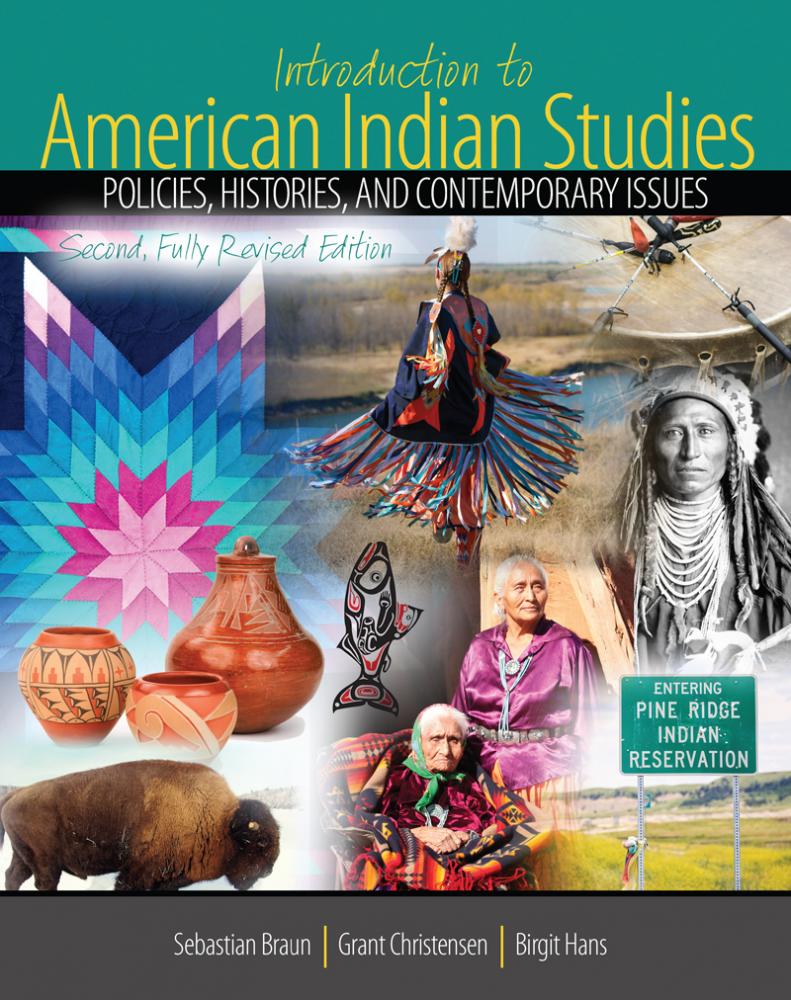
Introduction to American Indian Studies: Policies, Histories, and Contemporary Issues
Edition: 2
Copyright: 2021
Pages: 302
Edition: 2
Copyright: 2021
Pages: 304
Choose Your Format
Choose Your Platform | Help Me Choose


$87.52 USD
Ebook
$43.75 USD
This text provides a broad introduction to American Indian Studies by examining foundational concepts, historical developments, and contemporary issues affecting Indigenous nations in the United States. It explores key ideas related to tribal sovereignty, governance, treaty rights, federal recognition, and the relationship between tribal nations and the federal government. Students also engage with topics such as reservation life, taxation, economic development, and the legal and political frameworks that shape modern “Indian Country.”
The text further traces the history of American Indian law and policy, from early Supreme Court decisions through major policy shifts that affected land ownership, tribal authority, and self-determination. It incorporates historical perspectives and case studies of Native societies, emphasizing oral traditions and treaty relationships. In its final sections, the textbook addresses contemporary issues including education, health, justice, identity, environmental concerns, and family and community welfare, highlighting both ongoing challenges and the resilience of Indigenous communities in preserving culture and advancing sovereignty.
PART I Key Concepts in American Indian Studies
Terminology
Tribal Sovereignty
Bureau of Indian Affairs/Indian Agents
Treaty Rights
Rations
Federal Recognition
Tribal Government
Tribal Membership
“Indian Country” and the Modern Reservation
Oklahoma
Alaska
Taxation
Casinos
Violence Against Women Act (VAWA)
Culture, Ethnicity, and Privilege
PART II History of American Indian Law and Policy
The Marshall Trilogy
The Allotment Era: How Non-Indians Entered Indian Country
A Century of Changing Policy: Indians & Indian Tribes from the New Deal to Present
PART III Histories
Huff Site Map
Oral Traditions
Historical Perspectives of Native Societies
Native Communities: Three Case Studies
Sioux Treaty 1868
PART IV Contemporary Issues
American Indian Identities
History of American Indian Education
Health in American Indian Communities
Crime in Indian Country
The Indian Child Welfare Act
Gender in American Indian Communities
Environmental Values
Resource Development
Sebastian Braun is a scholar of Indigenous politics, culture, and environmental studies. He serves as Director of American Indian Studies at Iowa State University, a role he has held since 2015, and he previously chaired the Department of American Indian Studies at the University of North Dakota. He is also a Professor of Political Science, where his teaching and research focus on the intersections of culture, governance, and environmental change, particularly in relation to Indigenous communities. Braun’s research emphasizes ethnohistory of the Northern Plains, tribal sovereignty, and the impacts of natural resource extraction on Native nations and their connections to place. He earned a PhD in Anthropology from Indiana University in 2004 and a Licentiate in Ethnology, History, and Philosophy from the University of Basel in 1997.
Birgit Hans is a retired professor from the Department of History and American Indian Studies at the University of North Dakota. She is a Chester Fritz Distinguished Professor, a title awarded to faculty recognized for excellence in teaching, scholarship, and service. At UND, she has contributed to interdisciplinary instruction and scholarship focused on Indigenous histories, cultures, and contemporary issues, and has also served in editorial and advisory roles for academic publications.
Professor Grant Christensen is an Associate Professor of Law and an Affiliated Associate Professor of American Indian Studies at the University of North Dakota. He also serves as an Associate Justice on the Supreme Court of the Standing Rock Sioux Tribe and as the co-chair of the American Bar Association Business Law’s committee on Tribal Litigation. He earned his J.D. from Ohio State and his LL.M. in Indigenous Peoples Law and Policy from the University of Arizona. Prior to joining the faculty at North Dakota he taught Federal Indian Law as a Visiting Professor at the University of Oregon and an Adjunct Professor at the University of Toledo.