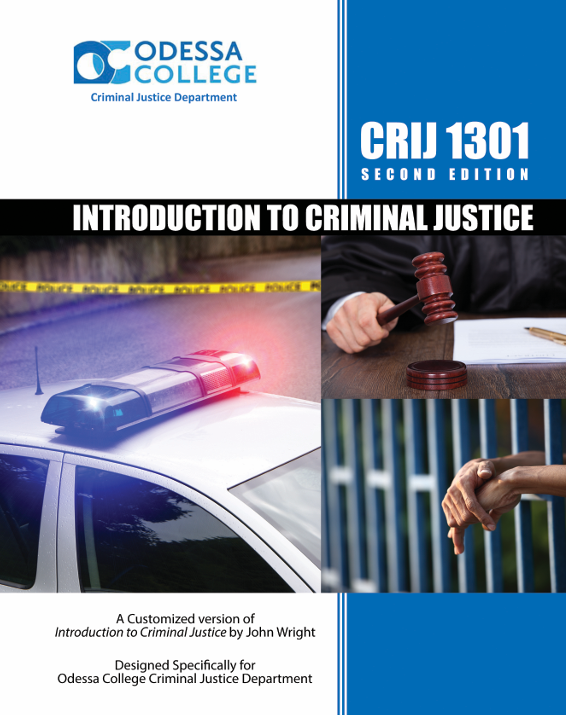
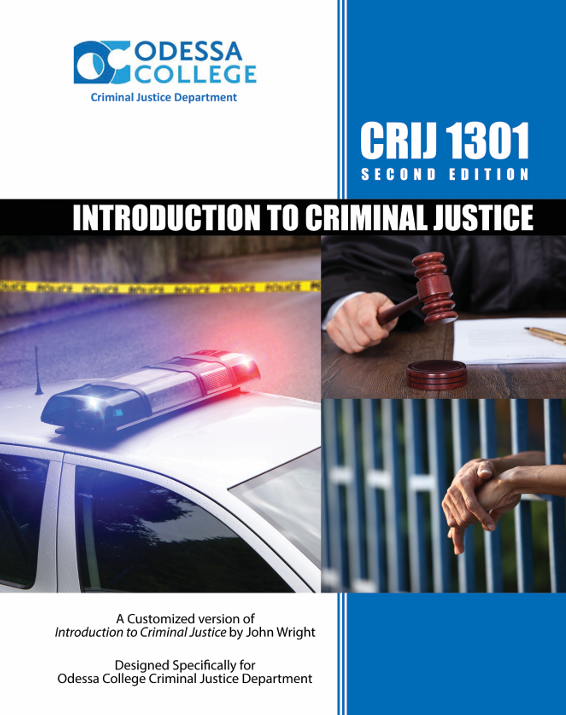
Introduction to Criminal Justice CRIJ 1301: A Customized Version of Introduction to Criminal Justice by John Wright, Designed Specifically for Odessa College Criminal Justice Department
Edition: 2
Copyright: 2026
Pages: 254
Edition: 2
Copyright: 2026
Pages: 254
Choose Your Format
Choose Your Platform | Help Me Choose


$100.00 USD
Ebook
$82.99 USD
Introductory courses in criminal justice remain widely popular, drawing students from a diverse array of educational and professional backgrounds. For the most part, students taking an introductory course in criminal justice have little to no substantive knowledge of the criminal justice system and they have yet to be introduced to its empirical studies. Contemporary introductory textbooks can meet the needs of many students, but they also tend to saturate them with too much information. Students often report feeling overwhelmed by information that is often only marginally relevant to the study of criminal justice actors or processes. Moreover, the coverage of material tends to be very basic and descriptive, with only few and isolated citations to research evidence on system operations. As a result, students are exposed to a variety of terms and concepts but with little appreciation for the need to incorporate research evidence into their understanding of criminal justice.
This book attempts to address these limitations. First, it provides students with a concise account of the criminal justice system, of system processing, and of the actors and agents that operate within the criminal justice system. The book is focused, covering only pertinent information that every student of criminal justice should know. In this sense, the book tries to avoid inundating students with information that is beyond the scope of an introductory course or offering information that is merely faddish or of limited intellectual utility. Second, empirical evidence on the criminal justice system is integrated throughout the text. Of course undergraduate students taking an introductory course should not be expected to understand the nuances of research methodology or statistical analyses, so the coverage of empirical evidence is broad-based and not highly detailed. The purpose of integrating empirical evidence, however, is to sensitize students to the fact that science can help to inform our knowledge of system processing and of criminal justice policies
Chapter 1: American Criminal Justice and the Nature of Crime
Chapter 2: Criminal Law
Chapter 3: Police in the United States: History and Function
Chapter 4: Law Enforcement Operations and Legal Limitations
Chapter 5: The Courts
Chapter 6: Criminal Punishment
Chapter 7: Institutional Corrections