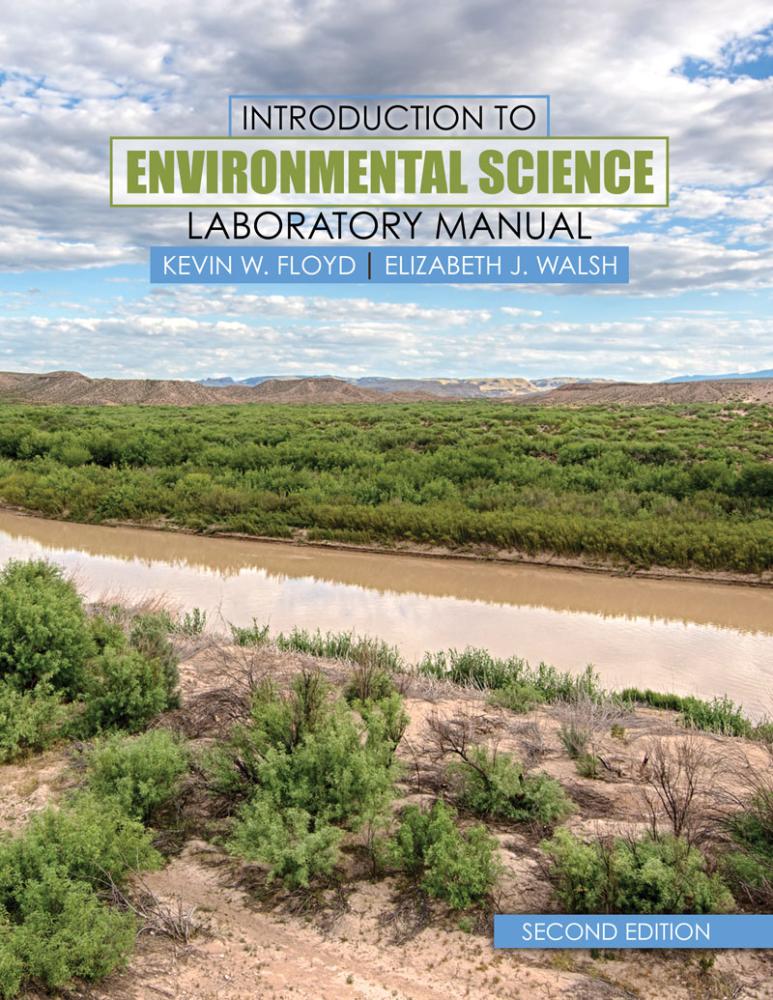
Introduction to Environmental Science Laboratory Manual
Edition: 2
Copyright: 2022
Pages: 160
Edition: 2
Copyright: 2022
Pages: 160
Choose Your Format
Choose Your Platform | Help Me Choose


$46.31 USD
Ebook
$33.08 USD
The Introduction to Environmental Science Laboratory Manual provides students with hands-on investigations that explore the interactions between humans and the natural environment. Through laboratory activities focused on sustainability, population growth, water resources, agriculture, energy, and climate change, the manual introduces students to the scientific principles that shape environmental systems and the challenges facing ecosystems worldwide. By emphasizing inquiry-based learning and real-world environmental issues, students gain a practical understanding of how scientific research informs environmental decision-making and sustainable resource management.
Throughout the manual, students develop laboratory and field skills by conducting experiments related to ecological footprints, water quality, aquatic biodiversity, composting, crop production, soil science, renewable energy, and climate change. Field sampling techniques, data analysis, statistical methods, and laboratory safety are integrated into each unit to strengthen scientific observation and critical thinking. By connecting environmental science concepts with local and global applications, the manual prepares students to evaluate environmental challenges and develop informed, evidence-based approaches to promoting sustainability and protecting natural resources.
Acknowledgments
Unit 1: Introduction to Ecological Footprints and Sustainability
Lab 1: Individual Ecological Footprint
Lab 2: Campus Ecological Footprint
Instructions for the Green Fund proposal
Unit 2: Introduction to Population Growth
Lab 3: Human Population Growth
Lab 4: Algal Biofuels and Population Growth
Unit 3: Introduction to Water
Lab 5: Introduction to Water Quality
Lab 6: Water Sampling Techniques
Lab 7: Introduction to Aquatic Biodiversity
Lab 8: El Paso Water Supply
Unit 4: Introduction to Food Production
Lab 9: Worm Composting
Lab 10: Crop Production
Lab 11: Soils and Agriculture
Unit 5: Introduction to Energy and Climate Change
Lab 12: Vehicles and Climate Change
Lab 13: Energy Development Scenarios
Appendix 1: Lab and River Safety
Appendix 2: Summary Statistics and Excel
Appendix 3: Water Chemistry and Glassware Cleaning
Appendix 4: Microscope Instructions

Ph.D. in Environmental Biology, University of Nevada, Las Vegas (1992)
B.S. in Animal Biology, University of Nevada, Las Vegas (1983)
Elizabeth J. Walsh is a Professor of Biological Sciences at the University of Texas at El Paso (UTEP), where she serves as Interim Dean of the College of Science and holds the Steven McKnight Distinguished Professorship in Biological Sciences. Her research spans evolution and ecology of aquatic invertebrates, particularly rotifers, environmental science, and bioinformatics.
The Introduction to Environmental Science Laboratory Manual provides students with hands-on investigations that explore the interactions between humans and the natural environment. Through laboratory activities focused on sustainability, population growth, water resources, agriculture, energy, and climate change, the manual introduces students to the scientific principles that shape environmental systems and the challenges facing ecosystems worldwide. By emphasizing inquiry-based learning and real-world environmental issues, students gain a practical understanding of how scientific research informs environmental decision-making and sustainable resource management.
Throughout the manual, students develop laboratory and field skills by conducting experiments related to ecological footprints, water quality, aquatic biodiversity, composting, crop production, soil science, renewable energy, and climate change. Field sampling techniques, data analysis, statistical methods, and laboratory safety are integrated into each unit to strengthen scientific observation and critical thinking. By connecting environmental science concepts with local and global applications, the manual prepares students to evaluate environmental challenges and develop informed, evidence-based approaches to promoting sustainability and protecting natural resources.
Acknowledgments
Unit 1: Introduction to Ecological Footprints and Sustainability
Lab 1: Individual Ecological Footprint
Lab 2: Campus Ecological Footprint
Instructions for the Green Fund proposal
Unit 2: Introduction to Population Growth
Lab 3: Human Population Growth
Lab 4: Algal Biofuels and Population Growth
Unit 3: Introduction to Water
Lab 5: Introduction to Water Quality
Lab 6: Water Sampling Techniques
Lab 7: Introduction to Aquatic Biodiversity
Lab 8: El Paso Water Supply
Unit 4: Introduction to Food Production
Lab 9: Worm Composting
Lab 10: Crop Production
Lab 11: Soils and Agriculture
Unit 5: Introduction to Energy and Climate Change
Lab 12: Vehicles and Climate Change
Lab 13: Energy Development Scenarios
Appendix 1: Lab and River Safety
Appendix 2: Summary Statistics and Excel
Appendix 3: Water Chemistry and Glassware Cleaning
Appendix 4: Microscope Instructions
Ph.D. in Environmental Biology, University of Nevada, Las Vegas (1992)
B.S. in Animal Biology, University of Nevada, Las Vegas (1983)
Elizabeth J. Walsh is a Professor of Biological Sciences at the University of Texas at El Paso (UTEP), where she serves as Interim Dean of the College of Science and holds the Steven McKnight Distinguished Professorship in Biological Sciences. Her research spans evolution and ecology of aquatic invertebrates, particularly rotifers, environmental science, and bioinformatics.