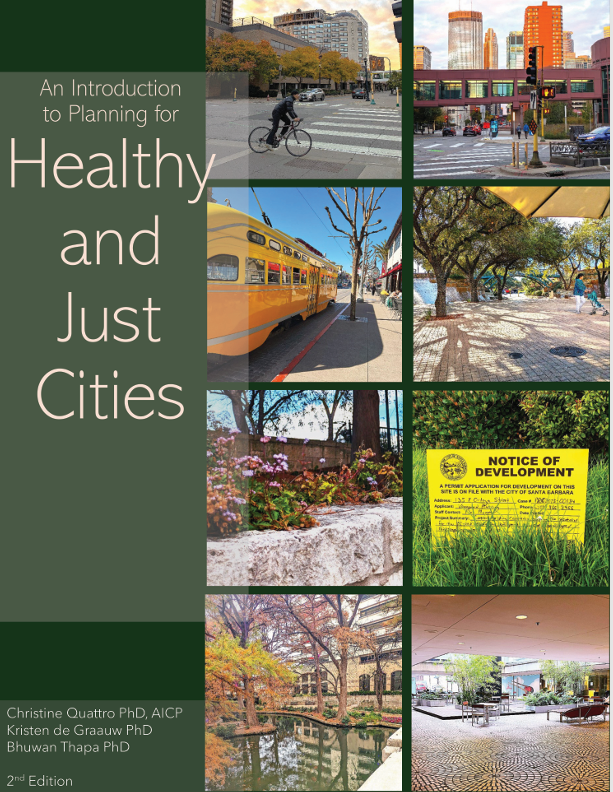
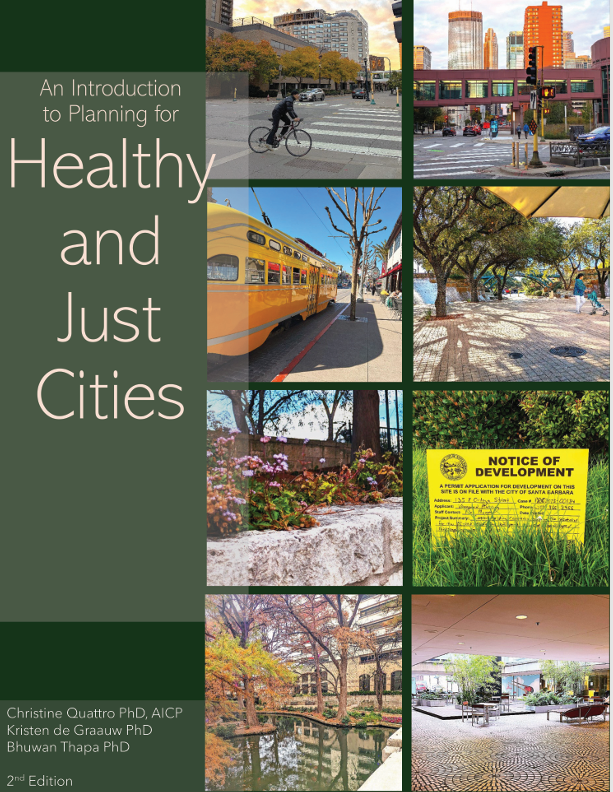
An Introduction to Planning for Healthy and Just Cities

Edition: 2

Copyright: 2026

Choose Your Format

Ebook

$87.00 USD

ISBN 9798319728586

Details Electronic Delivery EBOOK 180 days

This book is an exploration of what it means to plan for a healthy and just city. Communities of all sizes must work to meet residents’ diverse needs, often within constraints of limited resources, time, land, and labor. Neighbors living side by side bring different perspectives, lifestyles, and aspirations, adding complexity to local decision-making. These realities highlight the essential role of the planning profession. This book examines a range of approaches for making meaningful progress toward creating healthier, more just communities.

Chapter 1: Healthy and Just Cities 
Chapter 2: Environmental Pollution, Health and Well-being 
Chapter 3: What Is a Just City? 
Chapter 4: Legal Structures 
Chapter 5: Collaborating with Communities 
Chapter 6: Planning for Healthy Cities 
Chapter 7: Planning Resilient Economic Systems 
Chapter 8: Accessible Spaces 
Chapter 9: Designing Sustainable Cities 
Chapter 10: Frontiers of Resilience

Christine Quattro

Dr. Chris Quattro is a city and regional planning scholar and educator whose work connects urban planning, property law, land development, housing, and community development. Their research examines the social and environmental impacts of property law and land development regulations. They also bring extensive professional experience in city planning, including work involving zoning, comprehensive planning, housing, and infrastructure. Their academic background includes a Ph.D. and A.M. in City and Regional Planning from the University of Pennsylvania, as well as degrees and certificates in education, student affairs, teaching, and organizational leadership. In addition to teaching at Appalachian State University, Dr. Quattro works as a land development researcher for a Texas-based law firm and contributes to housing and planning organizations. Their focus on teaching, educational development, and community development makes their work particularly interdisciplinary.

Bhuwan Thapa

Dr. Bhuwan Thapa is an Assistant Professor in Geography, Environment, and Sustainability whose work focuses on the intersection of environmental planning, climate change, and geospatial analysis. His research examines nature-based solutions, climate change adaptation, disaster analytics, urban resilience, and water security, using geospatial tools to better understand and address environmental challenges. Dr. Thapa holds a Ph.D. in Geography from the University of Arizona, an M.P.P. in Public Policy from the University of Maryland, and degrees in Environmental Science from McNeese State University and St. Xavier’s College in Nepal. He teaches courses including North Carolina Environments, GIS Programming and Design Applications, and Environmental Planning, combining technical GIS skills with environmental and planning applications.

Kristen de Graauw
Dr. Kristen de Graauw is a broadly trained physical geographer with an instructional background that spans geography, environmental science and ethics, biology, and ecology, with an emphasis on experiential outdoor education opportunities in local ecosystems. Her research examines human-forest interactions in eastern North America, with a specialization in dendrochronology, and applications that include the dating of historic log and timber-frame buildings as well as reconstructions of past forest ecology. Dr. de Graauw holds a Ph.D. in Geography from West Virginia University, a M.S. in Earth and Quaternary Science from Indiana State University, and a B.A. in Geography from Kennesaw State University. 

This book is an exploration of what it means to plan for a healthy and just city. Communities of all sizes must work to meet residents’ diverse needs, often within constraints of limited resources, time, land, and labor. Neighbors living side by side bring different perspectives, lifestyles, and aspirations, adding complexity to local decision-making. These realities highlight the essential role of the planning profession. This book examines a range of approaches for making meaningful progress toward creating healthier, more just communities.

Chapter 1: Healthy and Just Cities 
Chapter 2: Environmental Pollution, Health and Well-being 
Chapter 3: What Is a Just City? 
Chapter 4: Legal Structures 
Chapter 5: Collaborating with Communities 
Chapter 6: Planning for Healthy Cities 
Chapter 7: Planning Resilient Economic Systems 
Chapter 8: Accessible Spaces 
Chapter 9: Designing Sustainable Cities 
Chapter 10: Frontiers of Resilience

Christine Quattro

Dr. Chris Quattro is a city and regional planning scholar and educator whose work connects urban planning, property law, land development, housing, and community development. Their research examines the social and environmental impacts of property law and land development regulations. They also bring extensive professional experience in city planning, including work involving zoning, comprehensive planning, housing, and infrastructure. Their academic background includes a Ph.D. and A.M. in City and Regional Planning from the University of Pennsylvania, as well as degrees and certificates in education, student affairs, teaching, and organizational leadership. In addition to teaching at Appalachian State University, Dr. Quattro works as a land development researcher for a Texas-based law firm and contributes to housing and planning organizations. Their focus on teaching, educational development, and community development makes their work particularly interdisciplinary.

Bhuwan Thapa

Dr. Bhuwan Thapa is an Assistant Professor in Geography, Environment, and Sustainability whose work focuses on the intersection of environmental planning, climate change, and geospatial analysis. His research examines nature-based solutions, climate change adaptation, disaster analytics, urban resilience, and water security, using geospatial tools to better understand and address environmental challenges. Dr. Thapa holds a Ph.D. in Geography from the University of Arizona, an M.P.P. in Public Policy from the University of Maryland, and degrees in Environmental Science from McNeese State University and St. Xavier’s College in Nepal. He teaches courses including North Carolina Environments, GIS Programming and Design Applications, and Environmental Planning, combining technical GIS skills with environmental and planning applications.

Kristen de Graauw
Dr. Kristen de Graauw is a broadly trained physical geographer with an instructional background that spans geography, environmental science and ethics, biology, and ecology, with an emphasis on experiential outdoor education opportunities in local ecosystems. Her research examines human-forest interactions in eastern North America, with a specialization in dendrochronology, and applications that include the dating of historic log and timber-frame buildings as well as reconstructions of past forest ecology. Dr. de Graauw holds a Ph.D. in Geography from West Virginia University, a M.S. in Earth and Quaternary Science from Indiana State University, and a B.A. in Geography from Kennesaw State University.