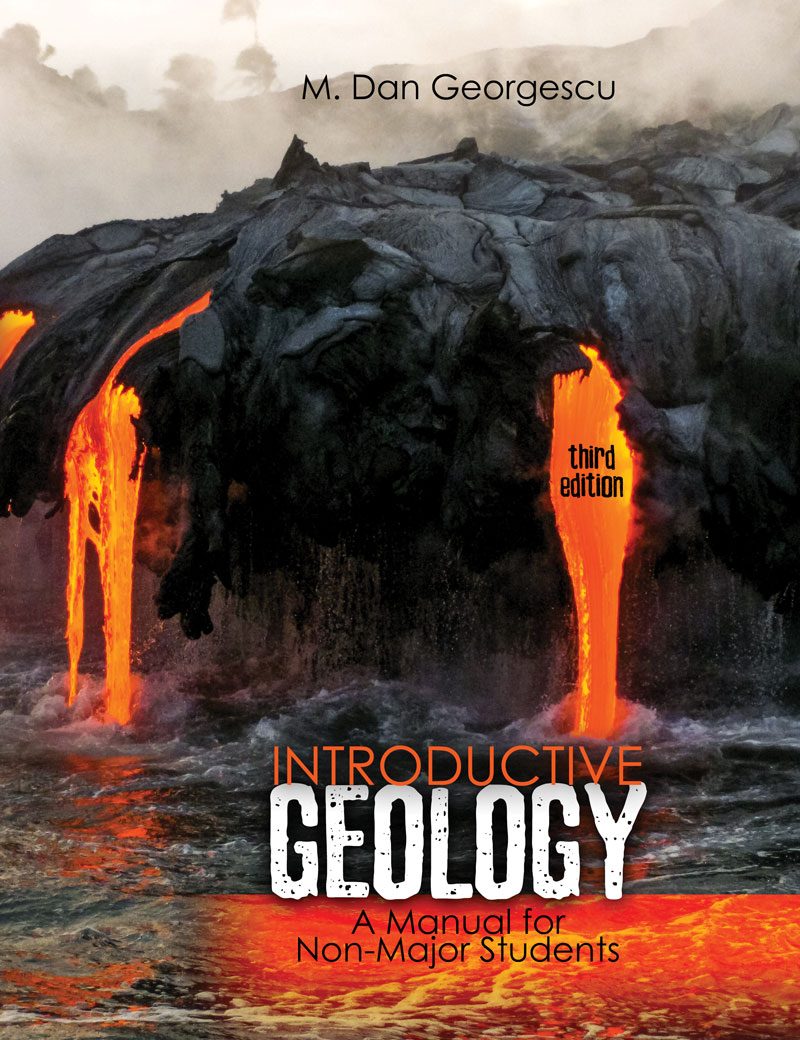
Introductive Geology: A Manual for Non-Major Students
Edition: 3
Copyright: 2018
Pages: 190
Edition: 3
Copyright: 2018
Pages: 190
Choose Your Format
$95.72 USD
Ebook
$76.58 USD
Introductive Geology: A Manual for Non-Major Students provides an accessible introduction to the fundamental concepts of Earth science for students who are not specializing in geology. The text explores the processes that shape the Earth, from its cosmic origins and internal structure to the formation of minerals, rocks, fossils, and landscapes. Designed to build scientific understanding, the book introduces key geological principles while emphasizing how geology connects to everyday life, natural resources, and the history of our planet.
The manual covers major topics including scientific thinking, Earth’s formation, mineralogy, igneous, sedimentary, and metamorphic rocks, fossils and evolution, structural geology, geological time, and plate tectonics. It also includes review materials and multiple-choice questions to reinforce learning and help students assess their understanding. Through clear explanations and foundational concepts, the book serves as a practical resource for students beginning their study of geology and Earth’s dynamic systems.
Chapter 1: Science and Scientific Thinking
1.1 Generalities
1.2 Greek Rationalism and Beginnings of Science
1.3 Science Rediscovery
1.4 Birth of Modern Science
1.5 Scientific Method and Dataflow in Science
1.6 Some Characteristics of Science
1.7 Scientific Language
1.8 Geology and Its Sub-disciplines
1.9 Conclusions
Chapter 2: Earth Formation: A Cosmic Perspective
2.1 Generalities
2.2 Milky Way
2.3 Universe Architecture and Age
2.4 Stars and Nebulae
2.5 The Solar System
2.5.1 The Sun
2.5.2 Planets
2.5.3 Natural Satellites
2.5.4 Asteroids
2.5.5 Comets
2.5.6 Meteorites
2.5.7 Space Dust
2.6 Solar Nebula Theory
2.7 Conclusions
Chapter 3: Earth Internal Structure and Chemical Composition
3.1 Generalities
3.2 Studying the Earth’s Interior
3.3 Earthquakes and Seismic Waves
3.4 Earth Internal Structure
3.5 Earth Elemental Composition
3.6 Gravitational Differentiation Process
3.7 Conclusions
Chapter 4: Minerals: Rock Building Materials
4.1 Generalities
4.2 Atoms, Elements, Isotopes, and Ions
4.3 Types of Bonds in Mineral Structure
4.4 Mineral Architecture
4.5 Crystals and Crystal Systems
4.6 Mineraloids
4.7 Mineral Physical Properties
4.8 Mineral Classification
4.9 Mineral Chemical Variability
4.10 Conclusions
Chapter 5: Igneous Rocks
5.1 Generalities
5.2 Igneous Rocks Classifications According to Crystallinity and Grain Size
5.3 Igneous Rock Classification According to Chemical and Mineralogical Composition
5.4 Intrusive Rock Textures
5.5 Bodies of Intrusive Rocks
5.6 Extrusive Rocks
5.7 Bodies of Extrusive Rocks
5.8 Conclusions
Chapter 6: Sedimentary Rocks
6.1 Generalities
6.2 Clastic Rocks: Definition and Components
6.3 Clastic Rock Formation Cycle
6.4 Detrital Rocks: Classification
6.5 Clastic Rocks: Sedimentary Structures
6.6 Clastic Rocks: Sedimentary Paleoenvironments
6.7 Chemical Rocks: Definition, Classification, and Composition
6.8 Carbonate Rocks: Classification
6.9 Carbonate Rocks: Sedimentary Environments
6.10 Evaporites
6.11 Biochemical Rocks
6.12 Conclusions
Chapter 7: Metamorphic Rocks
7.1 Generalities
7.2 Metamorphism Factors
7.3 Limits of Metamorphism
7.4 Types of Metamorphism
7.5 Degrees of Metamorphism
7.6 Metamorphic Rock Textures
7.7 Conclusions
Chapter 8: Fossils and Fossilization
8.1 Generalities
8.2 Recognizing the Fossil Nature: A Brief History
8.3 Kinds of Fossils
8.4 Kingdoms: The Major Subdivisions of the Living Realm
8.5 Kinds of Common Fossilization
8.6 Soft Tissue Fossilization
8.7 Exceptional Good Fossilization
8.8 Conclusions
Chapter 9: Structural Geology
9.1 Generalities
9.2 Rock Response to Force and Stress
9.3 Kinds of Stress and Deformation
9.4 Kinds of Rock Deformation
9.5 Folds: Terminology and Classifications
9.6 Fractures and Their Classification
9.7 Conclusions
Chapter 10: Principles of Stratigraphy and Geological Time
10.1 Generalities
10.2 Nicolaus Steno and the Principle of Layer Formation
10.3 Sedimentary Structures and Their Role in Recognizing the Nature of Stratigraphic Sections
10.4 Unconformities
10.5 Fossils and Stratigraphy
10.6 Igneous Rock Relative Order
10.7 Relative Geological Time Scale
10.8 Geological Time
10.9 Correlation and Its Types
10.10 Conclusions
Chapter 11: Fossil Record and Evolution
11.1 Generalities
11.2 Emergence of Life on Earth
11.3 Earliest Atmosphere and Inorganic Evolution
11.4 Prokaryotes and Their Early Evolution
11.5 Eukaryote Cells
11.6 Conclusions
Chapter 12: Plate Tectonics
12.1 Generalities
12.2 Oceanic Floor: Morphological Features
12.3 Oceanic Floor: Geological Features
12.4 Tectonic Regimes
12.4.1 Divergent Settings
12.4.2 Convergent Settings
12.4.3 Transform Settings
12.5 Wilson Cycle
12.6 North American Plate and Continent
12.7 Conclusions
Chapter 13: Multiple Choice Questions: Basic Notions
13.1 Science and Scientific Thinking
13.2 Earth Formation: A Cosmic Perspective
13.3 Earth Internal Structure and Chemical Composition
13.4 Minerals: Rock Building Materials
13.5 Igneous Rocks
13.6 Sedimentary Rocks
13.7 Metamorphic Rocks
13.8 Fossils and Fossilization
13.9 Structural Geology
13.10 Principles of Stratigraphy and Geological Time
13.11 Fossil Record and Evolution
13.12 Plate Tectonics
Chapter 14: Multiple Choice Tests: Visual Questions
14.1 Minerals
14.2 Igneous Rocks
14.3 Sedimentary Rocks
14.4 Metamorphic Rocks
14.5 Fossils and Fossilization
M. Dan Georgescu is an Earth scientist and micropaleontologist specializing in Cretaceous and Jurassic foraminifera, with particular expertise in taxonomy, evolution, and biostratigraphy. He earned his Ph.D. in Earth Sciences from the University of Bucharest in 1994, following M.S. and B.S. degrees in the same field (1988).
Dr. Georgescu’s research focuses on Cretaceous planktic foraminifera and Late Cretaceous benthic foraminifera, contributing to a deeper understanding of evolutionary patterns and stratigraphic correlations in marine sedimentary records. He has also conducted extensive work on historic micropaleontological collections, including the C.G. Ehrenberg Collection at the Museum für Naturkunde in Berlin, the Alcide d’Orbigny Collection at the Muséum National d’Histoire Naturelle in Paris, and the Jacob Whitman Bailey Collection at the Farlow Herbarium, Harvard University.
His field and analytical research includes participation in studies of major Deep Sea Drilling Project (DSDP) and Ocean Drilling Program (ODP) sites across the Pacific, Indian, Atlantic Oceans, and the Gulf of Mexico, as well as investigations of Jurassic and Cretaceous benthic foraminifera from Western and Arctic Canada.
In addition to his research, Dr. Georgescu has taught undergraduate courses including Introduction to Geology and Geological History of Life, reflecting his commitment to advancing geoscience education.