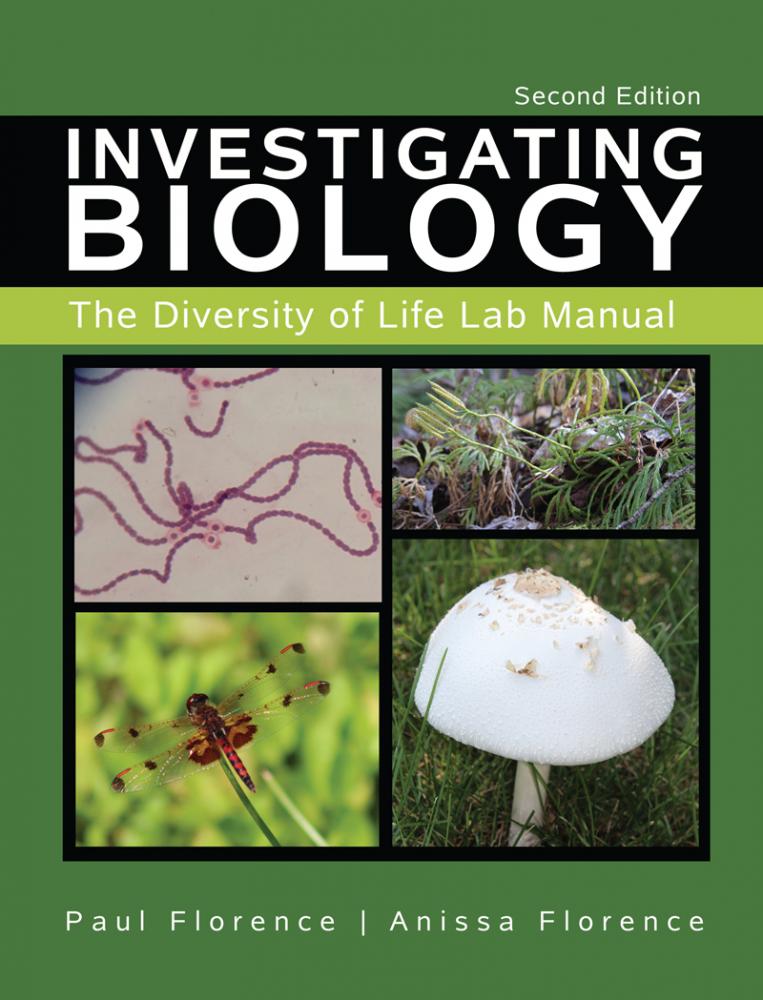
Investigating Biology: The Diversity of Life Lab Manual
Edition: 2
Copyright: 2013
Pages: 234
Edition: 2
Copyright: 2013
Pages: 234
Choose Your Format
Ebook
$69.69 USD
$87.10 USD
Investigating Biology: The Diversity of Life Lab Manual is a hands-on laboratory manual that introduces students to the remarkable diversity of living organisms through observation, classification, and comparative study. Beginning with the principles of biological classification, the manual explores the major groups of life, including prokaryotes, protists, plants, fungi, and animals. Laboratory exercises examine plant anatomy and trace the evolutionary progression of both plant and animal kingdoms, from simple multicellular organisms to the deuterostomes. Through inquiry-based investigations and practical laboratory experiences, students develop essential scientific skills while gaining a deeper understanding of biodiversity, evolutionary relationships, and the characteristics that unite and distinguish Earth's living organisms.
Exercise 1-
Classifications
Exercise 2-
Prokaryotes
Exercise 3-
Protists
Exercise 4-
Avascular Plants
Exercise 5-
Seedless Vascular Plants
Exercise 6-
Seed Plants
Exercise 7-
Plant Anatomy
Exercise 8-
Kingdom Fungi
Exercise 9-
Parazoa and Radiata
Exercise 10-
Lophotrochozoa
Exercise 11-
Ecdysozoa
Exercise 12-
Deuterostomia