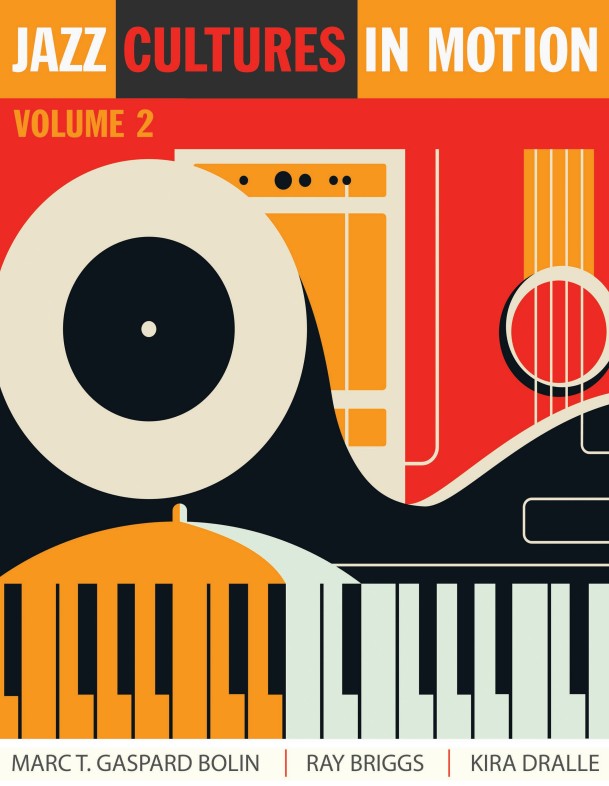
Jazz Cultures in Motion, Volume 2
Edition: 1
Copyright: 2026
Pages: 335
Choose Your Format
Ebook
$80.00 USD
Modern Jazz, Social Meaning, and Global Circulation (1940s–Present)
Jazz Cultures in Motion, Volume 2 examines jazz since the 1940s as a field of ongoing negotiation shaped by modernity, political struggle, media expansion, and global movement. Organized chronologically, the volume follows key developments from bebop and cool jazz through hard bop, the avant-garde, fusion, smooth jazz, hip hop, and contemporary global forms, treating style as inseparable from questions of race, gender, sexuality, labor, and cultural power. Across chapters, the volume foregrounds women, LGBTQ+ artists, Indigenous musicians, and diasporic communities, presenting jazz as a living, contested social practice.
Designed as a customizable online course package, Jazz Cultures in Motion, Volume 2:
- helps readers develop critical thinking, analytical listening, and academic writing skills while examining jazz as a modern and contemporary cultural practice shaped by power, resistance, and circulation.
- examines the relationships between music and society, encouraging readers to understand modern jazz as a site of creativity, critique, activism, and community formation within and beyond the United States.
- analyzes jazz compositions, media, and performance practices while connecting musical developments to broader social, political, and global contexts.
Jazz Cultures in Motion Bios 9.23.2025
Co-Authors
Marc T. Gaspard Bolin
Ray Briggs
Kira Dralle
Contributors
Johnson Oluwajuwon Adenuga
Clayton Cameron
Quinn Carson
Umut Dursun
Charley Harrison
Adam Lee
Jason Van Sugars
Chad Willis
Preface: Mapping Modern Jazz (1940s–Present)
Reframing the Story of Jazz
Beyond the “Birthplace” Narrative: Jazz as a Transnational Soundworld
Challenging the Colonial Archive: Recovering Jazz’s Hidden Histories
Recognizing Indigenous Contributions to Jazz
Why This Book Now?
Reimagining Jazz: Beyond Conventional Narratives
Expanded Global Perspectives in Jazz
An Interactive, Multimodal Learning Experience
Modern Mappings: Jazz as Sound, Memory, and Social Practice
Artificial Intelligence Use Disclosure
Chapter 1 The Sound of Modern Jazz: Themes and Frameworks (1940s–Present)
Introduction: Improvisation, Fragmentation, and the Shape of Modern Jazz
Proto-Bop: Setting the Stage
Technological Shifts and Media Influence
Defining Modern Jazz
Racialized Sound and Cultural Belonging: Whose Modernism?
The Roots of Gendered and Sexualized Stereotypes in Jazz Imagery
In This Book
Scholarship
Questions to Consider
Chapter 2 From Bebop to Cool Jazz: The Emergence of Modern Jazz (Late 1940s–1950s)
Introduction: Bebop, Cool, and the Postwar Terrain
Sounding White
White Jazz Lineage/Cool Jazz
Bebop as Break: Sound, Form, and Ensemble
Bebop as Cultural Assertion
Critics, Camps, and Controversies
Cool Jazz and the Politics of Sound
The Latin Jazz Explosion: Afro-Cuban Currents in Modern Jazz
Gender and Bebop: Underrecognized Artists
Bohemian Jazz, Queer Spaces: New York and San Francisco
Cool Jazz and the West Coast Sound: Race, Class, and the Performance of “Cool”
Third Stream as a Subcurrent: Jazz–Classical Fusion and Cultural Prestige
Technology and Circulation
Chapter Synthesis: Modernism and Image
In This Book
Scholarship
Questions to Consider
Chapter 3 Modal Jazz and Hard Bop (1950s–1960s)
Introduction
Modal Jazz: Miles Davis, John Coltrane, and Bill Evans
Horace Silver and the Hard Bop Aesthetic
Art Blakey and the Jazz Messengers
The Small Group as School: Postwar Pedagogy
The Hammond Organ and Guitar in Hard Bop
Barbara Donald, Jutta Hipp, and Margie Hyams: Women Instrumentalists at the Forefront
Regional Sounds and Influences: Caribbean and Indigenous Inflections
Detroit’s Hard Bop Roots: Barry Harris and McCoy Tyner
The Philadelphia Jazz Scene
Hard Bop and the Civil Rights Imagination
Beyond the Notes: Women, Indigenous, and Marginalized Instrumentalists
In This Book
Scholarship
Questions to Consider
Chapter 4 Free Jazz, Avant-Garde, and Black Nationalism (1960s)
Introduction
The Revolutionary Spirit of the Avant-Garde
John Coltrane’s Later Works and Spiritual Ecstasy
Black Nationalism and Musical Freedom
Abbey Lincoln, Alice Coltrane, and Carla Bley: Gendered Visions of Sonic Freedom
Community, Collectives, and the Loft Scene
Chicago and Creative Autonomy: The AACM
Los Angeles Pedagogies: Alma Julia Hightower and Community Teaching
Los Angeles as a Center of Black Experimental Practice
Queer Experimentation and Aesthetic Dissent in the Avant-Garde
Jazz and Visual Arts: AfriCOBRA, Spiral Group, and Black Artists Group
Chapter Synthesis: Freedom and Form
In This Book
Scholarship
Questions to Consider
Chapter 5 Jazz as Political and Social Activism (1960s–1970s)
Introduction
Fanzines and the Politics of Listening
Gender and Feminism
Chapter Synthesis: Sound as Liberation
In This Book
Scholarship
Questions to Consider
Chapter 6 Jazz Fusion, Third Stream, and Cross-Cultural Exchange (1970s)
Introduction: Fusion, Hybridity, and the Global 1970s
Electric Hybridity: Miles Davis and the Birth of Fusion
Chick Corea and Return to Forever
Third Stream Revisited: Orchestral and Experimental Intersections
Indo-Jazz Experiments: Joe Harriott and John Mayer
African Crossings: Manu Dibango and Soul Makossa
Fela Kuti and Afrobeat
Salsa-Jazz in New York
Mardi Gras Indians and Indian Funk
Indigenous Fusion: Jim Pepper and “Witchi Tai To”
Borderlands Jazz and Chicano Protest
Afro-Brazilian Innovation
Rise of Jazz-Rock
Queer Visibility: Gary Burton and Fusion on the Vibraphone
Studio, Technology, and Industry Infrastructures
Venues, Media, and Audiences
Women in Fusion and Experimental Hybridity
FM Radio and the Rise of Freeform DJs
Debates and Canons
Chapter Synthesis: Technology and Diaspora
In This Book
Scholarship
Questions to Consider
Chapter 7 Smooth Jazz, Crossover, and Neoclassicism (1960s–1990s)
Introduction
The 1970s: Creed Taylor, CTI, and the Crossover Formula
The 1980s: Branding Smooth Jazz
Smooth Jazz: Peak and Backlash (1990s–2000s)
The Neoclassical Turn and Canon Debates (1980s–1990s)
Global Circulations and Hybrid Forms (1990s–2000s)
The Young Lions: Geri Allen, Terence Blanchard, and Cassandra Wilson Reimagining the Canon
New Orleans Roots of the Young Lions
Canon and Critique
Preservation and Heritage
Chapter Synthesis: Tradition and Spectacle
In This Book
Scholarship
Questions to Consider
Chapter 8 Hip Hop, Jazz, and the Aesthetics of Sampling (1970s–1990s)
Introduction
Griots, Jali, and the African Oral Tradition
The Black Preaching Tradition
Jazz Poetry and the Harlem Renaissance
Sampling as Memory
Jazz Rap
Acid Jazz and Club Culture in the 1980s–1990s
Atlanta’s Southern Sonic Roots
New York City
Los Angeles
Chicago
Detroit
New Orleans
Houston and the Gulf Coast
Pedagogy and Legacy
Chapter Synthesis: Memory and Innovation
In This Book
Scholarship
Questions to Consider
Chapter 9 Jazz in the Twenty-First Century: Global Perspectives and New Directions
Introduction: Jazz in the Twenty-First Century
The Globalization of Jazz: Africa, Asia, and Latin America
Jazz and Hip Hop Fusion: A Deeper Look
Sampling, Jazz Rap, and A Tribe Called Quest
Reclaiming Jazz: Black Lives Matter, Protest, and Performance
Street Dance Activism and the Choreographies of Liberation
Streaming, Digital Platforms, and Social Media
Cross-Genre Collaborations and the Post-Genre Era
Resurgence of Vinyl and Independent Labels
New Tools of Performance: Loopers, Pedals, and Live Remixing
The West Coast Get Down and Los Angeles Collectivism
Brooklyn’s Bed-Stuy Renaissance
Chapter Synthesis: Continuity and Circulation
In This Book
Scholarship
Questions to Consider
Chapter 10 Jazz and Diaspora: Global Circulations and New Forms
Introduction
Asian American and Pacific Islander Artists: From Fred Ho to Hiromi
Indigenous Artists and Collaborations
Diaspora and Cosmopolitanism: Contrasting Global Logics
Local Diasporas and Cultural Hubs in Los Angeles
Mutual Aid and Collective Economies in Modern Jazz
Chapter Synthesis: Migration and Rememory
In This Book
Scholarship
Questions to Consider
Chapter 11 Jazz and Social Justice (1930s–Present)
Introduction: Sound, Refusal, and the Radical Imagination
Jazz as Sonic Revolution
Indigenous Protest and Land Rights
Sound as Strategy and Refusal
Blutopia: Sounding the World to Come
No Closure, Only Movement: Sound as Practice, Protest, and Possibility
Scat Singing: From Play to Protest
Wordless Vocalese: From Texture to Tension
Lyricized Vocalese: From Language to Collapse
Historical Lineage and Radical Departure
Scholarship
Questions to Consider
Glossary
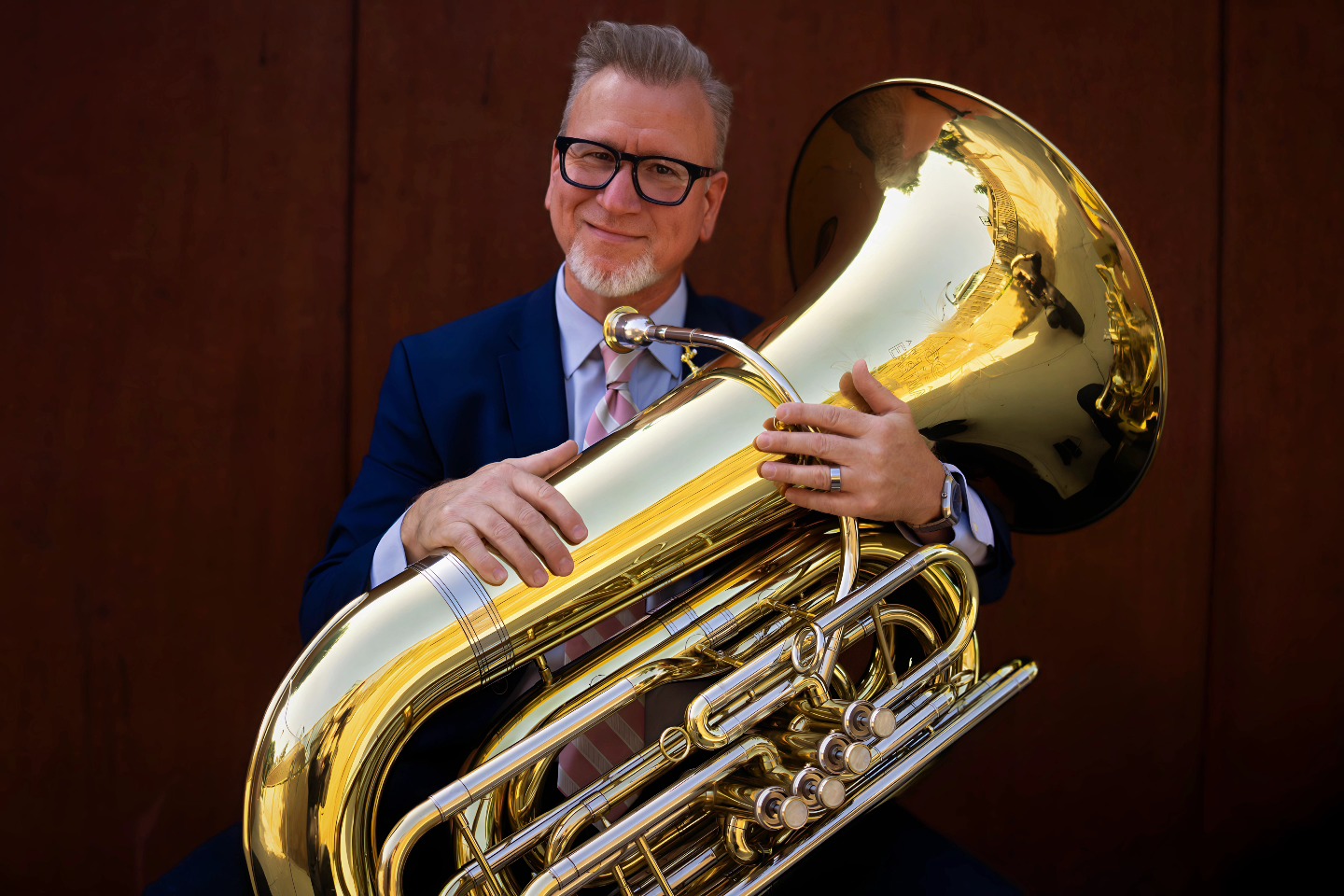
Marc T. Gaspard Bolin is a performer-scholar with a nearly three-decade career as a professional musician, arranger, and educator. He teaches jazz and ethnomusicology in the Department of Ethnomusicology at the University of California, Los Angeles; Jazz and the Political Imagination in the Department of African American Studies; and world music, ethnomusicology, and tuba/euphonium at California State Polytechnic University, Pomona. He has collaborated with leading jazz artists such as Kamasi Washington and Kenny Burrell and genre-crossing performers including Big Sean, Evanescence, John Legend, and Kanye West. His realization of Duke Ellington's unfinished opera Queenie Pie was originally commissioned by the Oakland Opera Theater and has since been staged by opera companies in Austin, Long Beach, and Chicago. His community-based work, which includes festival archiving, youth ensemble leadership, and collaborative ethnographic film, underscores a sustained commitment to cultural memory, public engagement, and intergenerational storytelling. His current research centers on overlooked continuities in New Orleans jazz traditions.
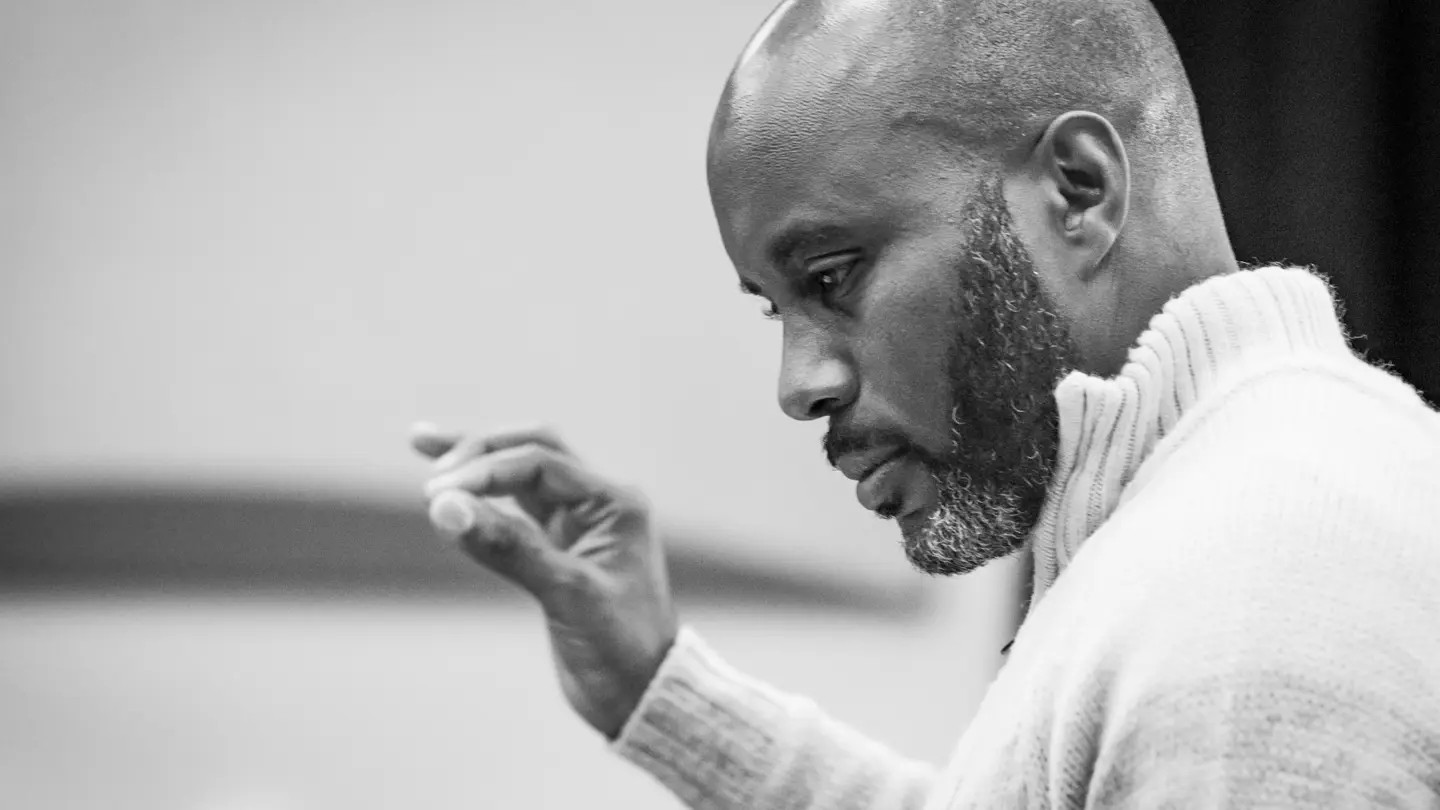
Ray Briggs is Professor of Music and Assistant Director of Jazz Studies for the Bob Cole Conservatory of Music at California State University, Long Beach, where he teaches courses in jazz history and ethnomusicology. With research interests in the regional study of jazz and the role of place in Black musical expression, Ray is completing a monograph on the history of jazz in Memphis. He remains active as a saxophonist and has performed with the Clayton/Hamilton Jazz Orchestra, Benny Green, Stefon Harris, and Roy Hargrove. He served as Director of the Quincy Jones Jazz Camp for several years, mentoring young musicians through immersive performance-based education. He is also co-founder of FEED (Focus on Education, Equity, and Diversity), a forum dedicated to social justice, community engagement, and inclusion in music education. In both scholarship and practice, Ray bridges performance, pedagogy, and cultural history to uplift community-rooted jazz traditions.

Kira Dralle is a jazz and popular music scholar whose work bridges academic and public musicology. She serves as Co-Editor in Chief of Jazz Perspectives and was recently a Visiting Assistant Professor of Jazz Studies at the University of Pittsburgh. She has held positions at Indexical, an experimental music venue in Santa Cruz, and was a Visiting Scholar in Residence at the University for Music and Performing Arts Graz, where she worked in the jazz archives of Dietrich Schulz-Köhn. Dralle has also curated and written for public-facing events, including the Steirischer Herbst Festival, the Black Sound Symposium, and the Northern California Performance Platform. Her research, at the intersection of historical ethnomusicology, visual culture, and political philosophy, examines archival silence around Black jazz musicians in the Third Reich and Vichy France and its effects on transatlantic jazz historiography. She also reconsiders the legacy of Joséphine Baker alongside unnamed Black jazz instrumentalists in European and Caribbean archives. Her writing appears in Jazz & Culture, Jazzforschung/Jazz Research, Jazz Research News, Notes, and the Journal of Jazz Research.
Modern Jazz, Social Meaning, and Global Circulation (1940s–Present)
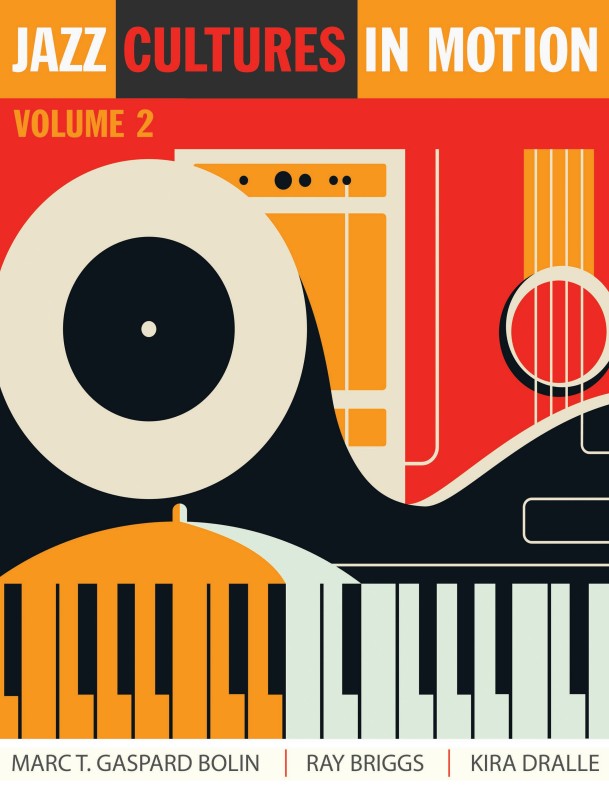
Jazz Cultures in Motion, Volume 2 examines jazz since the 1940s as a field of ongoing negotiation shaped by modernity, political struggle, media expansion, and global movement. Organized chronologically, the volume follows key developments from bebop and cool jazz through hard bop, the avant-garde, fusion, smooth jazz, hip hop, and contemporary global forms, treating style as inseparable from questions of race, gender, sexuality, labor, and cultural power. Across chapters, the volume foregrounds women, LGBTQ+ artists, Indigenous musicians, and diasporic communities, presenting jazz as a living, contested social practice.
Designed as a customizable online course package, Jazz Cultures in Motion, Volume 2:
- helps readers develop critical thinking, analytical listening, and academic writing skills while examining jazz as a modern and contemporary cultural practice shaped by power, resistance, and circulation.
- examines the relationships between music and society, encouraging readers to understand modern jazz as a site of creativity, critique, activism, and community formation within and beyond the United States.
- analyzes jazz compositions, media, and performance practices while connecting musical developments to broader social, political, and global contexts.
Jazz Cultures in Motion Bios 9.23.2025
Co-Authors
Marc T. Gaspard Bolin
Ray Briggs
Kira Dralle
Contributors
Johnson Oluwajuwon Adenuga
Clayton Cameron
Quinn Carson
Umut Dursun
Charley Harrison
Adam Lee
Jason Van Sugars
Chad Willis
Preface: Mapping Modern Jazz (1940s–Present)
Reframing the Story of Jazz
Beyond the “Birthplace” Narrative: Jazz as a Transnational Soundworld
Challenging the Colonial Archive: Recovering Jazz’s Hidden Histories
Recognizing Indigenous Contributions to Jazz
Why This Book Now?
Reimagining Jazz: Beyond Conventional Narratives
Expanded Global Perspectives in Jazz
An Interactive, Multimodal Learning Experience
Modern Mappings: Jazz as Sound, Memory, and Social Practice
Artificial Intelligence Use Disclosure
Chapter 1 The Sound of Modern Jazz: Themes and Frameworks (1940s–Present)
Introduction: Improvisation, Fragmentation, and the Shape of Modern Jazz
Proto-Bop: Setting the Stage
Technological Shifts and Media Influence
Defining Modern Jazz
Racialized Sound and Cultural Belonging: Whose Modernism?
The Roots of Gendered and Sexualized Stereotypes in Jazz Imagery
In This Book
Scholarship
Questions to Consider
Chapter 2 From Bebop to Cool Jazz: The Emergence of Modern Jazz (Late 1940s–1950s)
Introduction: Bebop, Cool, and the Postwar Terrain
Sounding White
White Jazz Lineage/Cool Jazz
Bebop as Break: Sound, Form, and Ensemble
Bebop as Cultural Assertion
Critics, Camps, and Controversies
Cool Jazz and the Politics of Sound
The Latin Jazz Explosion: Afro-Cuban Currents in Modern Jazz
Gender and Bebop: Underrecognized Artists
Bohemian Jazz, Queer Spaces: New York and San Francisco
Cool Jazz and the West Coast Sound: Race, Class, and the Performance of “Cool”
Third Stream as a Subcurrent: Jazz–Classical Fusion and Cultural Prestige
Technology and Circulation
Chapter Synthesis: Modernism and Image
In This Book
Scholarship
Questions to Consider
Chapter 3 Modal Jazz and Hard Bop (1950s–1960s)
Introduction
Modal Jazz: Miles Davis, John Coltrane, and Bill Evans
Horace Silver and the Hard Bop Aesthetic
Art Blakey and the Jazz Messengers
The Small Group as School: Postwar Pedagogy
The Hammond Organ and Guitar in Hard Bop
Barbara Donald, Jutta Hipp, and Margie Hyams: Women Instrumentalists at the Forefront
Regional Sounds and Influences: Caribbean and Indigenous Inflections
Detroit’s Hard Bop Roots: Barry Harris and McCoy Tyner
The Philadelphia Jazz Scene
Hard Bop and the Civil Rights Imagination
Beyond the Notes: Women, Indigenous, and Marginalized Instrumentalists
In This Book
Scholarship
Questions to Consider
Chapter 4 Free Jazz, Avant-Garde, and Black Nationalism (1960s)
Introduction
The Revolutionary Spirit of the Avant-Garde
John Coltrane’s Later Works and Spiritual Ecstasy
Black Nationalism and Musical Freedom
Abbey Lincoln, Alice Coltrane, and Carla Bley: Gendered Visions of Sonic Freedom
Community, Collectives, and the Loft Scene
Chicago and Creative Autonomy: The AACM
Los Angeles Pedagogies: Alma Julia Hightower and Community Teaching
Los Angeles as a Center of Black Experimental Practice
Queer Experimentation and Aesthetic Dissent in the Avant-Garde
Jazz and Visual Arts: AfriCOBRA, Spiral Group, and Black Artists Group
Chapter Synthesis: Freedom and Form
In This Book
Scholarship
Questions to Consider
Chapter 5 Jazz as Political and Social Activism (1960s–1970s)
Introduction
Fanzines and the Politics of Listening
Gender and Feminism
Chapter Synthesis: Sound as Liberation
In This Book
Scholarship
Questions to Consider
Chapter 6 Jazz Fusion, Third Stream, and Cross-Cultural Exchange (1970s)
Introduction: Fusion, Hybridity, and the Global 1970s
Electric Hybridity: Miles Davis and the Birth of Fusion
Chick Corea and Return to Forever
Third Stream Revisited: Orchestral and Experimental Intersections
Indo-Jazz Experiments: Joe Harriott and John Mayer
African Crossings: Manu Dibango and Soul Makossa
Fela Kuti and Afrobeat
Salsa-Jazz in New York
Mardi Gras Indians and Indian Funk
Indigenous Fusion: Jim Pepper and “Witchi Tai To”
Borderlands Jazz and Chicano Protest
Afro-Brazilian Innovation
Rise of Jazz-Rock
Queer Visibility: Gary Burton and Fusion on the Vibraphone
Studio, Technology, and Industry Infrastructures
Venues, Media, and Audiences
Women in Fusion and Experimental Hybridity
FM Radio and the Rise of Freeform DJs
Debates and Canons
Chapter Synthesis: Technology and Diaspora
In This Book
Scholarship
Questions to Consider
Chapter 7 Smooth Jazz, Crossover, and Neoclassicism (1960s–1990s)
Introduction
The 1970s: Creed Taylor, CTI, and the Crossover Formula
The 1980s: Branding Smooth Jazz
Smooth Jazz: Peak and Backlash (1990s–2000s)
The Neoclassical Turn and Canon Debates (1980s–1990s)
Global Circulations and Hybrid Forms (1990s–2000s)
The Young Lions: Geri Allen, Terence Blanchard, and Cassandra Wilson Reimagining the Canon
New Orleans Roots of the Young Lions
Canon and Critique
Preservation and Heritage
Chapter Synthesis: Tradition and Spectacle
In This Book
Scholarship
Questions to Consider
Chapter 8 Hip Hop, Jazz, and the Aesthetics of Sampling (1970s–1990s)
Introduction
Griots, Jali, and the African Oral Tradition
The Black Preaching Tradition
Jazz Poetry and the Harlem Renaissance
Sampling as Memory
Jazz Rap
Acid Jazz and Club Culture in the 1980s–1990s
Atlanta’s Southern Sonic Roots
New York City
Los Angeles
Chicago
Detroit
New Orleans
Houston and the Gulf Coast
Pedagogy and Legacy
Chapter Synthesis: Memory and Innovation
In This Book
Scholarship
Questions to Consider
Chapter 9 Jazz in the Twenty-First Century: Global Perspectives and New Directions
Introduction: Jazz in the Twenty-First Century
The Globalization of Jazz: Africa, Asia, and Latin America
Jazz and Hip Hop Fusion: A Deeper Look
Sampling, Jazz Rap, and A Tribe Called Quest
Reclaiming Jazz: Black Lives Matter, Protest, and Performance
Street Dance Activism and the Choreographies of Liberation
Streaming, Digital Platforms, and Social Media
Cross-Genre Collaborations and the Post-Genre Era
Resurgence of Vinyl and Independent Labels
New Tools of Performance: Loopers, Pedals, and Live Remixing
The West Coast Get Down and Los Angeles Collectivism
Brooklyn’s Bed-Stuy Renaissance
Chapter Synthesis: Continuity and Circulation
In This Book
Scholarship
Questions to Consider
Chapter 10 Jazz and Diaspora: Global Circulations and New Forms
Introduction
Asian American and Pacific Islander Artists: From Fred Ho to Hiromi
Indigenous Artists and Collaborations
Diaspora and Cosmopolitanism: Contrasting Global Logics
Local Diasporas and Cultural Hubs in Los Angeles
Mutual Aid and Collective Economies in Modern Jazz
Chapter Synthesis: Migration and Rememory
In This Book
Scholarship
Questions to Consider
Chapter 11 Jazz and Social Justice (1930s–Present)
Introduction: Sound, Refusal, and the Radical Imagination
Jazz as Sonic Revolution
Indigenous Protest and Land Rights
Sound as Strategy and Refusal
Blutopia: Sounding the World to Come
No Closure, Only Movement: Sound as Practice, Protest, and Possibility
Scat Singing: From Play to Protest
Wordless Vocalese: From Texture to Tension
Lyricized Vocalese: From Language to Collapse
Historical Lineage and Radical Departure
Scholarship
Questions to Consider
Glossary
Marc T. Gaspard Bolin is a performer-scholar with a nearly three-decade career as a professional musician, arranger, and educator. He teaches jazz and ethnomusicology in the Department of Ethnomusicology at the University of California, Los Angeles; Jazz and the Political Imagination in the Department of African American Studies; and world music, ethnomusicology, and tuba/euphonium at California State Polytechnic University, Pomona. He has collaborated with leading jazz artists such as Kamasi Washington and Kenny Burrell and genre-crossing performers including Big Sean, Evanescence, John Legend, and Kanye West. His realization of Duke Ellington's unfinished opera Queenie Pie was originally commissioned by the Oakland Opera Theater and has since been staged by opera companies in Austin, Long Beach, and Chicago. His community-based work, which includes festival archiving, youth ensemble leadership, and collaborative ethnographic film, underscores a sustained commitment to cultural memory, public engagement, and intergenerational storytelling. His current research centers on overlooked continuities in New Orleans jazz traditions.
Ray Briggs is Professor of Music and Assistant Director of Jazz Studies for the Bob Cole Conservatory of Music at California State University, Long Beach, where he teaches courses in jazz history and ethnomusicology. With research interests in the regional study of jazz and the role of place in Black musical expression, Ray is completing a monograph on the history of jazz in Memphis. He remains active as a saxophonist and has performed with the Clayton/Hamilton Jazz Orchestra, Benny Green, Stefon Harris, and Roy Hargrove. He served as Director of the Quincy Jones Jazz Camp for several years, mentoring young musicians through immersive performance-based education. He is also co-founder of FEED (Focus on Education, Equity, and Diversity), a forum dedicated to social justice, community engagement, and inclusion in music education. In both scholarship and practice, Ray bridges performance, pedagogy, and cultural history to uplift community-rooted jazz traditions.
Kira Dralle is a jazz and popular music scholar whose work bridges academic and public musicology. She serves as Co-Editor in Chief of Jazz Perspectives and was recently a Visiting Assistant Professor of Jazz Studies at the University of Pittsburgh. She has held positions at Indexical, an experimental music venue in Santa Cruz, and was a Visiting Scholar in Residence at the University for Music and Performing Arts Graz, where she worked in the jazz archives of Dietrich Schulz-Köhn. Dralle has also curated and written for public-facing events, including the Steirischer Herbst Festival, the Black Sound Symposium, and the Northern California Performance Platform. Her research, at the intersection of historical ethnomusicology, visual culture, and political philosophy, examines archival silence around Black jazz musicians in the Third Reich and Vichy France and its effects on transatlantic jazz historiography. She also reconsiders the legacy of Joséphine Baker alongside unnamed Black jazz instrumentalists in European and Caribbean archives. Her writing appears in Jazz & Culture, Jazzforschung/Jazz Research, Jazz Research News, Notes, and the Journal of Jazz Research.