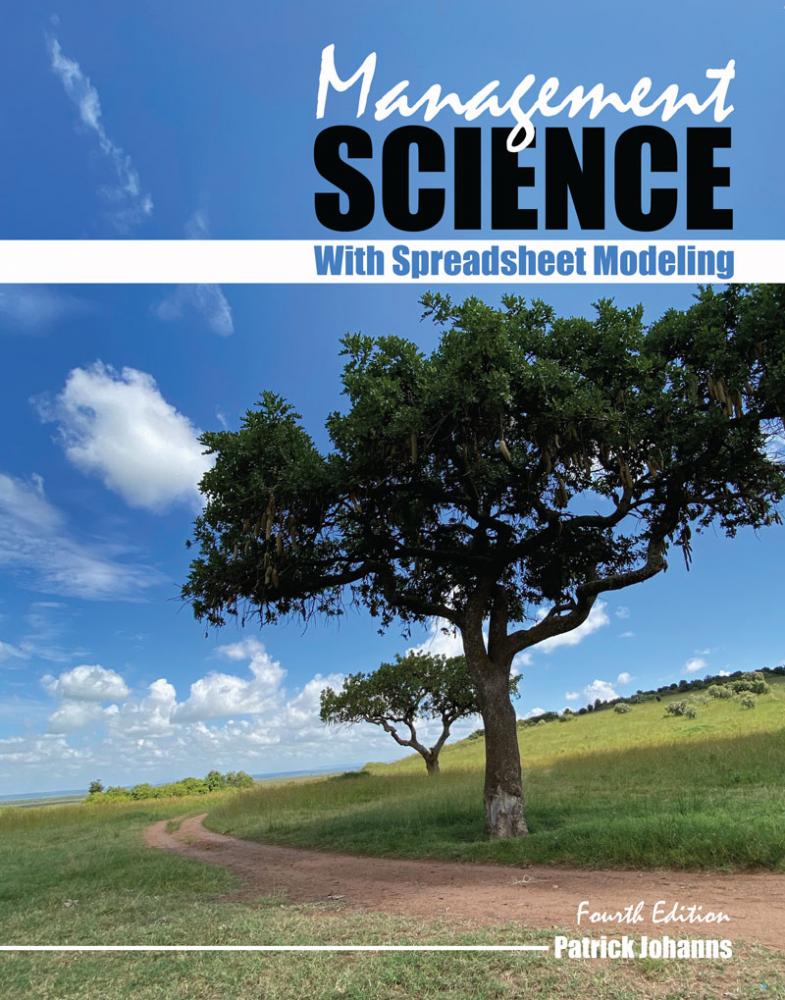
Management Science with Spreadsheet Modeling
Edition: 4
Copyright: 2021
Pages: 254
Edition: 4
Copyright: 2021
Pages: 254
Choose Your Format
Choose Your Platform | Help Me Choose


$145.26 USD
Ebook
$116.20 USD
This workbook is intended to introduce you to the field of management science. It will provide the practical knowledge and skills to enable you to construct valid mathematical and spreadsheet models for business applications, quantitatively analyze the models to arrive at a solution, and critically assess alternative solutions. The power of the personal computer gives managers the unprecedented ability to create spreadsheet models. A major goal of this workbook is to assist you in developing spreadsheet modeling skills that can be successfully applied to real world problems. Microsoft Excel is a staple in the workplace. It will be used as a platform for model building. Special add-ins to Excel will be implemented to aid in the finding of solutions to business problems. The best solution to the optimization problems found throughout the book will be identified using Excel Silver. Palisade’s
Each chapter will contain the following features: 1. Chapter Objectives: These are intended to alert you to important topics in the chapter and the business questions it will be addressing. 2. Examples: Each chapter will contain worked examples to illustrate the concepts and serve as a reference for examples that we will solve together in class or assign as homework. 3. Key Terms: Important terms presented in the chapter will be provided at the end of each chapter. 4. Exercises: At the end of each chapter will be a set of problems to allow you to practice the techniques covered and test your comprehension.
Preface
Chapter 1 Introduction to Management Science
Introduction
What Is a Model?
The Modeling Process
Mathematical Models
Example 1: Building a Mathematical Model for Down to Earth Pottery
Summary
Key Terms
Exercises
Chapter 2 Spreadsheet Model Design in Excel
Introduction
Spreadsheet Design
Spreadsheet Formatting Tips
Using Excel
Example: Down to Earth Pottery
Summary
Key Terms
Bibliography
Exercises
Chapter 3 Optimization of Linear Models
Introduction
Graphical Solution to Two Variable Linear Programs
Graphical Analysis of the Down to Earth Pottery Model
Optimal Solutions
Impact of Adding Constraints
Impact of Removing Constraints
Solving Linear Programs Using Excel with the Solver Add-in
Sensitivity Analysis
Summary
Key Terms
Exercises
Chapter 4 Optimization Applications
Introduction
Multi-Period Production and Inventory Planning
Marketing Research
Summary of LP Formulation
Workforce Scheduling
Summary
Key Terms
Exercises
Chapter 5 Non-Linear Optimization
Introduction
Formulation of a Nonlinear Program (NLP)
Global and Local Optimal Solutions
Applications
Using Solver
Location Analysis
Asset Allocation in Financial Portfolios
Summary
Key Terms
Exercises
Chapter 6 Integer Modeling and Applications
Introduction
Integer and Binary Constraints
Formulating Integer Linear Programs
LP Relaxation
Solver Options with Integer Linear Programs
Modeling Logical Conditions with Binary Variables
Integer Linear Programming Applications
Capital Budgeting
Spreadsheet Model
Fixed Cost Problems
Summary
Key Terms
Exercises
Chapter 7 Simulation Modeling
Introduction
Deterministic and Stochastic Models
Process for Developing and Using a Simulation Model
Simulation with Built-In Excel Functions
@RISK 142 Excel Reports
@RISK Simulations with Several Input Variables
Summary
Key Terms
Exercises
Chapter 8 Project Management
Introduction
Critical Path Method (CPM)
Critical Path Method Network Diagram
Models with Uncertain Activity Times
Time-Cost Trade Offs (Project Crashing)
Summary
Key Terms
Exercises
Chapter 9 Decision Analysis
Introduction
Decision Structure
Decision Criteria
Expected Value of Perfect Information (EVPI)
Decision Trees
Risk Analysis
Decision Analysis Software
Changing Probabilities and Values in Trees
Sensitivity Analysis Using PrecisionTree
Interpreting the Sensitivity Analysis Output
Tornado Chart
Summary
Key Terms
Exercises
Chapter 10 Multiple Criteria Decision Analysis
Introduction
domination and Efficient Solutions
Goal Programming
Frazee Motor Company
Solving the Goal Program
Summary
Key Terms
Exercises

Patrick (Pat) Johanns brings a unique blend of academic expertise and real-world business insight to his Associate Professor of Instruction role at the Tippie School of Management. His teaching portfolio spans foundational undergraduate courses to the MSBA capstone, focusing on Business Analytics and Operations Management. He is now developing an innovative course on Artificial Intelligence in Business.
Pat is a leading voice in integrating Artificial Intelligence into business education. His forthcoming textbook, AI in Business: Creating Value Using Artificial Intelligence, McGraw-Hill, 2025, provides a practical, non-technical guide for business students and professionals to implement AI effectively.
Holding a BS in Microbiology, an MBA, and a PhD in Operations Management from the University of Iowa, Pat’s academic career is enriched by international experience. He has taught extensively in MBA programs at Melbourne Business School and the German International School of Management and Administration, and his work in Kenya and Ghana since 2014 has focused on entrepreneurship and women’s empowerment. He also spent 12 years in Purdue’s top-five-ranked Quantitative Methods department.
From 2019 to 2024, Pat served as Director of the Professional Graduate Program in Business Analytics, helping shape it into a nationally ranked program recognized for its excellence in preparing students for careers in analytics.
This workbook is intended to introduce you to the field of management science. It will provide the practical knowledge and skills to enable you to construct valid mathematical and spreadsheet models for business applications, quantitatively analyze the models to arrive at a solution, and critically assess alternative solutions. The power of the personal computer gives managers the unprecedented ability to create spreadsheet models. A major goal of this workbook is to assist you in developing spreadsheet modeling skills that can be successfully applied to real world problems. Microsoft Excel is a staple in the workplace. It will be used as a platform for model building. Special add-ins to Excel will be implemented to aid in the finding of solutions to business problems. The best solution to the optimization problems found throughout the book will be identified using Excel Silver. Palisade’s
Each chapter will contain the following features: 1. Chapter Objectives: These are intended to alert you to important topics in the chapter and the business questions it will be addressing. 2. Examples: Each chapter will contain worked examples to illustrate the concepts and serve as a reference for examples that we will solve together in class or assign as homework. 3. Key Terms: Important terms presented in the chapter will be provided at the end of each chapter. 4. Exercises: At the end of each chapter will be a set of problems to allow you to practice the techniques covered and test your comprehension.
Preface
Chapter 1 Introduction to Management Science
Introduction
What Is a Model?
The Modeling Process
Mathematical Models
Example 1: Building a Mathematical Model for Down to Earth Pottery
Summary
Key Terms
Exercises
Chapter 2 Spreadsheet Model Design in Excel
Introduction
Spreadsheet Design
Spreadsheet Formatting Tips
Using Excel
Example: Down to Earth Pottery
Summary
Key Terms
Bibliography
Exercises
Chapter 3 Optimization of Linear Models
Introduction
Graphical Solution to Two Variable Linear Programs
Graphical Analysis of the Down to Earth Pottery Model
Optimal Solutions
Impact of Adding Constraints
Impact of Removing Constraints
Solving Linear Programs Using Excel with the Solver Add-in
Sensitivity Analysis
Summary
Key Terms
Exercises
Chapter 4 Optimization Applications
Introduction
Multi-Period Production and Inventory Planning
Marketing Research
Summary of LP Formulation
Workforce Scheduling
Summary
Key Terms
Exercises
Chapter 5 Non-Linear Optimization
Introduction
Formulation of a Nonlinear Program (NLP)
Global and Local Optimal Solutions
Applications
Using Solver
Location Analysis
Asset Allocation in Financial Portfolios
Summary
Key Terms
Exercises
Chapter 6 Integer Modeling and Applications
Introduction
Integer and Binary Constraints
Formulating Integer Linear Programs
LP Relaxation
Solver Options with Integer Linear Programs
Modeling Logical Conditions with Binary Variables
Integer Linear Programming Applications
Capital Budgeting
Spreadsheet Model
Fixed Cost Problems
Summary
Key Terms
Exercises
Chapter 7 Simulation Modeling
Introduction
Deterministic and Stochastic Models
Process for Developing and Using a Simulation Model
Simulation with Built-In Excel Functions
@RISK 142 Excel Reports
@RISK Simulations with Several Input Variables
Summary
Key Terms
Exercises
Chapter 8 Project Management
Introduction
Critical Path Method (CPM)
Critical Path Method Network Diagram
Models with Uncertain Activity Times
Time-Cost Trade Offs (Project Crashing)
Summary
Key Terms
Exercises
Chapter 9 Decision Analysis
Introduction
Decision Structure
Decision Criteria
Expected Value of Perfect Information (EVPI)
Decision Trees
Risk Analysis
Decision Analysis Software
Changing Probabilities and Values in Trees
Sensitivity Analysis Using PrecisionTree
Interpreting the Sensitivity Analysis Output
Tornado Chart
Summary
Key Terms
Exercises
Chapter 10 Multiple Criteria Decision Analysis
Introduction
domination and Efficient Solutions
Goal Programming
Frazee Motor Company
Solving the Goal Program
Summary
Key Terms
Exercises
Patrick (Pat) Johanns brings a unique blend of academic expertise and real-world business insight to his Associate Professor of Instruction role at the Tippie School of Management. His teaching portfolio spans foundational undergraduate courses to the MSBA capstone, focusing on Business Analytics and Operations Management. He is now developing an innovative course on Artificial Intelligence in Business.
Pat is a leading voice in integrating Artificial Intelligence into business education. His forthcoming textbook, AI in Business: Creating Value Using Artificial Intelligence, McGraw-Hill, 2025, provides a practical, non-technical guide for business students and professionals to implement AI effectively.
Holding a BS in Microbiology, an MBA, and a PhD in Operations Management from the University of Iowa, Pat’s academic career is enriched by international experience. He has taught extensively in MBA programs at Melbourne Business School and the German International School of Management and Administration, and his work in Kenya and Ghana since 2014 has focused on entrepreneurship and women’s empowerment. He also spent 12 years in Purdue’s top-five-ranked Quantitative Methods department.
From 2019 to 2024, Pat served as Director of the Professional Graduate Program in Business Analytics, helping shape it into a nationally ranked program recognized for its excellence in preparing students for careers in analytics.