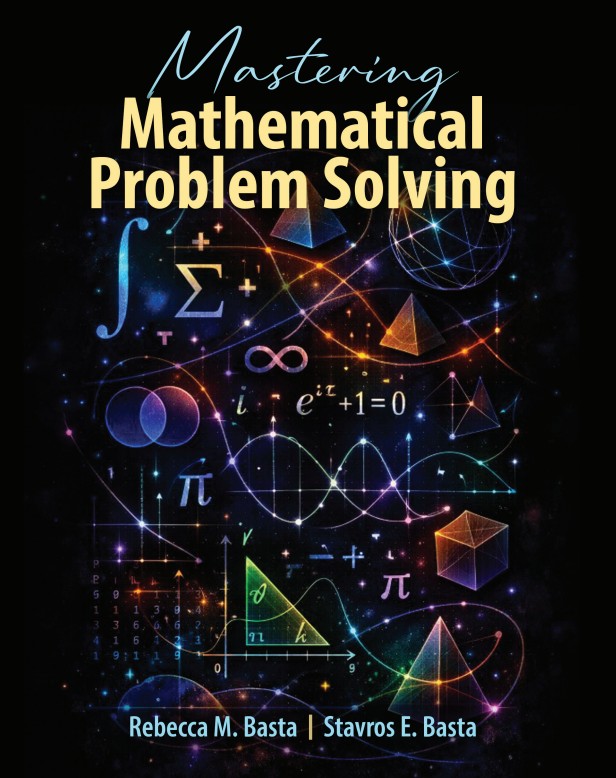
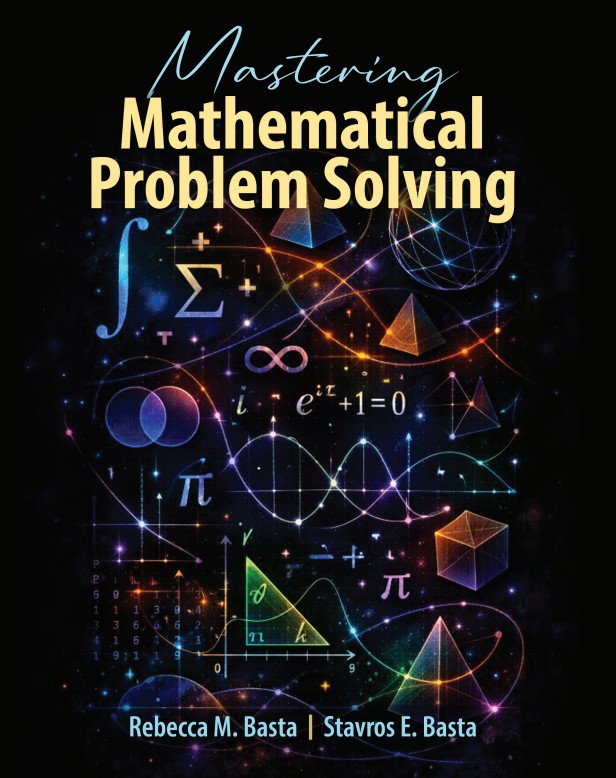
Mastering Mathematical Problem Solving
Edition: 1
Copyright: 2026
Pages: 390
Edition: 1
Copyright: 2026
Pages: 600
Choose Your Format
Print Package
$94.00 USD
Ebook
$75.20 USD
This book equips students and educators with sophisticated problem-solving skills and mathematical thinking strategies. Through Polya's four-step method and metacognitive techniques, readers will tackle challenging problems, enhance their analytical reasoning, and foster mathematical intuition. Ideal for both classroom instruction and self-study, this guide emphasizes creative exploration and systematic approaches to mathematical discovery.
About the Authors
Introduction: The Power of Mathematical Problem Solving
Understanding Pólya’s Four-Step Method
The Role of Metacognition in Problem Solving
Developing Mathematical Intuition
Integrating Technology and Visualization
Conclusion
Chapter 1: The Foundations of Problem Solving
1.1 Defining Mathematical Problem Solving
1.2 Pólya’s Four-Step Method: A Systematic Approach
1.3 The Role of Mindset and Persistence
1.4 Developing Mathematical Intuition
1.5 Metacognitive Strategies for Problem Solving
End of Chapter Problems
Chapter 2: Understanding the Problem
2.1 The Importance of Problem Comprehension
2.2 Techniques for Dissecting Problem Statements
2.3 Avoiding Premature Solutions and Common Pitfalls
2.4 Tools for Enhancing Problem Understanding
2.5 Practical Exercises to Strengthen Comprehension
Final Thoughts
End of Chapter Problems
Chapter 3: Devising a Plan
3.1 The Importance of Planning in Problem Solving
3.2 Heuristic Approaches to Problem Solving
3.3 Developing Mathematical Intuition
3.4 Evaluating and Selecting Optimal Strategies
3.5 Integrating Technology in Problem-Solving Plans
End of Chapter Problems
Chapter 4: Executing the Solution
4.1 The Importance of Solution Execution in Problem Solving
4.2 Techniques for Maintaining Logical Flow
4.3 Common Pitfalls and How to Avoid Them
4.4 Incremental Verification: Catching Errors Early
4.5 Enhancing Execution Through Metacognition
Conclusion
End of Chapter Problems
Chapter 5: Reflecting on Solutions
5.1 The Importance of Reflection in Problem Solving
5.2 Evaluating Efficiency and Elegance in Solutions
5.3 Generalizing Solutions and Identifying Patterns
5.4 Metacognition: Thinking About Thinking
5.5 Integrating Reflection Into Classroom Practice
End of Chapter Problems
Chapter 6: Inductive and Deductive Reasoning
6.1 The Foundations of Mathematical Reasoning
6.2 Inductive Reasoning: From Patterns to Conjectures
6.3 Deductive Reasoning: Building Proofs From First Principles
6.4 The Interplay Between Induction and Deduction
6.5 Common Pitfalls and How to Avoid Them
6.6 Exercises to Strengthen Reasoning Skills
End of Chapter Problems
Chapter 7: Problem-Solving Heuristics
7.1 The Power of Heuristics in Mathematical Problem Solving
7.2 Drawing Diagrams: Visualizing Mathematical Relationships
7.3 Working Backward: Unraveling Problems From the End
7.4 Considering Extreme Cases: Testing the Limits of Problems
7.5 Pattern Recognition and Generalization: From Specifics to Universals
Conclusion
End of Chapter Problems
Chapter 8: Developing Mathematical Intuition
8.1 The Nature of Mathematical Intuition
8.2 Cultivating Intuition Through Pattern Recognition
8.3 Balancing Intuition and Rigorous Proof
8.4 Metacognitive Strategies for Intuitive Growth
8.5 Exercises to Strengthen Mathematical Intuition
End of Chapter Problems
Chapter 9: Open-Ended Problem Solving
9.1 The Nature of Open-Ended Problems
9.2 Strategies for Approaching Open-Ended Problems
9.3 Evaluating and Comparing Solution Approaches
9.4 Fostering Creativity in Mathematical Exploration
9.5 Integrating Technology and Collaborative Learning
End of Chapter Problems
Chapter 10: Metacognition in Mathematics
10.1 The Foundations of Metacognition in Mathematics
10.2 Pólya’s Method and Metacognitive Integration
10.3 Cognitive Biases and Their Mitigation
10.4 Metacognitive Strategies for Educators
10.5 Cultivating Mathematical Intuition Through Metacognition
End of Chapter Problems
Chapter 11: Mathematical Argumentation
11.1 The Nature of Mathematical Arguments
11.2 Direct Proof and Its Applications
11.3 Proof by Contradiction: When Direct Methods Fail
11.4 Mathematical Induction: Reasoning Recursively
11.5 Evaluating and Critiquing Mathematical Arguments
End of Chapter Problems
Chapter 12: Technology in Problem Solving
12.1 The Role of Technology in Modern Mathematical Problem Solving
12.2 Selecting the Right Tools for Problem-Solving Tasks
12.3 Enhancing Visualization and Pattern Recognition
12.4 Metacognition and Technology: Reflecting on the Problem-Solving Process
12.5 Ethical Considerations and Future Directions
End of Chapter Problems
Chapter 13: Problem Solving in Geometry
13.1 The Role of Visualization in Geometric Problem Solving
13.2 Pólya’s Method Applied to Geometric Problems
13.3 Proof Techniques Unique to Geometry
13.4 Challenging Problems With Multiple Solution Paths
13.5 Integrating Technology in Geometric Exploration
End of Chapter Problems
Chapter 14: Algebraic Problem Solving
14.1 Understanding the Foundations of Algebraic Problems
14.2 Applying Pólya’s Four-Step Method to Algebra
14.3 Pattern Recognition and Algebraic Structures
14.4 Creative Approaches to Nonstandard Problems
14.5 Metacognition and Error Analysis
End of Chapter Problems
Chapter 15: Combinatorial Problem Solving
15.1 Foundations of Combinatorial Reasoning
15.2 Advanced Counting Techniques
15.3 Probability and Combinatorics
15.4 Graph Theory and Combinatorial Optimization
15.5 Metacognitive Strategies for Combinatorial Problem Solving
End of Chapter Problems
Chapter 16: Number Theory Challenges
16.1 The Foundations of Divisibility
16.2 Modular Arithmetic and Its Applications
16.3 Diophantine Equations: Seeking Integer Solutions
16.4 The Role of Conjecture and Proof in Number Theory
16.5 Historical Problems and Their Modern Relevance
End of Chapter Problems
Chapter 17: Calculus-Based Problem Solving
17.1 Understanding the Core Principles of Calculus Problem Solving
17.2 Applying Pólya’s Method to Differential Calculus
17.3 Advanced Techniques in Integral Calculus
17.4 Multivariable and Applied Calculus Problems
17.5 Leveraging Technology for Calculus Problem Solving
Conclusion
End of Chapter Problems
Chapter 18: Mathematical Modeling
18.1 The Process of Mathematical Modeling
18.2 Types of Mathematical Models
18.3 Applications Across Disciplines
18.4 Challenges and Limitations
18.5 Strategies for Effective Modeling
End of Chapter Problems
Chapter 19: Problem Solving in Competitions
19.1 Understanding Competition Problem Types
19.2 Time Management Strategies
19.3 Metacognition and Competition Psychology
19.4 Common Pitfalls and How to Avoid Them
19.5 Training Regimens for Competition Success
End of Chapter Problems
Chapter 20: Teaching Problem Solving
20.1 Creating a Problem-Rich Learning Environment
20.2 Implementing Pólya’s Four-Step Method in Instruction
20.3 Assessing Problem-Solving Processes
20.4 Fostering Mathematical Creativity
20.5 Integrating Technology and Visualization
End of Chapter Problems
Chapter 21: Assessing Problem-Solving Skills
21.1 The Importance of Evaluating Problem-Solving Processes
21.2 Designing Effective Rubrics for Problem Solving
21.3 Formative vs. Summative Assessment Techniques
21.4 Feedback Strategies That Foster Growth
21.5 Integrating Technology in Problem-Solving Assessment
End of Chapter Problems
Chapter 22: Overcoming Problem-Solving Obstacles
22.1 Understanding Common Problem-Solving Barriers
22.2 Strategies for Managing Frustration and Mental Blocks
22.3 Building Persistence and Resilience in Problem Solving
22.4 Case Studies: Navigating Challenging Problems
22.5 Integrating Technology and Metacognition
End of Chapter Problems
Chapter 23: The Psychology of Mathematical Discovery
23.1 The Cognitive Foundations of Mathematical Insight
23.2 The Role of Creativity in Mathematical Problem Solving
23.3 Incubation and the “Aha!” Moment
23.4 Strategies for Cultivating Mathematical Intuition
23.5 Creating Conditions for Discovery in Educational Settings
End of Chapter Problems
Chapter 24: Historical Problems and Their Solutions
24.1 The Role of Historical Problems in Mathematical Development
24.2 Pólya’s Method Applied to Historical Problems
24.3 Famous Unsolved Problems and Their Legacy
24.4 Technological Tools and Modern Solutions to Classical Problems
24.5 Lessons for Educators: Teaching Historical Problems in the Classroom
End of Chapter Problems
Chapter 25: Collaborative Problem Solving
25.1 The Power of Mathematical Collaboration
25.2 Strategies for Effective Mathematical Collaboration
25.3 Problems Suited for Group Work
25.4 Overcoming Challenges in Collaborative Problem Solving
25.5 Case Studies in Collaborative Problem Solving
Conclusion
End of Chapter Problems
Chapter 26: Advanced Problem-Solving Strategies
26.1 The Power of Invariant Principles
26.2 Leveraging Symmetry in Problem Solving
26.3 Advanced Heuristics for Complex Problems
26.4 Synthesizing Multiple Strategies
26.5 Metacognition and Reflection in Problem Solving
End of Chapter Problems
Chapter 27: Problem Posing and Creativity
27.1 The Art of Mathematical Problem Posing
27.2 Techniques for Modifying Existing Problems
27.3 Developing Original Problems From Scratch
27.4 The Role of Metacognition in Problem Posing
27.5 Integrating Technology and Collaborative Problem Posing
Conclusion
End of Chapter Problems
Chapter 28: The Future of Problem Solving
28.1 The Evolving Landscape of Mathematical Problem Solving
28.2 The Role of Artificial Intelligence in Mathematical Discovery
28.3 Interdisciplinary Approaches to Complex Problem Solving
28.4 Metacognition and the Future of Mathematical Learning
28.5 Preparing for the Unknown: Cultivating Adaptive Problem Solvers
End of Chapter Problems
Chapter 29: Conclusion: Becoming a Master Problem Solver
29.1 The Journey of Mathematical Mastery
29.2 Key Lessons From Pólya’s Framework
29.3 Cultivating Mathematical Intuition
29.4 Applying Problem Solving Beyond Mathematics
29.5 Final Thoughts and Continuing the Journey
End of Chapter Problems
Solution Guide to End of Chapter Problems
References
Index
Quick Reference by Subject
Competition Mathematics
Educational Approaches
Mathematical Topics
Problem Solving by Methodology
Psychology of Learning
Reasoning and Proof
Technology Tools
Rebecca M. Basta is a distinguished bioinformatics and cybersecurity education specialist with deep expertise at the critical intersection of health care technology, data science, and cybersecurity. Holding a Master of Science in Bioinformatics and a Bachelor of Science in Biochemistry with a Minor in Biotechnology, Basta combines advanced academic credentials with hands-on laboratory and educational expertise.
With an impressive portfolio of 30+ professional certifications spanning health care data analytics, AI governance, cybersecurity, risk management, and emerging security technologies, Basta demonstrates exceptional breadth across intersecting disciplines. Her credentials include Certified Health Data Analyst (CHDA), Certified Information Privacy Professional/United States (CIPP/US), Artificial Intelligence Governance Professional (AIGP), ISO 27001 and ISO 42001 Certified Lead Auditor, Certified Analytics Professional Expert (CAP), Certified Lean Six Sigma Master Black Belt, Certified Red Team Operations Management (CRTOM), and Certified Artificial Intelligence Security & Risk (CAISR). This diverse certification landscape reflects her commitment to understanding security from multiple angles: defensive, offensive, and governance perspectives. Basta’s research and publication record is exceptionally prolific, focusing on the convergence of health care security and advanced data analytics.
Stavros E. Basta is an accomplished cybersecurity professional and published researcher
specializing in industrial control systems (ICS) security and critical infrastructure protection. Holding a Master of Science in Cybersecurity and a Bachelor of Science in Cybersecurity, Basta brings advanced academic credentials alongside extensive industry experience.
With an impressive portfolio of 25+ professional certifications spanning security leadership, penetration testing, risk management, and cloud security, including GIAC Global Industrial Cyber Security Professional (GICSP), Certified Information Security Manager (CISM), Licensed Penetration Testing Master (LPTM), GIAC Security Leadership (GSLC), and Certified Penetration Testing Professional (CPENT), Basta demonstrates deep expertise across the cybersecurity landscape. Basta’s research investigates the critical gap between traditional cybersecurity frameworks and the unique vulnerabilities of industrial control systems and critical infrastructure.