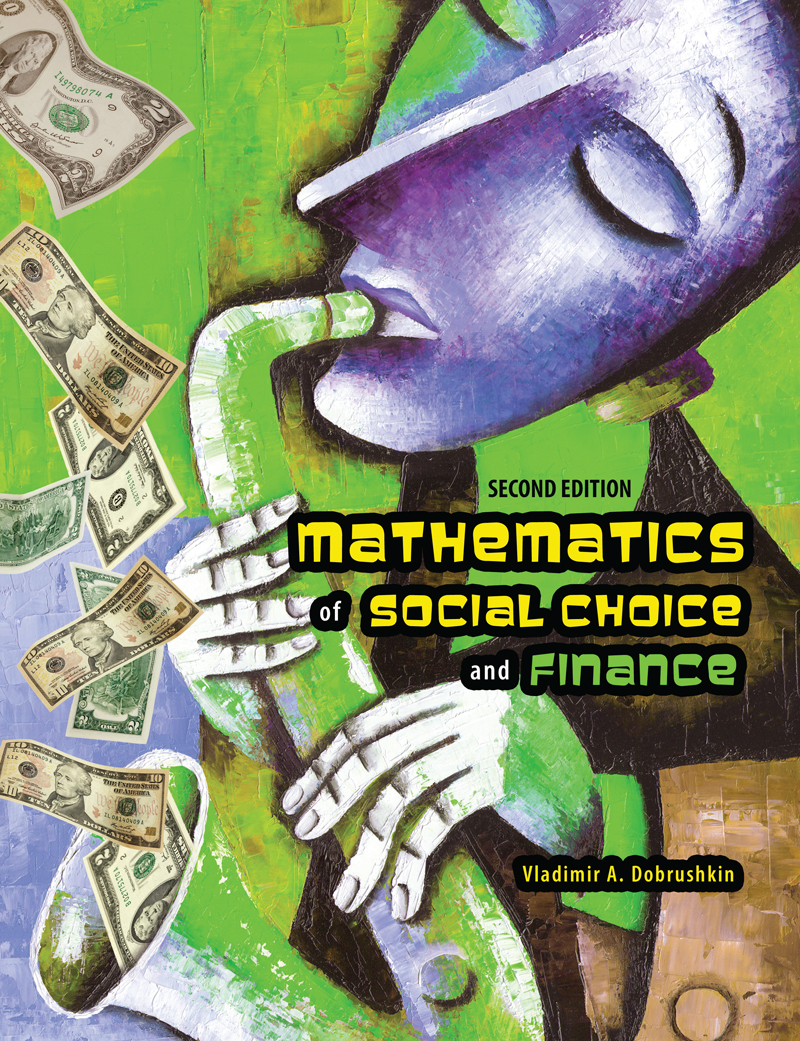
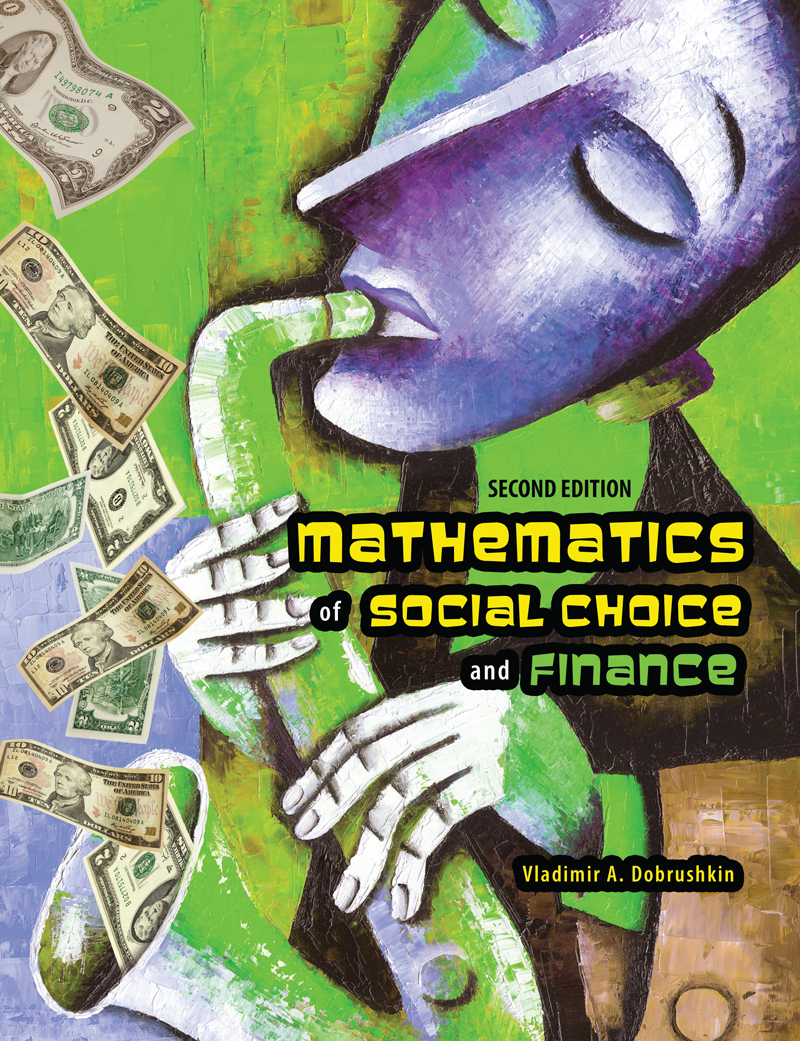
Mathematics of Social Choice and Finance
Edition: 2
Copyright: 2019
Pages: 386
Edition: 2
Copyright: 2019
Pages: 386
Choose Your Format
$145.53 USD
Ebook
$80.23 USD
Mathematics of Social Choice and Finance serves as an excellent foundation on which you can build a solid understanding of mathematics and its application in the real world. It will help you to utilize mathematical terminology and concepts. Such knowledge will give you control over the part of your life that includes numbers and logic.
Preface
1 Social Choice
1.1 Preference Ranking
1.2 The Plurality Methods
1.2.1 Runoff Method
1.2.2 Electoral College
1.2.3 The Single Transferable Vote
1.3 Point Distribution Systems
1.3.1 Some Other Systems
1.3.2 Nanson’s and Baldwin’s Methods
1.4 Head-to-Head Comparisons
1.5 The Approval Method
1.6 Arrow’s Impossibility Theorem
1.7 Two Ranking Methods
Chapter 1 Review
References and Further Reading
2 Apportionment Problems
2.1 Introduction
2.2 Hamilton’s Method
2.2.1 Lowndes’ Method
2.3 Jefferson’s Method
2.3.1 Adams’ Method
2.4 Webster’s Method
2.5 The Hill-Huntington Method
Chapter 2 Review
References and Further Reading
3 Everyday Finance
3.1 Review of Calculations
3.1.1 Taxes and Percentage
3.2 Simple Interest
3.2.1 Consumer Loans
3.3 Compound Interest
3.4 Systematic Savings/Annuities
3.5 Amortized Loans/Mortgages
3.5.1 Amortization Schedules
3.6 Personal Financial Decisions
Chapter 3 Review
References and Further Reading
Answers to Odd Problems
Index
Vladimir Dobrushkin, Ph.D., D.Sc. is a mathematician and engineer specializing in applied mathematics, mechanical engineering, and computational modeling. He earned a Ph.D. in Applied Mathematics from Belarus State University and a Doctor of Science (D.Sc.) in Mechanical Engineering from the Belarus Polytechnic Academy. His expertise includes mathematical modeling, solid and fluid mechanics, dynamic fracture mechanics, two-phase fluid flow, numerical methods, statistics, and scientific computing. His work integrates theoretical mathematics with computational techniques, including finite element, boundary element, and finite difference methods, to model and analyze complex physical systems.