The Menu & the Cycle of Cost Control
Edition: 7
Copyright: 2026
Pages: 270
Choose Your Format
Ebook
$68.00 USD
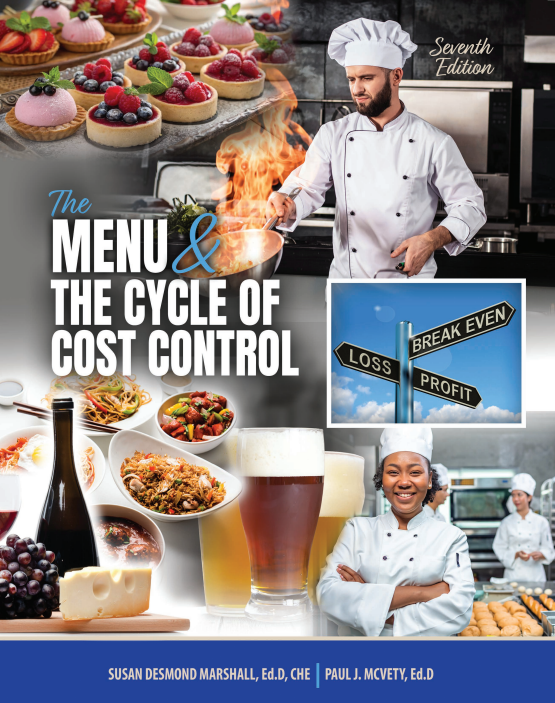
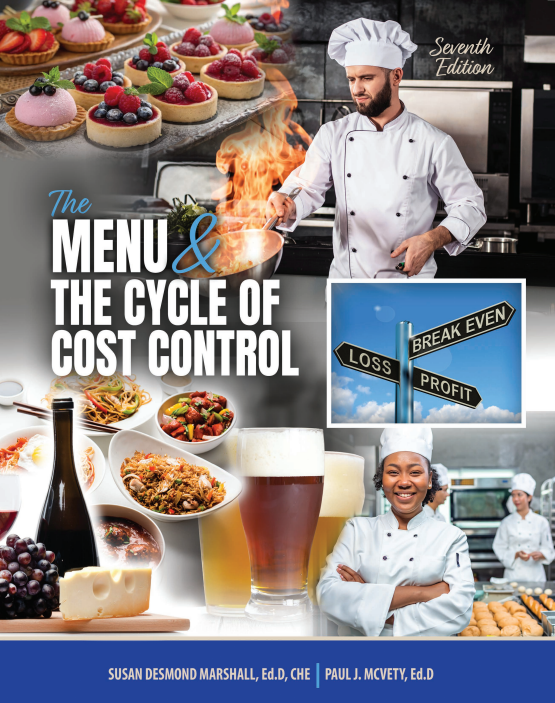
Success in today's food and beverage organizations requires a solid knowledge of industry trends, the ability to prepare cost-effective menus that appeal to guests' needs and wants, and the skills to develop and implement a concrete strategic fiscal plan to control costs and to manage sales. The Menu & The Cycle of Cost Control, 7th edition provides the reader with the knowledge necessary to accomplish these tasks and to become effective, contributing members of a management team.
The 7th edition of The Menu and the Cycle of Cost Control features current information on menu development, trends and concepts, cost control and sales analysis documents, industry-related law and requirements, as well as the necessary control procedures and mathematical processes to help to control costs, forecast, and analyze sales. Almost every procedure discussed, from recipe costing to labor cost controls, can be accomplished using a Point of Sales (POS) system with the right configurations. The POS can provide the business's cost and sales information often by simply running a report. However, what good is the information (a bunch of numbers and percentages) if a manager does not know what the information is indicating? Therefore, it is even more important to know how the information was calculated and what the information means so the results can be utilized to the business's advantage. Industry experience leads to understanding. Without industry experience, the same result can be achieved by understanding the reasons behind procedures and calculations. Implementing the procedures described in this text and using mathematical formulas to calculate needs and results will lead to a successful foodservice operation. To put it simply, this text provides the information and procedures needed to achieve the ‘common sense of experienced chefs and managers.
The Menu & The Cycle of Cost Control offers an integrated, enhanced learning package that includes an abundance of Instructor Resources that can be utilized and shared with students as desired. Instructor Resources include
- Chapter PowerPoints to be utilized as faculty classroom presentations or a study guide for students.
- Answers to Chapter Review Questions
- Additional Learning Activities
- Worksheets and Spreadsheets with formulas for additional practice for recipe costing, yield tests, cooking loss texts, purchasing, receiving, inventory, production forecast, sales analysis, calculating payroll, and more.
- Test Bank
- And Supplementary tools and Links to other resources.
The Menu & The Cycle of Cost Control is your tool to understanding the management complexities of food and beverage organizations.
Preface
About the Authors
Unit 1: The Menu
Chapter 1: The Foodservice Industry Today
Chapter 2: Concepts and the Strategic Business Plan
Chapter 3: Developing and Designing the Sales Menu
Chapter 4: Standards, Measurements, Recipes, and Formulas
Chapter 5: Determining Portion Costs and Selling Prices
Unit 2: The Cycle of Cost Control
Chapter 6: Analyzing and Budgeting Sales and Costs
Chapter 7: Purchasing Controls
Chapter 8: Receiving Controls
Chapter 9: Storage and Inventory Controls
Chapter 10: Daily Production Controls
Unit 3: Sales and Labor Analysis
Chapter 11: Sales Controls and Analysis
Chapter 12: Labor Cost Controls and Analysis
Appendices
Appendix A: Measurement, Equivalents, and Edible Yields
Appendix B: Success in Business Mathematics (The Percentage Formula Triangle)
Appendix C: Sample Chart of Accounts
Appendix D: Non-Computerized Sales Controls
Appendix E: Sample Wage Bracket Tables
Appendix F: Worksheets and Project Forms
Bibliography
Index
Susan Desmond Marshall, Ed.D., CHE, currently serves as the associate dean of the College of Food Innovation & Technology, Johnson & Wales University (JWU), Providence, RI. Since joining the faculty in 1984, she has been instrumental in the development of the culinary arts, culinary nutrition, culinary science & product development of bachelor’s degree programs. Specializing in restaurant, financial, and human resources management, she draws upon her experience in standardizing operating procedures, performing cost analysis, and improving customer service and employee morale.
Prior to her current role, Marshall was a professor teaching courses specific to her areas of expertise including Menu Planning, Cost Control, Foodservice Financial Systems, Executive Chef Supervisory Development, and Food Safety. Though not a chef, her industry experience in management and consulting throughout the years has allowed her to work hand-in-hand with chefs within many different food service concepts.
Paul J. McVety, Ed.D, celebrated 42 years as former faculty member and Dean of College of Culinary Arts and College of Hospitality Management. He focused on curriculum development and faculty enrichment in undergraduate and graduate academic degree programs at Johnson & Wales University. Expertise includes teaching menu planning, food & beverage cost control, food safety & sanitation management, restaurant facilities design & analysis, and curriculum development for secondary and post-secondary culinary arts programs. He served as project manager and co-author of Culinary Arts textbooks: Culinary Fundamentals, Service and the Art of Hospitality: Creating a Dining Experience, Culinary Recipes 2nd ed., Culinary Services, Baking & Pastry Formulas, and Baking & Pastry Fundamentals. His industry experience as a cook plus domestic and international foodservice consultant allowed him to incorporate current industry trends into his teaching, publishing and academic program development.