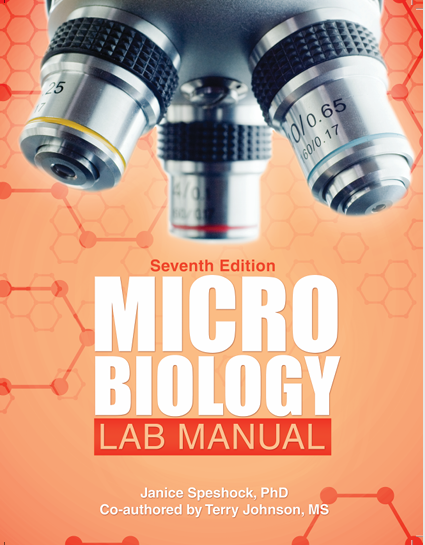
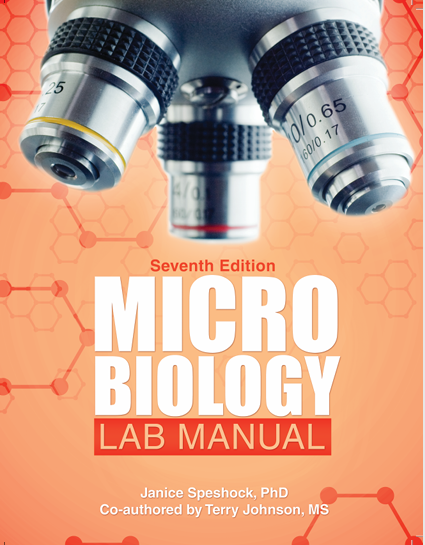
Microbiology Lab Manual
Edition: 6
Copyright: 2024
Pages: 86
Edition: 7
Copyright: 2026
Pages: 86
Edition: 7
Copyright: 2026
Pages: 86
Choose Your Format
Choose Your Platform | Help Me Choose


$59.99 USD
$63.99 USD
Ebook
$39.00 USD
This publication is a microbiology laboratory manual designed for a one-semester, college undergraduate education. The manual is designed to be self-guided so that the students can learn and discover on their own time. All college majors requiring a microbiology laboratory course will benefit from this publication.
This manual contains a series of experiments designed to build a student’s knowledge and mastery of microbiological laboratory techniques. It begins with basics of microscopy, aseptic technique, and culture handling, and then advances into diagnostic techniques applicable to many fields in microbiology. In addition, the manual has an unknown exercise that follows the student through the entire semester allowing for them to use various techniques and a dichotomous key to determine the identity of microorganisms.
LAB 1. INTRODUCTION TO MICROSCOPY
LAB 2. HANDWASHING
LAB 3. ASEPTIC TECHNIQUE AND PURE CULTURE TRANSFERS
LAB 4. SIMPLE STAIN
LAB 5. SURVEY OF EUKARYOTIC MICROORGANISMS
LAB 6. THE GRAM STAIN
LAB 7. SERIAL DILUTIONS (VIABLE PLATE COUNTS)
LAB 8. METABOLISM OF SUGAR
LAB 9. METABOLISM 2 AND MOTILITY
LAB 10. SELECTIVE AND DIFFERENTIAL MEDIA
LAB 11. FOOD MICROBIOLOGY
LAB 12. WATER MICROBIOLOGY
LAB 13. ANTIMICROBIAL SUSCEPTIBILITY
APPENDICES

Dr. Janice Speshock earned her Ph.D. from the Wayne State University School of Medicine in 2007 and completed a Postdoctoral Fellowship with the National Research Council/Defense Threat Reduction Agency. She teaches courses in Microbiology, Pathogenic Microbiology, and Immunology. Her research focuses on understanding how the host immune system responds to foreign entities. Her laboratory investigates the effects of engineered nanomaterials on immune system function while developing an in vivo model to study nanomaterial toxicity and biolocalization. She also studies how bacteria regulate virulence factor production to influence host colonization and disease, as well as the role of the host immune system in bacterial pathogenesis. Through her teaching and research, Dr. Speshock is committed to advancing knowledge in microbiology, immunology, and host–pathogen interactions.
This publication is a microbiology laboratory manual designed for a one-semester, college undergraduate education. The manual is designed to be self-guided so that the students can learn and discover on their own time. All college majors requiring a microbiology laboratory course will benefit from this publication.
This manual contains a series of experiments designed to build a student’s knowledge and mastery of microbiological laboratory techniques. It begins with basics of microscopy, aseptic technique, and culture handling, and then advances into diagnostic techniques applicable to many fields in microbiology. In addition, the manual has an unknown exercise that follows the student through the entire semester allowing for them to use various techniques and a dichotomous key to determine the identity of microorganisms.
LAB 1. INTRODUCTION TO MICROSCOPY
LAB 2. HANDWASHING
LAB 3. ASEPTIC TECHNIQUE AND PURE CULTURE TRANSFERS
LAB 4. SIMPLE STAIN
LAB 5. SURVEY OF EUKARYOTIC MICROORGANISMS
LAB 6. THE GRAM STAIN
LAB 7. SERIAL DILUTIONS (VIABLE PLATE COUNTS)
LAB 8. METABOLISM OF SUGAR
LAB 9. METABOLISM 2 AND MOTILITY
LAB 10. SELECTIVE AND DIFFERENTIAL MEDIA
LAB 11. FOOD MICROBIOLOGY
LAB 12. WATER MICROBIOLOGY
LAB 13. ANTIMICROBIAL SUSCEPTIBILITY
APPENDICES
Dr. Janice Speshock earned her Ph.D. from the Wayne State University School of Medicine in 2007 and completed a Postdoctoral Fellowship with the National Research Council/Defense Threat Reduction Agency. She teaches courses in Microbiology, Pathogenic Microbiology, and Immunology. Her research focuses on understanding how the host immune system responds to foreign entities. Her laboratory investigates the effects of engineered nanomaterials on immune system function while developing an in vivo model to study nanomaterial toxicity and biolocalization. She also studies how bacteria regulate virulence factor production to influence host colonization and disease, as well as the role of the host immune system in bacterial pathogenesis. Through her teaching and research, Dr. Speshock is committed to advancing knowledge in microbiology, immunology, and host–pathogen interactions.