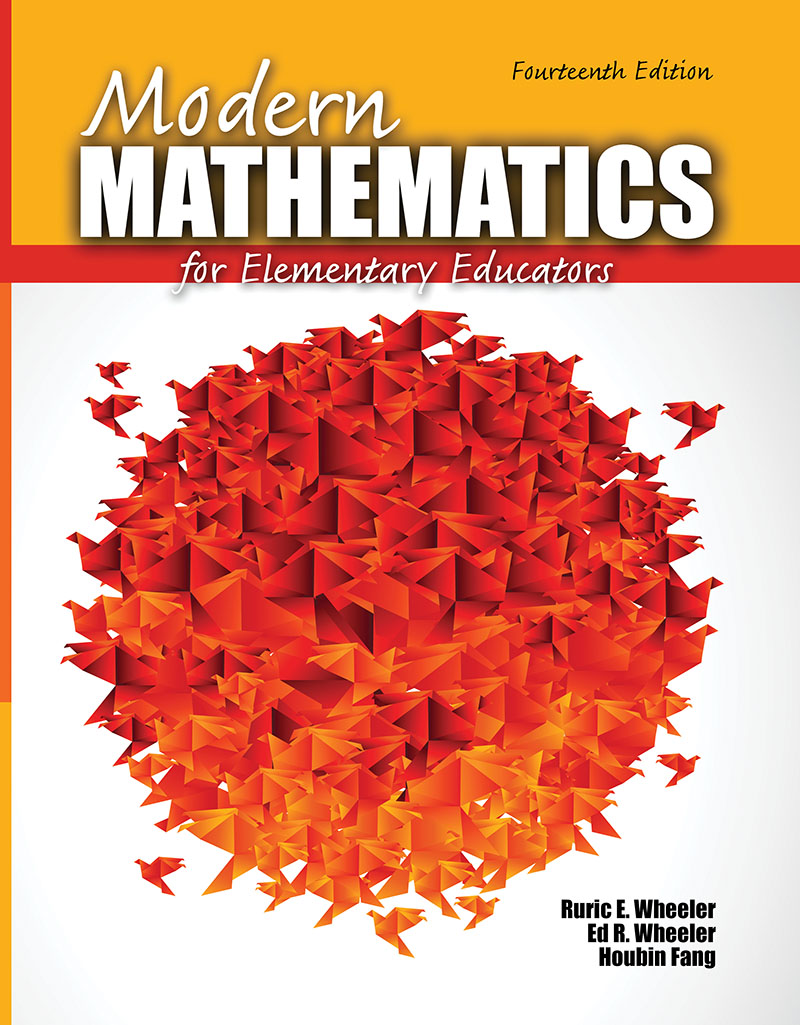
Modern Mathematics for Elementary Educators
Edition: 14
Copyright: 2014
Pages: 754
Edition: 14
Copyright: 2014
Pages: 756
Choose Your Format
Ebook
$71.24 USD
$256.47 USD
Modern Mathematics for Elementary Educators provides future elementary teachers with a comprehensive foundation in the mathematical concepts and reasoning needed to teach mathematics effectively. Rather than emphasizing rote computation, the text focuses on developing conceptual understanding, logical reasoning, and problem-solving skills across the major areas of elementary mathematics. Topics include critical thinking, logic, set theory, whole numbers, integers, rational and real numbers, geometry, measurement, probability, statistics, and functions, helping readers build both mathematical competence and confidence.
The book also connects mathematical theory to classroom practice by exploring multiple solution strategies, mathematical communication, and the reasoning behind standard algorithms and procedures. Through discussions of number systems, geometry, measurement, data analysis, and probability, readers gain a deeper understanding of the concepts they will teach and learn how to explain them in meaningful ways to young learners. Modern Mathematics for Elementary Educators prepares prospective teachers to foster mathematical thinking, encourage inquiry, and create engaging learning experiences that promote long-term understanding of mathematics in elementary classrooms.
Preface
Acknowledgments
Chapter 1: Critical Thinking and Problem Solving
Critical Thinking
Critical Thinking and Inductive Reasoning
Introduction to Problem Solving
Strategies for Problem Solving
Summary and Review
Chapter Test
Chapter 2: The Language of Logic
An Introduction to Logic
Conditionals and Equivalent Statements
Making Use of Deductive Logic
Quantifiers, Venn Diagrams, and Valid Arguments
Summary and Review
Chapter Test
Chapter 3: Sets, Relations, and Functions
An Introduction to Sets
Cartesian Product and Relations
The Number of Elements in a Set
Functions
Summary and Review
Chapter Test
Chapter 4: Whole Numbers and Numeration
Whole Number Addition, Subtraction, and Order
Whole Number Multiplication and Division
History of Numeration Systems
Patterns for Numeration: Decimal and Nondecimal Bases
Addition and Subtraction Algorithms
Multiplication and Division Algorithms
Summary and Review
Chapter Test
Chapter 5: The System of Integers and Elementary Number Theory
The System of Integers
Integer Multiplication and Division
Divisibility, Primes, Composites, and Factorization
Greatest Common Divisor and Least Common Multiple
Modular Arithmetic
Summary and Review
Chapter Test
Chapter 6: Introduction to the Rational Numbers
The Set of Rational Numbers
Addition and Subtraction of Rational Numbers
Multiplication and Division of Rational Numbers
Ratio and Proportion
The Rational Number System
Summary and Review
Chapter Test
Chapter 7: Real Numbers and Applications
Introduction to Decimals
The Arithmetic of Decimals
The Real Number System
The Language of Percent
A Matter of Interest
Summary and Review
Chapter Test
Chapter 8: Informal Geometry
An Introduction to Geometry
Lines, Planes, and Angles
Simple Closed Curves
Simple Closed Surfaces
Summary and Review
Chapter Test
Chapter 9: Measurement and the Metric System
Congruence, Linear Measure, and Measurement
Two-Dimensional Measure and Formulas for Area
Volume and Surface Area
Other SI Units of Measure
Summary and Review
Chapter Test
Chapter 10: Coordinate Geometry and Transformations
Introduction to Reflections (Flips) and Coordinate Geometry
Slides or Translations
Rotations and Successive Motions
Geometric Patterns in Nature and Art
Slopes and Linear Equations
Systems of Linear Equations
Summary and Review
Chapter Test
Chapter 11: Additional Topics of Geometry
Congruence and Triangles
Justifications of Constructions
Similar Geometric Figures
The Highway Inspector and the Traveling Salesman
Summary and Review
Chapter Test
Chapter 12: Introduction to Probability Theory
The Language of Probability
Probability of Events and Properties of Probability
Multistep Experiment, Expected Values, and Simulation
The Fundamental Principle of Counting and Permutations
Counting and Combinations
Summary and Review
Chapter Test
Chapter 13: The Uses and Misuses of Statistics
Frequency Distributions and Graphical Representation
What Is Average?
How to Measure Scattering
The Normal Distribution
Summary and Review
Chapter Test
Answers to Selected Exercises
Index
Ruric E. Wheeler (November 30, 1923 – July 26, 2016) was an American mathematician, educator, author, and Christian leader best known for his long career at Samford University in Birmingham, Alabama, and for writing more than 25 college-level mathematics textbooks used by over 1.5 million students.
Born in rural Kentucky to a family of storekeepers and farmers, Wheeler grew up during the Great Depression and World War II. He met his future wife, Joyce Ray, while in high school, and the two married several years later. After serving in the U.S. Army Air Forces during World War II, he earned a bachelor's degree from Western Kentucky University, followed by a master's degree and a Ph.D. in Mathematical Statistics from the University of Kentucky.
Wheeler began his teaching career at the University of Kentucky before joining the faculty at Florida State University. In 1953, he became a member of the faculty at Samford University's Howard College of Arts and Sciences, where he spent more than four decades in a variety of leadership roles. He served as chair of the mathematics department, chair of the division of natural sciences, dean of the Howard College of Arts and Sciences, and vice president for academic affairs from 1970 to 1987. Although he officially retired in 1994, Wheeler continued contributing to mathematics education as a research professor until 2009.
Throughout his career, Wheeler was recognized for his dedication to teaching, curriculum development, and mathematics education. His textbooks have helped generations of college students build strong mathematical foundations, and his legacy continues through his contributions to higher education and the field of mathematics.
Dr. Houbin Fang is a Professor in the Department of Mathematics at Columbus State University in Columbus, Georgia. He joined the university in 2013 as an Assistant Professor, was later promoted to Associate Professor, and became a full Professor in 2023.
Dr. Fang earned both his Ph.D. and Master of Science in Mathematics Education and Instructional Technology from the University of Southern Mississippi. His work focuses on mathematics education, instructional technology, and improving the teaching and learning of mathematics. Through his teaching, research, and service, he has contributed to the preparation of future mathematics educators and the advancement of effective instructional practices in higher education.