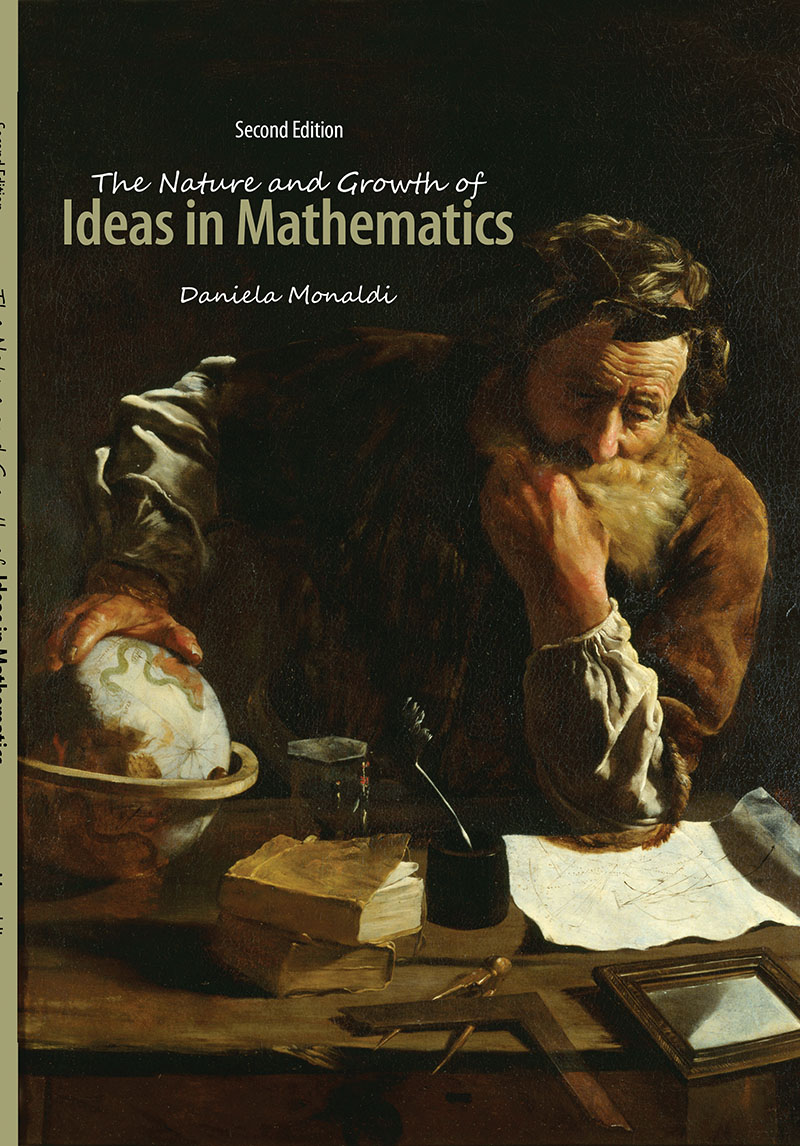
The Nature and Growth of Ideas in Mathematics
Edition: 2
Copyright: 2014
Pages: 208
Edition: 2
Copyright: 2014
Pages: 208
Choose Your Format
Ebook
$63.21 USD
$126.41 USD
The Nature and Growth of Ideas in Mathematics explores the historical development of mathematical thought from the earliest systems of counting to the emergence of probability theory and modern scientific reasoning. The text examines how mathematical ideas evolved across ancient civilizations, including Egypt and Greece, and highlights the contributions of influential thinkers such as Pythagoras, Euclid, Copernicus, Galileo, Kepler, and Newton. By placing mathematical discoveries within their historical and cultural contexts, the book demonstrates how mathematics has shaped humanity's understanding of the natural world.
Designed for students interested in the history, philosophy, and foundations of mathematics, this text combines historical narratives with mathematical concepts to illustrate the evolution of problem-solving and scientific inquiry. Through discussions of numeracy, geometry, astronomy, mathematical proof, and probability, readers gain an appreciation for the enduring influence of mathematical ideas on science, technology, and society. The book encourages critical thinking about how mathematics has developed over time and continues to serve as a fundamental tool for understanding the world.
Chapter 1: The Beginnings of Numeracy
Chapter 2: The Evolution of Numbers
Chapter 3: What Do We Know about Egyptian Mathematics?
Chapter 4: Greek Mathematics
Chapter 5: Hellenistic Mathematics, Euclid's The Elements in Particular
Chapter 6: Mathematics and the Physical World in Antiquity
Chapter 7: Mathematics and the Origin of Modern Science Part 1
Chapter 8: Mathematics and the Origins of Modern Science Part 2
Chapter 9: From the Mathematics of Chances to the Theory of Probability
Dr. Monaldi holds a university degree in physics from the University La Sapienza in Rome, Italy and worked as a junior researcher in a high-energy physics experiment at the HERA accelerator in Hamburg Germany. Her PhD is in the history of science, with a focus on twentieth-century physics, from the Institute for the History and Philosophy of Science and Technology at University of Toronto, Canada, and she was a post doctoral fellow at the Max Planck Institute for the History of Science in Berlin, Germany. Her most recent works are on the evolving conceptual understanding of quantum statistics, and on the role of food traditions in the transition to sustainable food systems.