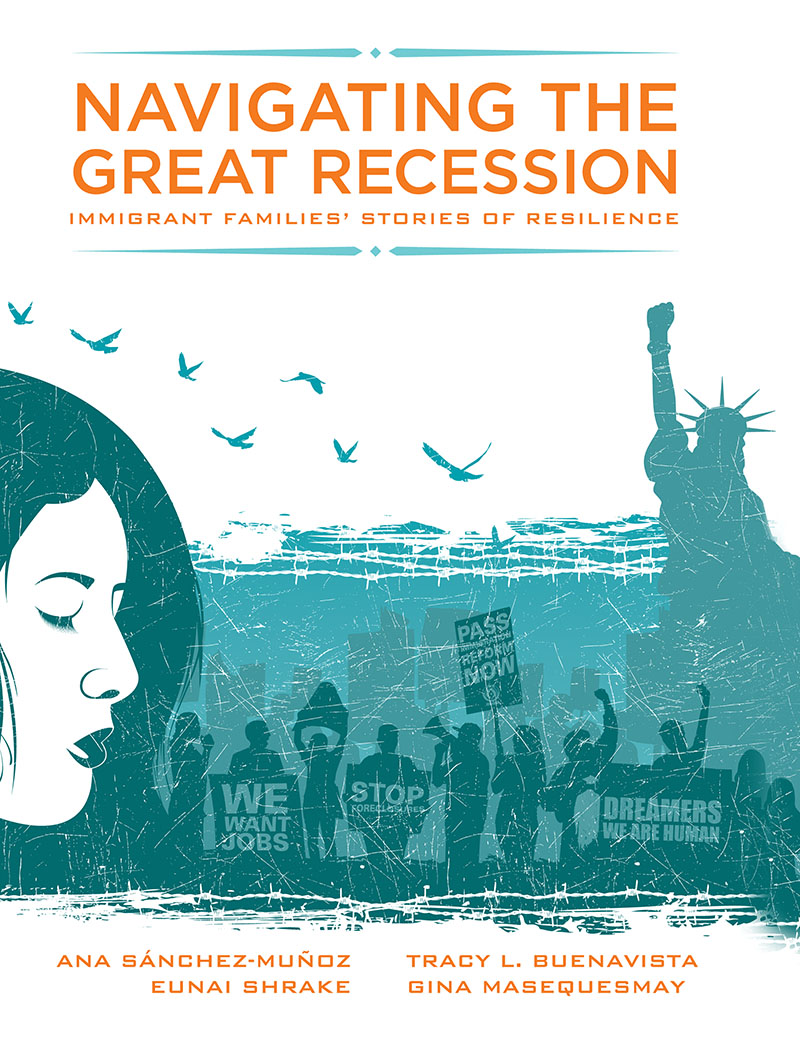
Navigating the Great Recession: Immigrant Families' Stories of Resilience
Edition: 1
Copyright: 2011
Pages: 128
Edition: 1
Copyright: 2011
Pages: 126
Choose Your Format
$67.33 USD
Ebook
$33.66 USD
Navigating the Great Recession: Immigrant Families' Stories of Resilience examines how immigrant communities develop resilience through family, institutional, social, and community support systems. The collection explores the experiences of immigrant students and families navigating economic hardship, educational barriers, cultural transitions, and systemic challenges while highlighting the strategies and resources that help individuals and communities persist and succeed.
The book emphasizes the role of intergenerational support, financial literacy, higher education resources, public assistance, language skills, spirituality, and community engagement in shaping immigrant resilience. Through personal narratives and scholarly perspectives, the work demonstrates how immigrants transform challenges into sources of strength while addressing broader issues of equity, identity, and social support.
eBook Version
You will receive access to this electronic text via email after using the shopping cart above to complete your purchase.
Foreword, Juana Mora
Acknowledgments
Introduction
SECTION 1 Family Support
INTRODUCTION
Resilience and Immigrant Families, Eunai Shrake
Story #1 My Family in the Economic Tsunami, Kevan Moscoso
Story #2 Mi Familia in Times of Crisis, Yaneli Gonzalez
Story #3 On Each Other’s Shoulders, Gabriela Habi
Story #4 Intergenerational Refugee Resilience, Yvonne Kwan
Story #5 History: Recognition of Ourselves, Daisy Le
Story #6 Learning from My Parents’ Struggles, Jane Shin
SECTION 2 Institutional Support
INTRODUCTION
The Role of Institutional Support in Shaping Immigrant Resilience, Tracy Lachica Buenavista
Story #7 Creating a Legacy of Financial Literacy: Savings Practices and Financial Aid, Roza Chirishyan
Story #8 “La Vida”: Coping with School, Work, and the Economic Crisis, Abraham Rodriguez
Story #9 Working School: The Role of On-Campus Financial Opportunities, Julie Tran
Story #10 The Struggles and Successes of an AB 540 Student: Fighting for Institutional Policy Reform in Higher Education, Raymundo Hernández
Story #11 When Family Is Not Enough: Institutional Support as a Mechanism for Survival, Hansook Oh
Story #12 Fighting through a Recession: The Relationship between Public Assistance and Resiliency, Robert Beam
SECTION 3 Social and Community Support
INTRODUCTION
Social and Community Support and Transformation, Gina Masequesmay
Story #13 Resiliency through Spiritual Means, Carlos Jiménez
Story #14 The Support in My Life/Navigating the Financial Maze, Anita Arce
Story #15 From Human Capital to Community Resource: Language Brokering Work as Survival and Strength, Hyeyoung Kwon
Story #16 Working Together for a Better World: Community Development and Social Work, Wanda Pathomrit
Story #17 Economic Realities and Student Dreams in the City of Angels, Jean-Paul deGuzman
CONCLUSION
Resilient Immigrants Resisting: Making It through the Many “Great Recessions”
Ana Sánchez-Muñoz
Co-Editors Biographies
Eunai Shrake, PhD is Professor Emeritus of Asian American Studies at California State University, Northridge (CSUN). She earned a BA and MA from Presbyterian College, a Master of Theology (ThM) from Austin Presbyterian Seminary, and a PhD from the University of California, Los Angeles. During her tenure at CSUN, Dr. Shrake taught courses in Asian American Studies, contributing to scholarship and education on the histories, cultures, and experiences of Asian American communities.
Ana Sánchez-Muñoz, PhD is a linguist and professor specializing in Hispanic linguistics, bilingualism, and language acquisition. Originally from Spain, she earned a BA in Philology from the University of Salamanca and a PhD in Hispanic Linguistics from the University of Southern California. Her research focuses on language variation and change, bilingualism, language contact, and the development and maintenance of Spanish among heritage speakers in the United States.
Dr. Sánchez-Muñoz is an assistant professor in the Department of Chicana/o Studies and a faculty member in the Linguistics Program at California State University, Northridge (CSUN). Her teaching and research examine Spanish-English language contact, heritage language development, and bilingual language acquisition, with an emphasis on how Spanish is learned, used, and maintained within multilingual communities.
Tracy Lachica Buenavista, PhD is a scholar of Asian American Studies whose research focuses on race and racism, educational equity, and the experiences of Pilipina/o and other underserved communities of color in the United States. She earned a BA in Biology with a minor in Ethnic Studies from the University of California, Berkeley, an MA in Asian American Studies from San Francisco State University, and a PhD in Education from the University of California, Los Angeles.
Dr. Buenavista is an assistant professor in the Department of Asian American Studies at California State University, Northridge (CSUN). Her teaching and research examine educational access, social justice, systemic inequality, and the ways race and public policy shape educational opportunities and outcomes for historically marginalized communities.
Gina Masequesmay, PhD is a Professor and former Chair of the Department of Asian American Studies at California State University, Northridge (CSUN). She earned her undergraduate degree from Pomona College and a PhD in Sociology from the University of California, Los Angeles. Her teaching and research focus on Asian American studies, immigration, race and racism, gender, sexuality, queer studies, and Vietnamese American experiences, with particular emphasis on the intersections of race, class, gender, sexuality, and disability.
Dr. Masequesmay's scholarship includes Vietnamese American identity, entrepreneurship, LGBTQ+ communities, critical pedagogy, and social justice. She has co-edited works on Asian American sexualities, contributed to research on race and disability, and co-founded the CSUN Positive Space Program and Ally Project to support LGBTQ+ students. Her work also incorporates mindfulness and Buddhist psychology into education, reflecting her broader interest in healing, community well-being, and inclusive teaching practices.