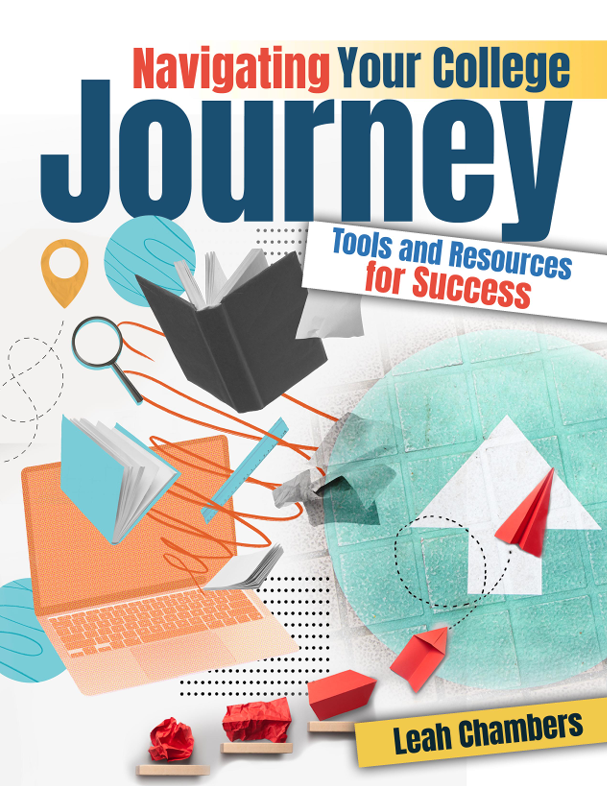
Navigating Your College Journey: Tools and Resources for Success

Author(s): Leah Chambers

Edition: 1

Copyright: 2026

Pages: 224

Choose Your Format

Ebook

$40.00 USD

ISBN 9798319714398

Details Electronic Delivery EBOOK 180 days

Navigating Your College Journey is a first-year seminar text organized around what the research on college success consistently shows: students do better when they build real connections, with professors, peers, and staff, and when they learn how learning actually works.

The book moves through three phases that mirror the first-year experience itself. In Connect, students build relationships, a sense of belonging, and a college mindset while examining their own goals and strengths. In Explore, they dig into evidence-based learning strategies, questioning, and critical thinking. In Discover, they put those skills to work in a collaborative research project — finding and evaluating sources, using AI responsibly, synthesizing what they learn, and presenting it to a real audience at the end of the term. Along the way, the text scaffolds the skills first-year students most need and least often get direct instruction in: reading academic sources strategically, evaluating information, and designing research for someone other than the professor.

Each chapter includes recurring features, including Pause and Reflect, Try This, Mentor Moment and Data Snapshot, that turn concepts into practice; full-color visuals translate the research on learning, mindset, and information literacy into information that’s easy for students to recall. A companion write-in workbook, Navigation Essentials, follows the text chapter by chapter with structured versions of the book’s key activities. Throughout, the text draws on high-quality open resources — from open-access scholarship to freely available tools students can keep using after the course ends — and grounds its claims in current, cited research.

Written by a faculty member who directs a multi-campus first-year seminar program, the book is shaped by years of teaching first-year students. Campus-specific material is deliberately adaptable, so programs can localize the resources, people, and places to their own institution.

Features

  • A three-phase arc — Connect, Explore, Discover — scaffolding the full seminar from first-day community building to a public research presentation
  • Grounded in current research on belonging, mindset, evidence-based learning, and relationship-rich education
  • Timely, practical treatment of information literacy, source evaluation, and responsible AI use
  • Visuals that make key concepts concrete and memorable
  • Companion write-in workbook (Navigation Essentials) aligned chapter by chapter with the text’s key activities
  • Connections to quality open-access resources students can continue using beyond the course

 To the Student
About the Author
Acknowledgments
To Instructors 
CHAPTER 1 Welcome to FYS 1000 
CHAPTER 2 Building Your College Mindset
CHAPTER 3 Finding Your People and Your Place 
CHAPTER 4 Managing Your College Life
CHAPTER 5 Learning How to Learn 
CHAPTER 6 Asking Questions and Thinking Critically 
CHAPTER 7 Developing Research Skills 
CHAPTER 8 Using Information Responsibly
CHAPTER 9 Synthesizing and Sharing Your Research 

Leah Chambers

Leah Chambers is a Professor of English and Director of First-Year Academic Success at PennWest University, where she leads the first-year seminar program. Her doctoral research focused on the retention of students most at risk of leaving college and the institutional structures that support or inhibit their success. She has developed summer bridge and first-year seminar programs, created and facilitated faculty development across disciplines, and led the redesign of gateway courses to narrow equity gaps. With her colleague, Rich Lane, she also co-created PennWest’s Directed Self-Placement program for first year writing and co-founded and co-directs the Community Learning Workshop, which offers free educational resources and programming to community members of all ages in rural Clarion County, PA. Her work, in the classroom and well beyond it, returns to a single conviction: students succeed when they are known, supported, and connected to the people around them. Everything else—the programs, the courses, the systems—should be designed to make that possible.