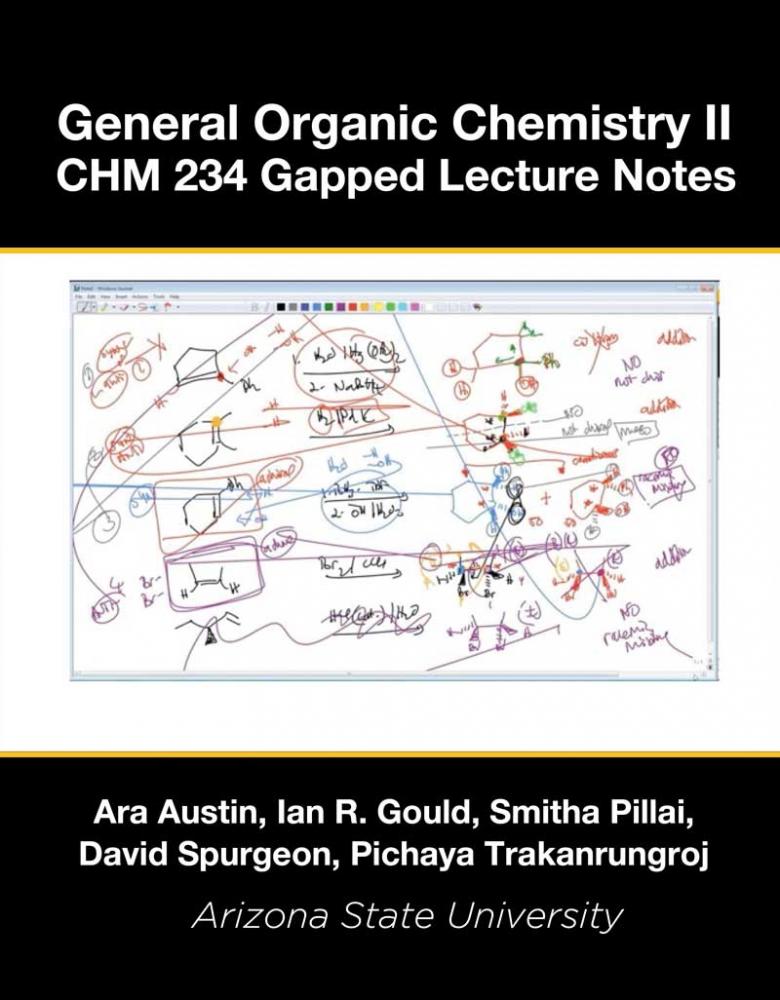
Organic Chemistry II
Edition: 1
Copyright: 2021
Pages: 188
Choose Your Format
$22.61 USD
This portion of Organic Chemistry builds on the fundamentals learned in Organic Chemistry I by introducing more advanced reaction mechanisms, synthesis strategies, and functional group transformations. Students learn how chemists design multistep syntheses, create carbon–carbon bonds, understand aromatic compounds, and explore the chemistry of carbonyl-containing molecules. These topics emphasize reaction selectivity, mechanism prediction, and applying multiple concepts together to solve complex organic chemistry problems.
1. Synthesis and Retrosynthesis: Putting reactions Together
2. Alkynes: Selectivity in Organic Reactions
3. Alcohols: Oxidation and Reduction
4. Organometallic Reagents: Carbon-Carbon Bonds
5. Ethers/Epoxides: Reactions with Bronsted Acids and Bases
6. Conjugated Systems: Return to MO Theory
7. Aromaticity: Stability of Conjugated p-Systems
8. Reactions of Benzenes: Electrophilic Aromatic Substitution
9. Aldehydes and Ketones: Nucleophilic Addition
10. Enols, Enolates and Enamines: Carbon Nucleophiles
11. Carboxylic Acids and Derivatives: Addition/Elimination
12. Amines: Organic Bases

Ian Gould is President's Professor in the School of Molecular Sciences at Arizona State University. He joined ASU in 1998. He has over 150 refereed publications and an H-index over 50. Current research interests are in organic geochemistry and geochemically inspired green organic chemistry. He also has research programs in understanding student performance in organic chemistry courses and is developing an intelligent online tutoring system for organic chemistry in collaboration with ASU Professor Kurt VanLehn.
Prior to ASU, Professor Gould's doctorate was earned from the University of Manchester in the United Kingdom (1980), where he worked with A. A. Gorman on the mechanisms of singlet oxygen reactions. In 1981, he joined N. J. Turro's lab at Columbia University as a postdoctoral researcher and worked on several problems in mechanistic organic chemistry, including the fast reactions of carbenes, ylides and radicals, and chemical reactions in microheterogeneous environments. In 1986 he moved to the Eastman Kodak Company in Rochester, NY, where has was a member of the Corporate Research Laboratories, and also the NSF Science and Technology Center for Photoinduced Charge Transfer. In Rochester he primarily collaborated with S. Farid on the fundamental aspects of single electron transfer reactions and the reactions of radical ions.

Ara Austin is the assistant dean of instructional innovation at The College of Liberal Arts and Sciences. She supports a variety of high-impact, large-scale educational initiatives for The College such as the first-year math curriculum redesign and the implementation of Dreamscape Learn for general chemistry. She also operationalized and manages the Online Undergraduate Research Scholars (OURS) Program to provide critical experiential opportunities for ASU Online students. In her prior administrative role at the School of Molecular Sciences, Austin was responsible for launching and managing the biochemistry and chemistry online degree programs, which were the first of its kind in the U.S.
Dr. Smitha Pillai holds a PhD in Chemistry from Arizona State University, where she conducted research on the design and synthesis of artificial photosynthesis molecules to mimic aspects of natural photosynthesis mechanisms. She has one year of postdoctoral experience at Arizona State University. Dr. Pillai has over ten years of professional experience teaching organic chemistry. She began her career as a Visiting Assistant Professor at Whitman College for one year before joining Arizona State University, where she served as a Lecturer for five years, a Senior Lecturer for three years, and an Associate Teaching Professor for two years. Outside of her professional work, she enjoys gardening and traveling.
This portion of Organic Chemistry builds on the fundamentals learned in Organic Chemistry I by introducing more advanced reaction mechanisms, synthesis strategies, and functional group transformations. Students learn how chemists design multistep syntheses, create carbon–carbon bonds, understand aromatic compounds, and explore the chemistry of carbonyl-containing molecules. These topics emphasize reaction selectivity, mechanism prediction, and applying multiple concepts together to solve complex organic chemistry problems.
1. Synthesis and Retrosynthesis: Putting reactions Together
2. Alkynes: Selectivity in Organic Reactions
3. Alcohols: Oxidation and Reduction
4. Organometallic Reagents: Carbon-Carbon Bonds
5. Ethers/Epoxides: Reactions with Bronsted Acids and Bases
6. Conjugated Systems: Return to MO Theory
7. Aromaticity: Stability of Conjugated p-Systems
8. Reactions of Benzenes: Electrophilic Aromatic Substitution
9. Aldehydes and Ketones: Nucleophilic Addition
10. Enols, Enolates and Enamines: Carbon Nucleophiles
11. Carboxylic Acids and Derivatives: Addition/Elimination
12. Amines: Organic Bases
Ian Gould is President's Professor in the School of Molecular Sciences at Arizona State University. He joined ASU in 1998. He has over 150 refereed publications and an H-index over 50. Current research interests are in organic geochemistry and geochemically inspired green organic chemistry. He also has research programs in understanding student performance in organic chemistry courses and is developing an intelligent online tutoring system for organic chemistry in collaboration with ASU Professor Kurt VanLehn.
Prior to ASU, Professor Gould's doctorate was earned from the University of Manchester in the United Kingdom (1980), where he worked with A. A. Gorman on the mechanisms of singlet oxygen reactions. In 1981, he joined N. J. Turro's lab at Columbia University as a postdoctoral researcher and worked on several problems in mechanistic organic chemistry, including the fast reactions of carbenes, ylides and radicals, and chemical reactions in microheterogeneous environments. In 1986 he moved to the Eastman Kodak Company in Rochester, NY, where has was a member of the Corporate Research Laboratories, and also the NSF Science and Technology Center for Photoinduced Charge Transfer. In Rochester he primarily collaborated with S. Farid on the fundamental aspects of single electron transfer reactions and the reactions of radical ions.
Ara Austin is the assistant dean of instructional innovation at The College of Liberal Arts and Sciences. She supports a variety of high-impact, large-scale educational initiatives for The College such as the first-year math curriculum redesign and the implementation of Dreamscape Learn for general chemistry. She also operationalized and manages the Online Undergraduate Research Scholars (OURS) Program to provide critical experiential opportunities for ASU Online students. In her prior administrative role at the School of Molecular Sciences, Austin was responsible for launching and managing the biochemistry and chemistry online degree programs, which were the first of its kind in the U.S.
Dr. Smitha Pillai holds a PhD in Chemistry from Arizona State University, where she conducted research on the design and synthesis of artificial photosynthesis molecules to mimic aspects of natural photosynthesis mechanisms. She has one year of postdoctoral experience at Arizona State University. Dr. Pillai has over ten years of professional experience teaching organic chemistry. She began her career as a Visiting Assistant Professor at Whitman College for one year before joining Arizona State University, where she served as a Lecturer for five years, a Senior Lecturer for three years, and an Associate Teaching Professor for two years. Outside of her professional work, she enjoys gardening and traveling.