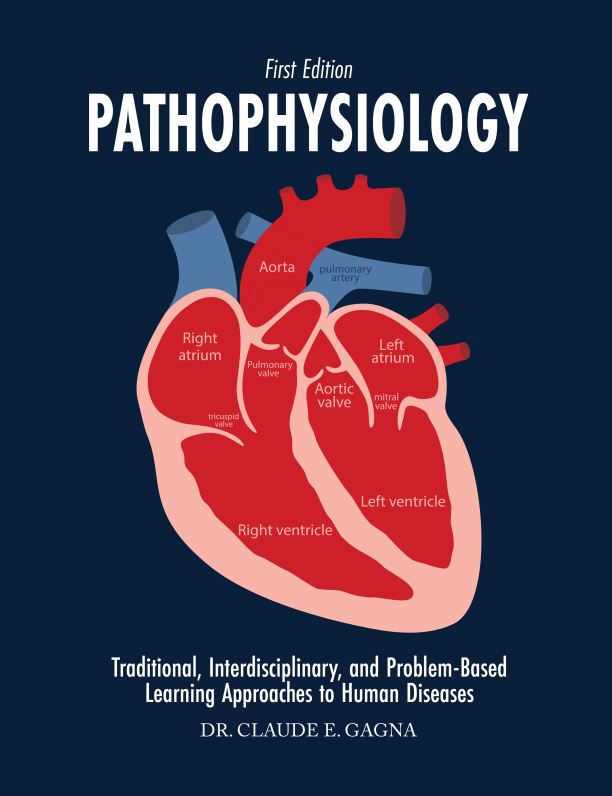
Pathophysiology Lab Manual
Edition: 1
Copyright: 2025
Pages: 56
Choose Your Format
$35.00 USD
Pathophysiology Lab Manual by Claude E. Gagna is a hands-on workbook designed to reinforce students' understanding of disease processes through interactive laboratory activities and clinical applications. The manual guides students in exploring the physiological mechanisms underlying common disorders while integrating concepts from anatomy, physiology, microbiology, and pathology. Through experiments, data analysis, case-based exercises, and critical thinking activities, the workbook helps students connect foundational scientific principles to real-world healthcare scenarios and develop practical skills for careers in nursing and the allied health professions.
Drawings of Tissues
How to Label Tissue Drawings
Normal Tissues (Non-Pathological)
Pathology Tissues
Discussion of Pathologies
Pathology Report
Patient History
Critical Thinking Assignments
Defining Human Blood Testing
Additional Body Fluid Tests
Pathophysiology Critical Thinking Questions
Acknowledgments
Grade and Comments

Claude Gagna is a professor in the Department of Biological and Chemical Sciences. He is the course director of Anatomical Sciences (e.g., Histology, Anatomy, Physiology, Embryology, and Pathophysiology) and a senior educator in lecture and labs. Gagna is a Molecular Biologist, DNA Nanotechnologist, and Human Anatomist who holds patents, and has published conference proceedings/abstracts, book chapters, review articles, case studies, methodologies, and original research articles. His continuing goal is to add to the knowledgebase of DNA and RNA structure and function in normal and diseased tissues, and cell death (terminal differentiation: denucleation, i.e., lens and epidermis), while developing novel “omics” technologies (e.g., “Genomesorganizomics” and “Structural Spatial Transcriptomics“), and new nucleic acid-based nanotech devices (e.g., next generation DNA and RNA microarrays). The “Canonical, and Multistranded, Alternative and Transitional Helical (C-MATH) Nucleic Acid Microarrays” will enhance the characterization of gene function and help produce drugs/biologics that inhibit gene expression. Gagna characterizes intact, non-denatured canonical B-DNA, and unusual nucleic acids, such as alternative Z-DNA, and multistranded nucleic acids, e.g., triplex DNA, G4-quadruplex DNA and i-motif quadruplex DNA. He also engages high school and undergraduate students in related STEM-based research projects, such as DNA bioinformatics and micro-CT scanning to characterize the eye globes of different species.
As a senior Biologist, Professor Gagna involves undergraduate, graduate and medical students, and postdoctoral fellows and residents in research projects, scientific meetings, and publications. He has produced tailor-made laboratory manuals for Histology, Human Gross Anatomy, Comparative Anatomy, Pathophysiology, Human Physiology, Developmental Biology, and Biomedical Research I, II, and III courses. Additionally, he is working in partnership with other faculty at major universities, medical schools, and research institutions. Gagna holds adjunct positions at the Rutgers-NJMS (formerly University of Medicine & Dentistry of NJ) in the Department of Pathology and Laboratory Medicine, and Department of Medicine (Dermatology). He also focuses on clinical disease-based research, i.e., cancer (e.g., melanoma), dermatophytes, cataracts, and xeroderma pigmentosum.
He received his B.S. in Biology from St. Peter’s University, his M.S. in Human Anatomy (minor: Genetic Engineering) from Fairleigh Dickinson University School of Dental Medicine, and his Ph.D. from New York University-Basic Medical Sciences (Department of Human Anatomy, and Department of Biochemistry). He was a postdoctoral fellow at NYU-Basic Medical Sciences and Rutgers-NJMS.
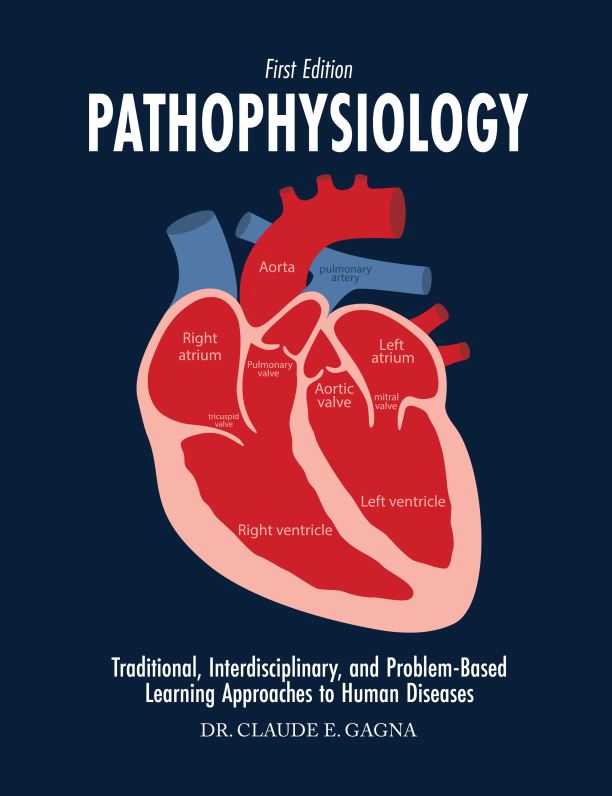
Pathophysiology Lab Manual by Claude E. Gagna is a hands-on workbook designed to reinforce students' understanding of disease processes through interactive laboratory activities and clinical applications. The manual guides students in exploring the physiological mechanisms underlying common disorders while integrating concepts from anatomy, physiology, microbiology, and pathology. Through experiments, data analysis, case-based exercises, and critical thinking activities, the workbook helps students connect foundational scientific principles to real-world healthcare scenarios and develop practical skills for careers in nursing and the allied health professions.
Drawings of Tissues
How to Label Tissue Drawings
Normal Tissues (Non-Pathological)
Pathology Tissues
Discussion of Pathologies
Pathology Report
Patient History
Critical Thinking Assignments
Defining Human Blood Testing
Additional Body Fluid Tests
Pathophysiology Critical Thinking Questions
Acknowledgments
Grade and Comments
Claude Gagna is a professor in the Department of Biological and Chemical Sciences. He is the course director of Anatomical Sciences (e.g., Histology, Anatomy, Physiology, Embryology, and Pathophysiology) and a senior educator in lecture and labs. Gagna is a Molecular Biologist, DNA Nanotechnologist, and Human Anatomist who holds patents, and has published conference proceedings/abstracts, book chapters, review articles, case studies, methodologies, and original research articles. His continuing goal is to add to the knowledgebase of DNA and RNA structure and function in normal and diseased tissues, and cell death (terminal differentiation: denucleation, i.e., lens and epidermis), while developing novel “omics” technologies (e.g., “Genomesorganizomics” and “Structural Spatial Transcriptomics“), and new nucleic acid-based nanotech devices (e.g., next generation DNA and RNA microarrays). The “Canonical, and Multistranded, Alternative and Transitional Helical (C-MATH) Nucleic Acid Microarrays” will enhance the characterization of gene function and help produce drugs/biologics that inhibit gene expression. Gagna characterizes intact, non-denatured canonical B-DNA, and unusual nucleic acids, such as alternative Z-DNA, and multistranded nucleic acids, e.g., triplex DNA, G4-quadruplex DNA and i-motif quadruplex DNA. He also engages high school and undergraduate students in related STEM-based research projects, such as DNA bioinformatics and micro-CT scanning to characterize the eye globes of different species.
As a senior Biologist, Professor Gagna involves undergraduate, graduate and medical students, and postdoctoral fellows and residents in research projects, scientific meetings, and publications. He has produced tailor-made laboratory manuals for Histology, Human Gross Anatomy, Comparative Anatomy, Pathophysiology, Human Physiology, Developmental Biology, and Biomedical Research I, II, and III courses. Additionally, he is working in partnership with other faculty at major universities, medical schools, and research institutions. Gagna holds adjunct positions at the Rutgers-NJMS (formerly University of Medicine & Dentistry of NJ) in the Department of Pathology and Laboratory Medicine, and Department of Medicine (Dermatology). He also focuses on clinical disease-based research, i.e., cancer (e.g., melanoma), dermatophytes, cataracts, and xeroderma pigmentosum.
He received his B.S. in Biology from St. Peter’s University, his M.S. in Human Anatomy (minor: Genetic Engineering) from Fairleigh Dickinson University School of Dental Medicine, and his Ph.D. from New York University-Basic Medical Sciences (Department of Human Anatomy, and Department of Biochemistry). He was a postdoctoral fellow at NYU-Basic Medical Sciences and Rutgers-NJMS.