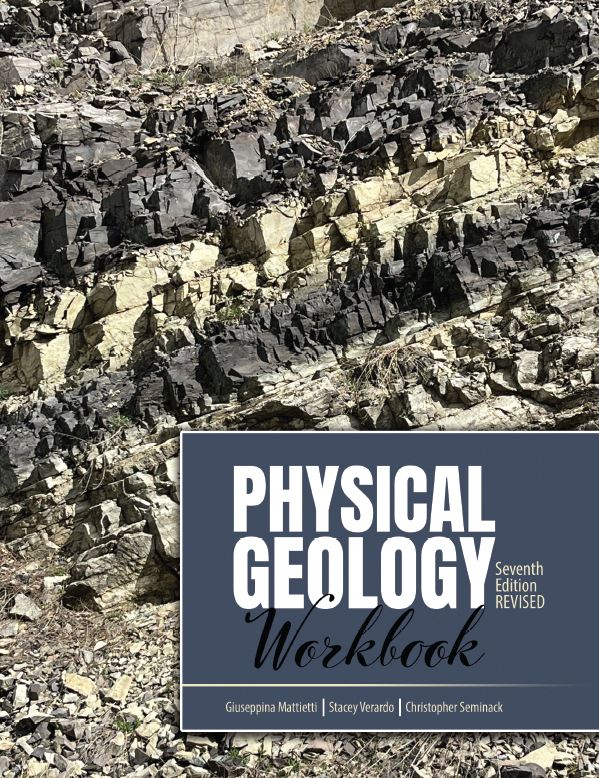
Physical Geology Workbook

Choose Your Format

Introductory Physical Geology Workbook provides hands-on activities that complement the physical geology lectures and guide the students from understanding science to applying their knowledge.

Introductory Physical Geology Workbook:

  • includes modified exercises to encourage students to explore relevant and up-to-date aspects of physical geology.
  • strengthens the connection between lecture and laboratory experience by designing pre-lab questions.
  • features more database-related exercises that the students need to be able to query databases, produce meaningful representations of the data and grasp the meaning and the implications of the information that retrieved this way.


Introduction 

SECTION 1: EARTH MATERIALS 
Chapter 1 Common Rock Forming Mineral Identification 
Chapter 2 Igneous Rock Identification 
Chapter 3 Sedimentary Rock Identification 
Chapter 4 Metamorphic Rocks 
Chapter 5 Review of Rocks 

SECTION 2: EARTH PROCESSES 
Chapter 6 Introduction to Topographic Maps 
Chapter 7 Volcanic Processes 
Chapter 8 Landscape Modification by Stream Erosion 
Chapter 9 Flooding 
Chapter 10 Coastline Morphology 
Chapter 11 Mass Wasting 
Chapter 12 Earthquake Analysis 
Chapter 13 Geologic Structures and Geologic Maps 
Chapter 14 Plate Dynamics and Isostasy

Giuseppina Kysar Mattietti

Giuseppina Mattietti, Ph.D. is an Instructional Associate Professor in the Department of Atmospheric, Oceanic, and Earth Sciences at George Mason University. She earned her Ph.D. from George Washington University in 2001. Dr. Mattietti specializes in undergraduate instruction in the Earth sciences, supporting student learning in geology, atmospheric science, and related environmental disciplines. 

Stacey Verardo

Stacey Verardo, Ph.D. is a Professor and Undergraduate Advisor in the Department of Atmospheric, Oceanic, and Earth Sciences at George Mason University. She earned her Ph.D. from the City University of New York in 1995. Dr. Verardo teaches undergraduate courses in the Earth sciences and advises students throughout their academic programs. Her work emphasizes student success, scientific inquiry, and building a strong understanding of Earth, oceanic, and atmospheric systems.

Chris Seminack

Christopher Seminack, Ph.D. is an Associate Professor of Geology at the University of North Georgia. He earned his Ph.D. in Environmental Science and Policy from George Mason University, an M.S. in Geology from Temple University, and a B.A. in Geology from La Salle University. Dr. Seminack teaches courses in physical geology, historical geology, geomorphology, and sedimentology and stratigraphy. His research focuses on coastal geology, geomorphology, sedimentology, and stratigraphy, with particular emphasis on the geologic evolution of barrier islands along the U.S. Atlantic coast. Using techniques such as remote sensing, geophysical surveying, sediment coring, geochronology, and historical map analysis, he investigates storm impacts, tidal inlet dynamics, sea-level change, climate change, and the reconstruction of ancient coastal environments.

Introductory Physical Geology Workbook provides hands-on activities that complement the physical geology lectures and guide the students from understanding science to applying their knowledge.

Introductory Physical Geology Workbook:

  • includes modified exercises to encourage students to explore relevant and up-to-date aspects of physical geology.
  • strengthens the connection between lecture and laboratory experience by designing pre-lab questions.
  • features more database-related exercises that the students need to be able to query databases, produce meaningful representations of the data and grasp the meaning and the implications of the information that retrieved this way.


Introduction 

SECTION 1: EARTH MATERIALS 
Chapter 1 Common Rock Forming Mineral Identification 
Chapter 2 Igneous Rock Identification 
Chapter 3 Sedimentary Rock Identification 
Chapter 4 Metamorphic Rocks 
Chapter 5 Review of Rocks 

SECTION 2: EARTH PROCESSES 
Chapter 6 Introduction to Topographic Maps 
Chapter 7 Volcanic Processes 
Chapter 8 Landscape Modification by Stream Erosion 
Chapter 9 Flooding 
Chapter 10 Coastline Morphology 
Chapter 11 Mass Wasting 
Chapter 12 Earthquake Analysis 
Chapter 13 Geologic Structures and Geologic Maps 
Chapter 14 Plate Dynamics and Isostasy

Giuseppina Kysar Mattietti

Giuseppina Mattietti, Ph.D. is an Instructional Associate Professor in the Department of Atmospheric, Oceanic, and Earth Sciences at George Mason University. She earned her Ph.D. from George Washington University in 2001. Dr. Mattietti specializes in undergraduate instruction in the Earth sciences, supporting student learning in geology, atmospheric science, and related environmental disciplines. 

Stacey Verardo

Stacey Verardo, Ph.D. is a Professor and Undergraduate Advisor in the Department of Atmospheric, Oceanic, and Earth Sciences at George Mason University. She earned her Ph.D. from the City University of New York in 1995. Dr. Verardo teaches undergraduate courses in the Earth sciences and advises students throughout their academic programs. Her work emphasizes student success, scientific inquiry, and building a strong understanding of Earth, oceanic, and atmospheric systems.

Chris Seminack

Christopher Seminack, Ph.D. is an Associate Professor of Geology at the University of North Georgia. He earned his Ph.D. in Environmental Science and Policy from George Mason University, an M.S. in Geology from Temple University, and a B.A. in Geology from La Salle University. Dr. Seminack teaches courses in physical geology, historical geology, geomorphology, and sedimentology and stratigraphy. His research focuses on coastal geology, geomorphology, sedimentology, and stratigraphy, with particular emphasis on the geologic evolution of barrier islands along the U.S. Atlantic coast. Using techniques such as remote sensing, geophysical surveying, sediment coring, geochronology, and historical map analysis, he investigates storm impacts, tidal inlet dynamics, sea-level change, climate change, and the reconstruction of ancient coastal environments.