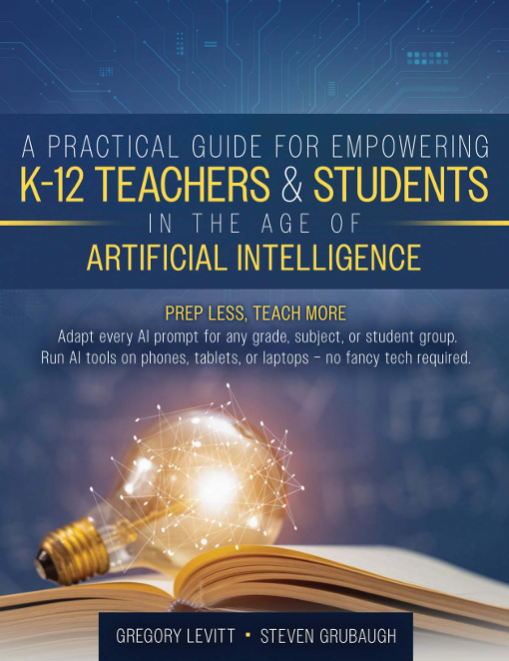
A Practical Guide for Empowering K-12 Teachers & Students in the Age of Artificial Intelligence

Edition: 1

Copyright: 2025

Pages: 445

Choose Your Format

Choose Your Platform | Help Me Choose

Ebook

$55.00 USD

ISBN 9798385186150

Details Electronic Delivery EBOOK 180 days

Part 1 Grounded and Ready—Teaching with Heart in the Age of AI
Introduction A New Era of Teaching: Centering Humanity in an AI-Powered World
A Call to Lead: Why Teachers Belong at the Center of the AI Conversation 
From Uncertain to Unstoppable: What You’ll Gain From This Book
Built for You: How to Use This Book When You’re Busy, Curious, or Just Ready to Start 
Teach With Purpose: Staying Grounded in a Time of Change 
AI Power Tools for Teachers 

Chapter 1 Welcome to the Future: AI Tools That Work for You, Not Against You
Tale of Two Teachers 
Why This Matters 
AI Demystified: What It Is and Why It Matters for Your Classroom
A Plain-Language Definition of Artificial Intelligence 
What AI Can Do Well 
What AI Cannot Do 
Types of AI Relevant to Education
Setting the Tone for Human–AI Collaboration in Education 
Busting the Top 5 AI Myths Holding Teachers Back 
Debunking the Most Common Teacher Misconceptions About AI
Clarifying That Using AI Is Not “Cheating” 
Addressing Fears Around Job Security and Professional Autonomy 
Reinforcing That AI Requires Human Guidance to Be Effective 
Encouraging a Shift From Fear to Curiosity and Experimentation 
What’s Possible With AI? A Look at Time-Saving, Student-Boosting Use Cases  
Tasks Best Suited for AI Versus Tasks Requiring Human Expertise 
Speed, Efficiency, Personalization, and Automation—AI’s Strengths
Empathy, Ethics, Inspiration, and Problem-Solving—The Human Touch 
Illustrating the Divide Through Real Classroom Scenarios 
Encouraging Teachers to Focus on the Human Touch 
Warning Signs: What AI Can’t Do and Why That’s a Good Thing 
Using the Co-Pilot Metaphor to Frame AI’s Role 
Teachers as the Drivers of Instructional Decision-Making 
Examples of Co-Creation and Teacher-Guided Use of AI  
Reframing AI as Empowerment, Not Displacement
Real-World Analogies That Build Comfort and Clarity 
You’re Still the Boss: How to Stay in Charge With AI at Your Side
From Calculator Controversies to Common Tools 
Google, Wikipedia, and the Shift Toward Guided Information Literacy  
AI as a Natural Evolution of EdTech 
Success Stories From Early AI-Adopting Teachers 
Experimentation Over Perfection 
Summary: Rewriting the Script: How Teachers Can Lead the AI Transformation  
AI Power Tools for Teachers 

Chapter 2 Building Confidence: AI Basics Every Teacher and Student Should Know 
A Tale of Two Teachers 
Why This Matters 
AI by Grade Band: Teaching What’s Age-Appropriate and Future-Ready 
Defining AI Literacy in Simple Terms by Grade Band 
Age-Appropriate AI Knowledge and Skills 
Sample Classroom Activities by Grade Band 
Starting Early Matters 
Connecting AI Literacy With Core Subjects and Digital Citizenship 
Connecting AI to What You Already Believe About Teaching 
AI as a Complement to Student-Centered Philosophies 
AI in Project-Based Learning and UDL
Honoring Pedagogical Beliefs—Not Replacing Them 
Addressing Concerns From Across the Philosophical Spectrum 
First Steps: Hands-On AI Activities to Try This Week 
Beginner-Friendly AI Activities for Elementary Students 
Engaging Middle School Learners With Guided AI Use 
Hands-On Activities for High School Classrooms 
Encouraging Co-Learning and Exploration 
Teaching Digital Citizenship and Ethical Tech Use Through AI 
Redefining Digital Citizenship in the Age of AI  
Establishing Ethical and Respectful AI Use Norms 
Teaching Students to Spot and Avoid AI Misuse 
Sample Ethical Dilemmas and Reflection Prompts 
Connecting to SEL and Character Education 
Helping Students Stay Well in an AI-Driven World 
AI Tools for Monitoring Engagement, Stress, and Workload 
The Role of Human Oversight in AI-Enhanced Wellness Tools 
Tools That Support Emotional Reflection and Goal-Setting 
AI as a Piece of a Larger Wellness and SEL Strategy
Limitations, Privacy, and Ethical Considerations 
Supporting Your Own Mental Health While Innovating 
Reducing Teacher Stress With AI-Driven Automation 
Examples of Time-Saving Applications 
Creating Space for Creativity, Relationships, and Self-Care 
Framing AI as a Wellness Ally, Not a Tech Burden 
Reflection Prompts and AI-Supported Wellness Planning 
Making It Real: Exploring AI in Pop Culture and Everyday Life 
Pop Culture and the Mythology of AI 
Real-World AI: Far Less Sci-Fi, Still Worth Understanding  
Bringing Pop Culture Into the Classroom: Questions and Activities
Building Engagement and Relevance Through Culture 
Separating Fact From Fiction: A Critical Thinking Imperative 
Summary: Starting Small, Thinking Big—AI Literacy That Sticks 
AI Power Tools for Teachers

Chapter 3 Smarter Choices: Picking the Right AI Tools for Real Classrooms 
A Tale of Two Teachers  
Why This Matters 
Teacher-Tested Criteria for Evaluating AI Tools 
Key Classroom Needs to Consider 
Integration with Existing Classroom Systems 
Trial First, Then Trust: The Importance of Sandboxing
Don’t Get Burned: What to Know About Privacy, Data, and FERPA 
Defining Key Terms: Data, Privacy, and Third-Party Access 
FERPA, COPPA, and What They Mean for Educators 
How to Spot Privacy Red Flags—Fast 
Responsible versus Risky: Real-World Examples 
Checklist for Ethical AI Tool Evaluation 
Free versus Paid Tools: What You Get—And What You Don’t 
Understanding the Differences: What Free Versions Typically Offer 
What’s Often Missing in Free Versions 
Evaluating the Cost-Benefit of a Paid Upgrade  
When Free Is Enough and Worth Celebrating 
Exploring Grants, Licenses, and Shared Access 
Inside the Toolbox: Favorite Platforms From Real Educators  
Case Study 1: Ms. Lawrence, 5th Grade Reading—Personalizing Comprehension
Case Study 2: Mr. Chen, 8th Grade Science—Enhancing Student Feedback 
Case Study 3: Ms. Ruiz, 11th Grade English—Encouraging Enrichment  and Extension 
Start Here: Build Your Own Beginner AI Toolkit  
Organizing Your AI Toolkit by Function and Grade Level 
Start Small: One Tool, One Function, One Win 
AI Programs Mentioned in This Chapter 
Summary: Choosing Tools That Serve, Not Swerve, Your Teaching Values 
AI Power Tools for Teachers 

Part 2 Streamline, Strengthen, and Spark Joy with AI 
Chapter 4 Using Artificial Intelligence (AI) for Classroom Management to  Achieve Calm, Focused, and Thriving Students
A Tale of Two Teachers 
Why This Matters 
Creating a Culture of Respect, Engagement, and Belonging 
Using AI to Support Proactive Culture Building 
Strengthening Relationships Through Personalized Feedback 
Designing Inclusive, Responsive Classroom Environments 
Positioning the Teacher as Leader, Not the AI 
Using AI to Amplify Student Voice and Choice 
AI to the Rescue: Support for Managing the Day-to-Day 
Automating Behavior Logs and Reflection Support 
Generating Participation Summaries and Behavior Plans
Non Judgmental Language and the Importance of Framing 
Avoiding Over-Reliance and Preserving Human Judgment 
Teaching Conflict Resolution with Restorative Prompts 
Using AI to Generate Restorative Prompts and Questions 
Maintaining Human Leadership in Restorative Dialogs 
Opportunities for Role-Play, Journaling, and Peer Mediation
Culturally Responsive Communication Through Reflective Language 
Behavior Plans That Actually Work With AI’s Help 
Using AI to Create Individualized Behavior Support Plans and Reports  
Personalizing Self-Regulation Strategies With AI Support 
Co-Creating Behavior Routines With Students Using AI 
Adapting for Different Ages, Needs, and Frameworks 
Summary: Managing Your Classroom Without Losing Your Mind 
AI Power Tools for Teachers 

Chapter 5 Get Your Time Back: Automate the Busywork and Focus on What Matters
A Tale of Two Teachers  
Why This Matters? 
AI for Weekly Plans, To-Do Lists, and Staying Ahead 
Using AI to Support Long-Range Planning 
Generating Weekly and Daily Planning Structures 
Staying Organized with AI-Supported Calendars and Checklists 
Adapting AI Plans for Real-Life Classrooms 
Expanding Planning Capacity for Teams and New Teachers  
Rubrics, Newsletters, and Feedback—Simplified With AI 
Generating Rubrics That Align With Standards and Assignments
Creating Personalized Feedback Without Losing Time or Voice 
Using AI to Draft Newsletters and Family Updates 
Tone-Checking and Cultural Responsiveness in AI Outputs 
Maintaining a Human Touch in Automated Workflows 
Parent Emails That Practically Write Themselves 
Using AI to Draft Weekly Summaries and Reports 
Using Language Translation and Tone Adjustment Features 
Cultural Sensitivity and Inclusive Messaging 
Saving Time While Improving Clarity and Frequency 
Sample Templates and Reusable Scripts 
Turn Standards into Lessons in Minutes 
Generating Standards-Aligned Lesson Plans with AI 
Adapting Materials for Reading Levels and Learning Styles 
Customizing Content for Real Students, Real Contexts 
Refreshing Outdated Materials and Streamlining Revisions 
Reviewing AI Output for Accuracy, Bias, and Relevance 
Reclaim Your Creativity, Energy, and Relationships 
Freeing Time from Repetition and Routine 
Reinvesting Time into Relationships and Creative Teaching 
Building in Time for Teacher Reflection and Growth 
Rediscovering Joy Through Intentional Planning 
Reassessing Time and Priorities with AI’s Support
Summary: More Time for Teaching, Less Time on Tasks 
AI Power Tools for Teachers 

Chapter 6 Designing Great Lessons Without Starting from Scratch
A Tale of Two Teachers 
Why This Matters 
Build a Standards-Aligned Year Plan with AI’s Help 
Creating a Yearly Teaching Calendar with AI Support  
Mapping Units Around School Events, Testing, and Flex Time 
Customizing AI-Generated Calendars for Individual Contexts 
Adjusting the Calendar Mid-Year with AI 
AI as a Drafting Partner, Not a Final Decision-Maker  
Create Flexible and Fun Curriculum Worksheets in Minutes 
Defining CRWs as Instructional Blueprints 
Populating CRWs with Diverse and Inclusive Resources 
Aligning CRWs to Standards and Interdisciplinary Goals 
Keeping CRWs Flexible and Adaptable With AI 
What a Thoughtful AI-Generated CRW Looks Like 
Revamp Old Lessons or Design New Ones from Scratch 
Generating Components of Lesson and Unit Plans 
Differentiating, Scaffolding, and Enriching with AI Support 
Maintaining Instructional Coherence Through Teacher Review 
Adapting Lessons Across Grade Levels and Content Areas 
Blending AI with Student-Centered, Teacher-Led Planning 
Make It Matter: Tie Lessons to the Real World 
Generating Timely Examples and Connections 
Making Pop Culture and Trends Part of the Learning Experience  
Fact-Checking and Critical Evaluation of AI-Generated Materials 
Updating Legacy Curriculum to Stay Fresh and Responsive 
Leveraging AI Responsibly to Keep Curriculum Dynamic 
Summary: You + AI = Lessons That Land 
AI Power Tools for Teachers 

Chapter 7 Classic Teaching Strategies Reimagined with AI: Level Up Your Teaching  Toolbox 
A Tale of Two Teachers 
Chapter 7 Introduction: Why This Matters 
Ten Timeless Strategies—Now Supercharged by AI 
Make Cross-Curricular Magic with Art, Music, and More 
Bringing Together Core Content and Creative Disciplines 
Designing Projects That Engage Different Strengths 
Embedding Movement, Voice, and Expression into Core Lessons 
Customizing Cross-Curricular Learning with AI Prompts 
Classroom-Tested Examples from Teachers Using AI 
Unleashing New Possibilities with Unique AI Approaches 
Simulated Interviews with Historical and Fictional Figures 
Decision Trees and Critical Choice Pathways 
Role-Play and Role Ownership in Simulated Environments 
Ethical Dilemmas and Perspective-Taking 
Future Forecasting and Speculative Thinking 
Best Practices for Accuracy, Bias, and Reflection 
 Let Students Help: Co-Create Learning Experiences Together
Inviting Students to Prompt AI as Co-Designers 
Examples of Co-Creation in Action 
Building AI Literacy Through Critical Use and Reflection  
Protocols for Safe and Responsible AI Use in the Classroom 
Balancing Innovation with Human Connection 
Summary: From Good to Great—Teaching That Transforms 
AI Power Tools for Teachers 

Part 3 Personalization, Equity, and Student-Centered Success 
Chapter 8 Teaching Future-Ready and Practical Life Skills with AI 
A Tale of Two Teachers 
Introduction to the Chapter 
Future-Ready Skills You Can Teach Today 
Linking Future-Ready Skills to AI Tool Use 
Embedding Prompts Across Content Areas 
The Urgency of Teaching These Skills Now 
Visual Chart: Connecting Skills to AI Use in Classrooms 
Practical-Life Skills Every Student Deserves 
Defining Practical Life Skills 
How AI Supports Practical Life Skills 
Classroom Examples and Simulation Activities 
Student Checklists and Reflection Tools 
Connecting Practical Skills to Personal, Academic, and Career Success 
Turning Problems into Projects: Teaching with Purpose 
Using Project-Based Learning and Inquiry to Apply Skills 
Sample Topics: Climate Change, Community Challenges, Wellness, AI Ethics
How AI Supports Research, Brainstorming, and Presenting 
Encouraging Student Agency and Civic Responsibility 
Highlighting Cross-Curricular Connections and Service Learning 
Cross-Disciplinary, Standards-Aligned High-Impact Lessons Powered by AI 
Using AI to Design Interdisciplinary Units that Meet Multiple Standards 
Lesson Examples: History and Financial Literacy, Science, and Ethics
Using AI to Organize, Differentiate, and Scaffold for All Learners
Reinforcing Teacher Creative Control
Offering a Lesson Planning Template That Integrates AI Tools,  Standards, and Skills 
Build Leaders: Collaboration and Creativity Tools 
Supporting Student-Driven Inquiry Through Genius Hour and Passion Projects  
Prompts and Checklists for Brainstorming, Planning, and Self-Assessment 
Emphasizing Creativity, Iteration, and Presentation 
Managing Time and Grouping with AI Support 
Summary: Making School Relevant in an AI World  
AI Power Tools for Teachers 

Chapter 9 Reach Every Learner: Differentiation and Personalized Support with AI 
A Tale of Two Teachers 
Introduction to the Chapter 
Modify Reading Levels and Language in Seconds 
How AI Tools Modify Texts for Diverse Learners 
Example Prompts for Rewording and Translation 
Supporting ELLs, Newcomers, and Struggling Readers 
Reviewing AI Output for Accuracy, Tone, and Cultural Relevance 
Promoting Access Without Lowering Expectations 
Scaffolds and Supports That Actually Stick 
Using AI to Generate Customized Scaffolds 
Prompts for Tiered Questions and Step-by-Step Instructions 
Supporting IEPs, 504 Plans, and MTSS Interventions 
Matching Scaffolds to Real Student Needs 
AI as a Tool for Inclusion, Not Tracking 
Match Content to Student Interests and Strengths 
Designing Interest-Based Lessons and Projects with AI 
Supporting Learning Profiles with AI-Generated Materials 
The Motivational Power of Passion and Identity 
Balancing Personalization with Exposure to New Ideas 
Inclusive Classrooms Begin with Thoughtful Design 
Defining Adaptive Technology and Its Role in UDL 
Tools That Provide Text-to-Speech, Voice Typing, Personalized Pacing, and Visual Supports 
Classroom Practices That Support Differentiated Engagement with the Same Task 
Equity and Access for Students With Disabilities and Neurodiverse Learners
The Teacher’s Role in Building a Culture of Respect, Flexibility, and Growth 
Summary: AI Tools That Fit Every Student, Every Day 
AI Power Tools for Teachers

Chapter 10 Impartiality in Action: Using AI to Build Fair and Inclusive Classrooms
A Tale of Two Teachers 
Introduction to the Chapter 
Accessible and Inclusive Learning, Powered by AI 
Creating Materials Accessible to Students with Disabilities 
Tools That Support Multimodal Access 
Prompts for Adapting Resources for Diverse Physical, Cognitive,  and Sensory Needs 
Reviewing AI Outputs for Clarity, Tone, and Dignity 
Accessibility as Proactive, Not Reactive, Teaching 
Meeting the Needs of Multilingual and Diverse Learners 
Supporting Translation, Vocabulary Building, and Scaffolding for Multilingual Learners 
Encouraging Cross-Team Collaboration Using Shared AI Tools 
Integrating AI Within RTI, MTSS, and UDL to Reduce Marginalization 
Emphasizing Inclusive Planning Over Individual Fixes 
Addressing Bias and Fostering Belonging 
The Risk of Bias in AI-Generated Outputs 
Strategies and Prompts to Detect and Mitigate Bias 
Using AI to Explore Diverse Viewpoints and Elevate Underrepresented Voices
Creating Critical Conversations About Data, Power, and Storytelling 
Culturally Responsive Teaching as a Human Responsibility 
Teaching Through a Justice Lens 
Using the “Learning for Justice” Social Justice Standards in Lesson Design
Using AI to Develop Lessons Around Identity, Diversity, Justice, and Action
Prompts for Equity and Justice-Aligned Activities 
Examples of Standards-Aligned Projects 
Why Students Benefit From AI-Supported Learning Around Fairness and Activism 
Bridging the Digital Divide with Smarter Tools  
Defining the Digital Divide in the Age of AI 
Strategies for Equitable AI Integration in Low-Resourced Classrooms 
The Role of School and District Leadership in Access and Equity 
Addressing the Risk of “AI for Some” 
The Moral and Civic Imperative of Equitable AI Access 
Summary: Equity Isn’t Extra—It’s Essential 
AI Power Tools for Teachers

Part 4 Leading with Vision, Heart, and Innovation
Chapter 11 Curiosity Unleashed: Let Students Explore, Question, and Create With AI 
A Tale of Two Teachers 
Introduction to the Chapter 
Launch Inquiry Projects That Start With Wonder 
Using AI to Generate Compelling Inquiry Questions and Unit Structures 
Prompts to Support Each Stage of the Inquiry Cycle 
Co-Constructing Questions with Students Using AI Brainstorming Tools 
Applying Inquiry Across Disciplines 
AI as a Support Tool, Not the Driver 
Equip Students to Ask Big, Brave Questions 
Using AI to Model and Scaffold Questioning Techniques 
Prompts for Socratic Seminars, Mock Trials, and Academic Controversies
Exploring Multiple Perspectives Through AI 
Emphasizing Dialog, Evidence, and Empathy 
Fostering Student Ownership and Real-World Relevance 
From Ideas to Innovations: Student-Led Projects 
Using AI to Brainstorm, Plan, and Manage Passion Projects 
Examples of AI-Supported Student Creations 
Scaffolding Projects with AI-Generated Outlines and Reflection Tools 
Encouraging Creative Risk-Taking, Peer Feedback, and Public Sharing 
The Teacher as Guide, Coach, and Ethical Sounding Board 
Use AI to Spark Creative Media and Digital Production 
Generative AI as a Tool for Student Creative Expression 
Ethical and Innovative Media Projects With AI 
Emphasizing Remix Culture, Originality, and Ethical Use 
Encouraging Responsible Experimentation and Student Reflection 
Reinforcing Digital Literacy and Authorship in the AI Age 
Summary: Letting Students Lead the Way 
AI Power Tools for Teachers 

Chapter 12 Overcome the Hurdles: Growing Professionally with AI at Your Side 
A Tale of Two Teachers 
Introduction to the Chapter 
Build a PD Plan That Works for You (Not Against You) 
Designing Professional Development That Starts With the Teacher 
Using Reflection Prompts to Identify Professional Growth Needs 
Letting AI Recommend Resources and Organize Learning Logs 
Encouraging Self-Paced and Interest-Driven PD 
Aligning AI PD with School Goals and Evaluation Systems 
Conquering Common Roadblocks to AI Use 
Identifying the Most Common AI Adoption Barriers 
Simple, Realistic First Steps 
Case Studies and Testimonials from Early Adopters 
Templates That Offset Learning Curves and Save Time 
You Don’t Need to Master AI—You Just Need to Begin  
Reflective Practice That Stays Relevant 
Using AI to Prompt Teacher Self-Reflection 
Journaling, Lesson Reviews, and Pattern Recognition 
Analyzing Student Work Trends with AI Support 
Protocols That Blend Human and AI Insight 
Accelerating the Feedback Loop Without Losing Depth 
Find Your People: Create AI Learning Communities 
Forming AI Learning Teams, PLCs, and Innovation Hubs 
Peer-to-Peer Collaboration: Co-Planning, Testing, Sharing 
Tapping into Online AI Educator Networks 
Creating Safe Spaces to Ask, Experiment, and Reflect 
Community as the Foundation for Scalable Innovation 
Summary: Professional Growth That Honors Your Values 
AI Power Tools for Teachers

Chapter 13 Schoolwide Shifts: Leading the AI Conversation in Your Building 
A Tale of Two Teachers 
Introduction to the Chapter 
Why a Shared Vision Matters More Than Ever 
Build a Clear and Shared Vision for AI in Your School 
Crafting a Schoolwide AI Mission and Guiding Principles 
Sample Vision Statements That Align With School Values 
Aligning Vision with District Policies, Curriculum, and Technology Plans 
Vision Before Tools: Leading With Purpose 
Support Skeptical Colleagues Without Pushing 
Understanding the Roots of Hesitation 
Peer Coaching, Team Teaching, and Shared Planning 
Reflecting on What Support Really Looks Like 
Pacing Matters: Change Is a Process, Not a Sprint 
Summary: Lead the Way—Building a Vision for AI Integration That Starts With People  
AI Power Tools for Teachers 

Chapter 14 Stronger Together: Partnering with Parents and Communities  
A Tale of Two Teachers 
Chapter Introduction: Inviting the Whole Community into the  Learning Process 
Connect Students to Purpose Through Service Learning Defining Service Learning as Student-Led, Purpose-Driven Learning 
Using AI to Support Research, Planning, and Action 
Real-World Examples of Student-Led Projects 
Centering Reflection, Collaboration, and Student Voice 
AI Enhances Work—But Students Lead the Way 
Keep Families Informed and Inspired About AI 
Building Trust Through Transparent Communication 
Sharing Practical Tools for Family Communication 
Prioritizing Safety, Creativity, and Well-Being 
Using AI to Support Multilingual Communication 
Centering the Family Partnership in AI-Supported Education 
Teach Digital Responsibility Beyond the School Walls 
Defining Digital Responsibility in an AI-Connected World 
Supporting Student Reflection Through AI-Assisted Prompts and Activities 
Designing Joint Classroom–Family Activities for Shared Norms 
Modeling Responsible Use as Adults 
Digital Citizenship as a Shared Responsibility 
Unlock the Power of Local Expertise and Community Wisdom 
Building Real-World Connections into the Curriculum Using AI to Identify and Connect with Local Experts 
Coordinating Interviews, Guest Speakers, and Showcases 
Learning With and From Authentic Audiences 
Preparing Students for Civic Life and Lifelong Engagement 
Summary: Connecting Classrooms with Families, Communities, and Purpose 
AI Power Tools for Teachers 

Steven Grubaugh
Gregory Alan Levitt

Part 1 Grounded and Ready—Teaching with Heart in the Age of AI
Introduction A New Era of Teaching: Centering Humanity in an AI-Powered World
A Call to Lead: Why Teachers Belong at the Center of the AI Conversation 
From Uncertain to Unstoppable: What You’ll Gain From This Book
Built for You: How to Use This Book When You’re Busy, Curious, or Just Ready to Start 
Teach With Purpose: Staying Grounded in a Time of Change 
AI Power Tools for Teachers 

Chapter 1 Welcome to the Future: AI Tools That Work for You, Not Against You
Tale of Two Teachers 
Why This Matters 
AI Demystified: What It Is and Why It Matters for Your Classroom
A Plain-Language Definition of Artificial Intelligence 
What AI Can Do Well 
What AI Cannot Do 
Types of AI Relevant to Education
Setting the Tone for Human–AI Collaboration in Education 
Busting the Top 5 AI Myths Holding Teachers Back 
Debunking the Most Common Teacher Misconceptions About AI
Clarifying That Using AI Is Not “Cheating” 
Addressing Fears Around Job Security and Professional Autonomy 
Reinforcing That AI Requires Human Guidance to Be Effective 
Encouraging a Shift From Fear to Curiosity and Experimentation 
What’s Possible With AI? A Look at Time-Saving, Student-Boosting Use Cases  
Tasks Best Suited for AI Versus Tasks Requiring Human Expertise 
Speed, Efficiency, Personalization, and Automation—AI’s Strengths
Empathy, Ethics, Inspiration, and Problem-Solving—The Human Touch 
Illustrating the Divide Through Real Classroom Scenarios 
Encouraging Teachers to Focus on the Human Touch 
Warning Signs: What AI Can’t Do and Why That’s a Good Thing 
Using the Co-Pilot Metaphor to Frame AI’s Role 
Teachers as the Drivers of Instructional Decision-Making 
Examples of Co-Creation and Teacher-Guided Use of AI  
Reframing AI as Empowerment, Not Displacement
Real-World Analogies That Build Comfort and Clarity 
You’re Still the Boss: How to Stay in Charge With AI at Your Side
From Calculator Controversies to Common Tools 
Google, Wikipedia, and the Shift Toward Guided Information Literacy  
AI as a Natural Evolution of EdTech 
Success Stories From Early AI-Adopting Teachers 
Experimentation Over Perfection 
Summary: Rewriting the Script: How Teachers Can Lead the AI Transformation  
AI Power Tools for Teachers 

Chapter 2 Building Confidence: AI Basics Every Teacher and Student Should Know 
A Tale of Two Teachers 
Why This Matters 
AI by Grade Band: Teaching What’s Age-Appropriate and Future-Ready 
Defining AI Literacy in Simple Terms by Grade Band 
Age-Appropriate AI Knowledge and Skills 
Sample Classroom Activities by Grade Band 
Starting Early Matters 
Connecting AI Literacy With Core Subjects and Digital Citizenship 
Connecting AI to What You Already Believe About Teaching 
AI as a Complement to Student-Centered Philosophies 
AI in Project-Based Learning and UDL
Honoring Pedagogical Beliefs—Not Replacing Them 
Addressing Concerns From Across the Philosophical Spectrum 
First Steps: Hands-On AI Activities to Try This Week 
Beginner-Friendly AI Activities for Elementary Students 
Engaging Middle School Learners With Guided AI Use 
Hands-On Activities for High School Classrooms 
Encouraging Co-Learning and Exploration 
Teaching Digital Citizenship and Ethical Tech Use Through AI 
Redefining Digital Citizenship in the Age of AI  
Establishing Ethical and Respectful AI Use Norms 
Teaching Students to Spot and Avoid AI Misuse 
Sample Ethical Dilemmas and Reflection Prompts 
Connecting to SEL and Character Education 
Helping Students Stay Well in an AI-Driven World 
AI Tools for Monitoring Engagement, Stress, and Workload 
The Role of Human Oversight in AI-Enhanced Wellness Tools 
Tools That Support Emotional Reflection and Goal-Setting 
AI as a Piece of a Larger Wellness and SEL Strategy
Limitations, Privacy, and Ethical Considerations 
Supporting Your Own Mental Health While Innovating 
Reducing Teacher Stress With AI-Driven Automation 
Examples of Time-Saving Applications 
Creating Space for Creativity, Relationships, and Self-Care 
Framing AI as a Wellness Ally, Not a Tech Burden 
Reflection Prompts and AI-Supported Wellness Planning 
Making It Real: Exploring AI in Pop Culture and Everyday Life 
Pop Culture and the Mythology of AI 
Real-World AI: Far Less Sci-Fi, Still Worth Understanding  
Bringing Pop Culture Into the Classroom: Questions and Activities
Building Engagement and Relevance Through Culture 
Separating Fact From Fiction: A Critical Thinking Imperative 
Summary: Starting Small, Thinking Big—AI Literacy That Sticks 
AI Power Tools for Teachers

Chapter 3 Smarter Choices: Picking the Right AI Tools for Real Classrooms 
A Tale of Two Teachers  
Why This Matters 
Teacher-Tested Criteria for Evaluating AI Tools 
Key Classroom Needs to Consider 
Integration with Existing Classroom Systems 
Trial First, Then Trust: The Importance of Sandboxing
Don’t Get Burned: What to Know About Privacy, Data, and FERPA 
Defining Key Terms: Data, Privacy, and Third-Party Access 
FERPA, COPPA, and What They Mean for Educators 
How to Spot Privacy Red Flags—Fast 
Responsible versus Risky: Real-World Examples 
Checklist for Ethical AI Tool Evaluation 
Free versus Paid Tools: What You Get—And What You Don’t 
Understanding the Differences: What Free Versions Typically Offer 
What’s Often Missing in Free Versions 
Evaluating the Cost-Benefit of a Paid Upgrade  
When Free Is Enough and Worth Celebrating 
Exploring Grants, Licenses, and Shared Access 
Inside the Toolbox: Favorite Platforms From Real Educators  
Case Study 1: Ms. Lawrence, 5th Grade Reading—Personalizing Comprehension
Case Study 2: Mr. Chen, 8th Grade Science—Enhancing Student Feedback 
Case Study 3: Ms. Ruiz, 11th Grade English—Encouraging Enrichment  and Extension 
Start Here: Build Your Own Beginner AI Toolkit  
Organizing Your AI Toolkit by Function and Grade Level 
Start Small: One Tool, One Function, One Win 
AI Programs Mentioned in This Chapter 
Summary: Choosing Tools That Serve, Not Swerve, Your Teaching Values 
AI Power Tools for Teachers 

Part 2 Streamline, Strengthen, and Spark Joy with AI 
Chapter 4 Using Artificial Intelligence (AI) for Classroom Management to  Achieve Calm, Focused, and Thriving Students
A Tale of Two Teachers 
Why This Matters 
Creating a Culture of Respect, Engagement, and Belonging 
Using AI to Support Proactive Culture Building 
Strengthening Relationships Through Personalized Feedback 
Designing Inclusive, Responsive Classroom Environments 
Positioning the Teacher as Leader, Not the AI 
Using AI to Amplify Student Voice and Choice 
AI to the Rescue: Support for Managing the Day-to-Day 
Automating Behavior Logs and Reflection Support 
Generating Participation Summaries and Behavior Plans
Non Judgmental Language and the Importance of Framing 
Avoiding Over-Reliance and Preserving Human Judgment 
Teaching Conflict Resolution with Restorative Prompts 
Using AI to Generate Restorative Prompts and Questions 
Maintaining Human Leadership in Restorative Dialogs 
Opportunities for Role-Play, Journaling, and Peer Mediation
Culturally Responsive Communication Through Reflective Language 
Behavior Plans That Actually Work With AI’s Help 
Using AI to Create Individualized Behavior Support Plans and Reports  
Personalizing Self-Regulation Strategies With AI Support 
Co-Creating Behavior Routines With Students Using AI 
Adapting for Different Ages, Needs, and Frameworks 
Summary: Managing Your Classroom Without Losing Your Mind 
AI Power Tools for Teachers 

Chapter 5 Get Your Time Back: Automate the Busywork and Focus on What Matters
A Tale of Two Teachers  
Why This Matters? 
AI for Weekly Plans, To-Do Lists, and Staying Ahead 
Using AI to Support Long-Range Planning 
Generating Weekly and Daily Planning Structures 
Staying Organized with AI-Supported Calendars and Checklists 
Adapting AI Plans for Real-Life Classrooms 
Expanding Planning Capacity for Teams and New Teachers  
Rubrics, Newsletters, and Feedback—Simplified With AI 
Generating Rubrics That Align With Standards and Assignments
Creating Personalized Feedback Without Losing Time or Voice 
Using AI to Draft Newsletters and Family Updates 
Tone-Checking and Cultural Responsiveness in AI Outputs 
Maintaining a Human Touch in Automated Workflows 
Parent Emails That Practically Write Themselves 
Using AI to Draft Weekly Summaries and Reports 
Using Language Translation and Tone Adjustment Features 
Cultural Sensitivity and Inclusive Messaging 
Saving Time While Improving Clarity and Frequency 
Sample Templates and Reusable Scripts 
Turn Standards into Lessons in Minutes 
Generating Standards-Aligned Lesson Plans with AI 
Adapting Materials for Reading Levels and Learning Styles 
Customizing Content for Real Students, Real Contexts 
Refreshing Outdated Materials and Streamlining Revisions 
Reviewing AI Output for Accuracy, Bias, and Relevance 
Reclaim Your Creativity, Energy, and Relationships 
Freeing Time from Repetition and Routine 
Reinvesting Time into Relationships and Creative Teaching 
Building in Time for Teacher Reflection and Growth 
Rediscovering Joy Through Intentional Planning 
Reassessing Time and Priorities with AI’s Support
Summary: More Time for Teaching, Less Time on Tasks 
AI Power Tools for Teachers 

Chapter 6 Designing Great Lessons Without Starting from Scratch
A Tale of Two Teachers 
Why This Matters 
Build a Standards-Aligned Year Plan with AI’s Help 
Creating a Yearly Teaching Calendar with AI Support  
Mapping Units Around School Events, Testing, and Flex Time 
Customizing AI-Generated Calendars for Individual Contexts 
Adjusting the Calendar Mid-Year with AI 
AI as a Drafting Partner, Not a Final Decision-Maker  
Create Flexible and Fun Curriculum Worksheets in Minutes 
Defining CRWs as Instructional Blueprints 
Populating CRWs with Diverse and Inclusive Resources 
Aligning CRWs to Standards and Interdisciplinary Goals 
Keeping CRWs Flexible and Adaptable With AI 
What a Thoughtful AI-Generated CRW Looks Like 
Revamp Old Lessons or Design New Ones from Scratch 
Generating Components of Lesson and Unit Plans 
Differentiating, Scaffolding, and Enriching with AI Support 
Maintaining Instructional Coherence Through Teacher Review 
Adapting Lessons Across Grade Levels and Content Areas 
Blending AI with Student-Centered, Teacher-Led Planning 
Make It Matter: Tie Lessons to the Real World 
Generating Timely Examples and Connections 
Making Pop Culture and Trends Part of the Learning Experience  
Fact-Checking and Critical Evaluation of AI-Generated Materials 
Updating Legacy Curriculum to Stay Fresh and Responsive 
Leveraging AI Responsibly to Keep Curriculum Dynamic 
Summary: You + AI = Lessons That Land 
AI Power Tools for Teachers 

Chapter 7 Classic Teaching Strategies Reimagined with AI: Level Up Your Teaching  Toolbox 
A Tale of Two Teachers 
Chapter 7 Introduction: Why This Matters 
Ten Timeless Strategies—Now Supercharged by AI 
Make Cross-Curricular Magic with Art, Music, and More 
Bringing Together Core Content and Creative Disciplines 
Designing Projects That Engage Different Strengths 
Embedding Movement, Voice, and Expression into Core Lessons 
Customizing Cross-Curricular Learning with AI Prompts 
Classroom-Tested Examples from Teachers Using AI 
Unleashing New Possibilities with Unique AI Approaches 
Simulated Interviews with Historical and Fictional Figures 
Decision Trees and Critical Choice Pathways 
Role-Play and Role Ownership in Simulated Environments 
Ethical Dilemmas and Perspective-Taking 
Future Forecasting and Speculative Thinking 
Best Practices for Accuracy, Bias, and Reflection 
 Let Students Help: Co-Create Learning Experiences Together
Inviting Students to Prompt AI as Co-Designers 
Examples of Co-Creation in Action 
Building AI Literacy Through Critical Use and Reflection  
Protocols for Safe and Responsible AI Use in the Classroom 
Balancing Innovation with Human Connection 
Summary: From Good to Great—Teaching That Transforms 
AI Power Tools for Teachers 

Part 3 Personalization, Equity, and Student-Centered Success 
Chapter 8 Teaching Future-Ready and Practical Life Skills with AI 
A Tale of Two Teachers 
Introduction to the Chapter 
Future-Ready Skills You Can Teach Today 
Linking Future-Ready Skills to AI Tool Use 
Embedding Prompts Across Content Areas 
The Urgency of Teaching These Skills Now 
Visual Chart: Connecting Skills to AI Use in Classrooms 
Practical-Life Skills Every Student Deserves 
Defining Practical Life Skills 
How AI Supports Practical Life Skills 
Classroom Examples and Simulation Activities 
Student Checklists and Reflection Tools 
Connecting Practical Skills to Personal, Academic, and Career Success 
Turning Problems into Projects: Teaching with Purpose 
Using Project-Based Learning and Inquiry to Apply Skills 
Sample Topics: Climate Change, Community Challenges, Wellness, AI Ethics
How AI Supports Research, Brainstorming, and Presenting 
Encouraging Student Agency and Civic Responsibility 
Highlighting Cross-Curricular Connections and Service Learning 
Cross-Disciplinary, Standards-Aligned High-Impact Lessons Powered by AI 
Using AI to Design Interdisciplinary Units that Meet Multiple Standards 
Lesson Examples: History and Financial Literacy, Science, and Ethics
Using AI to Organize, Differentiate, and Scaffold for All Learners
Reinforcing Teacher Creative Control
Offering a Lesson Planning Template That Integrates AI Tools,  Standards, and Skills 
Build Leaders: Collaboration and Creativity Tools 
Supporting Student-Driven Inquiry Through Genius Hour and Passion Projects  
Prompts and Checklists for Brainstorming, Planning, and Self-Assessment 
Emphasizing Creativity, Iteration, and Presentation 
Managing Time and Grouping with AI Support 
Summary: Making School Relevant in an AI World  
AI Power Tools for Teachers 

Chapter 9 Reach Every Learner: Differentiation and Personalized Support with AI 
A Tale of Two Teachers 
Introduction to the Chapter 
Modify Reading Levels and Language in Seconds 
How AI Tools Modify Texts for Diverse Learners 
Example Prompts for Rewording and Translation 
Supporting ELLs, Newcomers, and Struggling Readers 
Reviewing AI Output for Accuracy, Tone, and Cultural Relevance 
Promoting Access Without Lowering Expectations 
Scaffolds and Supports That Actually Stick 
Using AI to Generate Customized Scaffolds 
Prompts for Tiered Questions and Step-by-Step Instructions 
Supporting IEPs, 504 Plans, and MTSS Interventions 
Matching Scaffolds to Real Student Needs 
AI as a Tool for Inclusion, Not Tracking 
Match Content to Student Interests and Strengths 
Designing Interest-Based Lessons and Projects with AI 
Supporting Learning Profiles with AI-Generated Materials 
The Motivational Power of Passion and Identity 
Balancing Personalization with Exposure to New Ideas 
Inclusive Classrooms Begin with Thoughtful Design 
Defining Adaptive Technology and Its Role in UDL 
Tools That Provide Text-to-Speech, Voice Typing, Personalized Pacing, and Visual Supports 
Classroom Practices That Support Differentiated Engagement with the Same Task 
Equity and Access for Students With Disabilities and Neurodiverse Learners
The Teacher’s Role in Building a Culture of Respect, Flexibility, and Growth 
Summary: AI Tools That Fit Every Student, Every Day 
AI Power Tools for Teachers

Chapter 10 Impartiality in Action: Using AI to Build Fair and Inclusive Classrooms
A Tale of Two Teachers 
Introduction to the Chapter 
Accessible and Inclusive Learning, Powered by AI 
Creating Materials Accessible to Students with Disabilities 
Tools That Support Multimodal Access 
Prompts for Adapting Resources for Diverse Physical, Cognitive,  and Sensory Needs 
Reviewing AI Outputs for Clarity, Tone, and Dignity 
Accessibility as Proactive, Not Reactive, Teaching 
Meeting the Needs of Multilingual and Diverse Learners 
Supporting Translation, Vocabulary Building, and Scaffolding for Multilingual Learners 
Encouraging Cross-Team Collaboration Using Shared AI Tools 
Integrating AI Within RTI, MTSS, and UDL to Reduce Marginalization 
Emphasizing Inclusive Planning Over Individual Fixes 
Addressing Bias and Fostering Belonging 
The Risk of Bias in AI-Generated Outputs 
Strategies and Prompts to Detect and Mitigate Bias 
Using AI to Explore Diverse Viewpoints and Elevate Underrepresented Voices
Creating Critical Conversations About Data, Power, and Storytelling 
Culturally Responsive Teaching as a Human Responsibility 
Teaching Through a Justice Lens 
Using the “Learning for Justice” Social Justice Standards in Lesson Design
Using AI to Develop Lessons Around Identity, Diversity, Justice, and Action
Prompts for Equity and Justice-Aligned Activities 
Examples of Standards-Aligned Projects 
Why Students Benefit From AI-Supported Learning Around Fairness and Activism 
Bridging the Digital Divide with Smarter Tools  
Defining the Digital Divide in the Age of AI 
Strategies for Equitable AI Integration in Low-Resourced Classrooms 
The Role of School and District Leadership in Access and Equity 
Addressing the Risk of “AI for Some” 
The Moral and Civic Imperative of Equitable AI Access 
Summary: Equity Isn’t Extra—It’s Essential 
AI Power Tools for Teachers

Part 4 Leading with Vision, Heart, and Innovation
Chapter 11 Curiosity Unleashed: Let Students Explore, Question, and Create With AI 
A Tale of Two Teachers 
Introduction to the Chapter 
Launch Inquiry Projects That Start With Wonder 
Using AI to Generate Compelling Inquiry Questions and Unit Structures 
Prompts to Support Each Stage of the Inquiry Cycle 
Co-Constructing Questions with Students Using AI Brainstorming Tools 
Applying Inquiry Across Disciplines 
AI as a Support Tool, Not the Driver 
Equip Students to Ask Big, Brave Questions 
Using AI to Model and Scaffold Questioning Techniques 
Prompts for Socratic Seminars, Mock Trials, and Academic Controversies
Exploring Multiple Perspectives Through AI 
Emphasizing Dialog, Evidence, and Empathy 
Fostering Student Ownership and Real-World Relevance 
From Ideas to Innovations: Student-Led Projects 
Using AI to Brainstorm, Plan, and Manage Passion Projects 
Examples of AI-Supported Student Creations 
Scaffolding Projects with AI-Generated Outlines and Reflection Tools 
Encouraging Creative Risk-Taking, Peer Feedback, and Public Sharing 
The Teacher as Guide, Coach, and Ethical Sounding Board 
Use AI to Spark Creative Media and Digital Production 
Generative AI as a Tool for Student Creative Expression 
Ethical and Innovative Media Projects With AI 
Emphasizing Remix Culture, Originality, and Ethical Use 
Encouraging Responsible Experimentation and Student Reflection 
Reinforcing Digital Literacy and Authorship in the AI Age 
Summary: Letting Students Lead the Way 
AI Power Tools for Teachers 

Chapter 12 Overcome the Hurdles: Growing Professionally with AI at Your Side 
A Tale of Two Teachers 
Introduction to the Chapter 
Build a PD Plan That Works for You (Not Against You) 
Designing Professional Development That Starts With the Teacher 
Using Reflection Prompts to Identify Professional Growth Needs 
Letting AI Recommend Resources and Organize Learning Logs 
Encouraging Self-Paced and Interest-Driven PD 
Aligning AI PD with School Goals and Evaluation Systems 
Conquering Common Roadblocks to AI Use 
Identifying the Most Common AI Adoption Barriers 
Simple, Realistic First Steps 
Case Studies and Testimonials from Early Adopters 
Templates That Offset Learning Curves and Save Time 
You Don’t Need to Master AI—You Just Need to Begin  
Reflective Practice That Stays Relevant 
Using AI to Prompt Teacher Self-Reflection 
Journaling, Lesson Reviews, and Pattern Recognition 
Analyzing Student Work Trends with AI Support 
Protocols That Blend Human and AI Insight 
Accelerating the Feedback Loop Without Losing Depth 
Find Your People: Create AI Learning Communities 
Forming AI Learning Teams, PLCs, and Innovation Hubs 
Peer-to-Peer Collaboration: Co-Planning, Testing, Sharing 
Tapping into Online AI Educator Networks 
Creating Safe Spaces to Ask, Experiment, and Reflect 
Community as the Foundation for Scalable Innovation 
Summary: Professional Growth That Honors Your Values 
AI Power Tools for Teachers

Chapter 13 Schoolwide Shifts: Leading the AI Conversation in Your Building 
A Tale of Two Teachers 
Introduction to the Chapter 
Why a Shared Vision Matters More Than Ever 
Build a Clear and Shared Vision for AI in Your School 
Crafting a Schoolwide AI Mission and Guiding Principles 
Sample Vision Statements That Align With School Values 
Aligning Vision with District Policies, Curriculum, and Technology Plans 
Vision Before Tools: Leading With Purpose 
Support Skeptical Colleagues Without Pushing 
Understanding the Roots of Hesitation 
Peer Coaching, Team Teaching, and Shared Planning 
Reflecting on What Support Really Looks Like 
Pacing Matters: Change Is a Process, Not a Sprint 
Summary: Lead the Way—Building a Vision for AI Integration That Starts With People  
AI Power Tools for Teachers 

Chapter 14 Stronger Together: Partnering with Parents and Communities  
A Tale of Two Teachers 
Chapter Introduction: Inviting the Whole Community into the  Learning Process 
Connect Students to Purpose Through Service Learning Defining Service Learning as Student-Led, Purpose-Driven Learning 
Using AI to Support Research, Planning, and Action 
Real-World Examples of Student-Led Projects 
Centering Reflection, Collaboration, and Student Voice 
AI Enhances Work—But Students Lead the Way 
Keep Families Informed and Inspired About AI 
Building Trust Through Transparent Communication 
Sharing Practical Tools for Family Communication 
Prioritizing Safety, Creativity, and Well-Being 
Using AI to Support Multilingual Communication 
Centering the Family Partnership in AI-Supported Education 
Teach Digital Responsibility Beyond the School Walls 
Defining Digital Responsibility in an AI-Connected World 
Supporting Student Reflection Through AI-Assisted Prompts and Activities 
Designing Joint Classroom–Family Activities for Shared Norms 
Modeling Responsible Use as Adults 
Digital Citizenship as a Shared Responsibility 
Unlock the Power of Local Expertise and Community Wisdom 
Building Real-World Connections into the Curriculum Using AI to Identify and Connect with Local Experts 
Coordinating Interviews, Guest Speakers, and Showcases 
Learning With and From Authentic Audiences 
Preparing Students for Civic Life and Lifelong Engagement 
Summary: Connecting Classrooms with Families, Communities, and Purpose 
AI Power Tools for Teachers 

Steven Grubaugh
Gregory Alan Levitt
