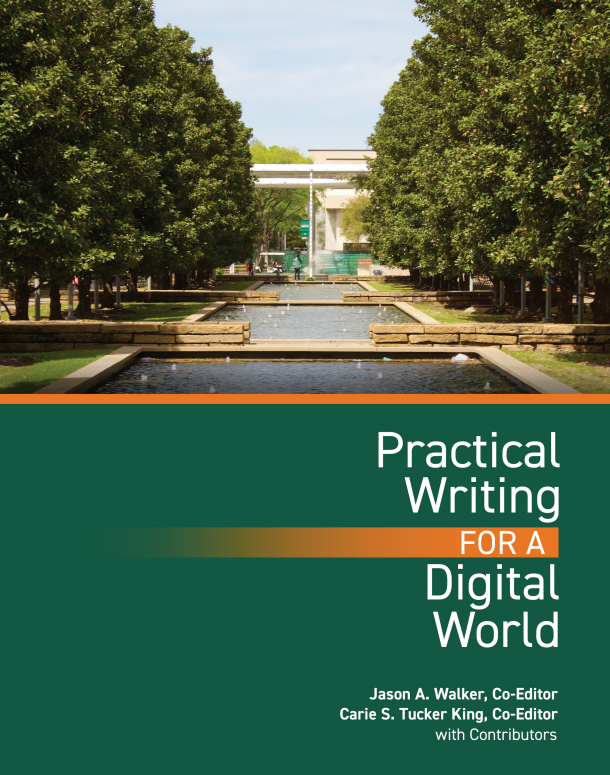
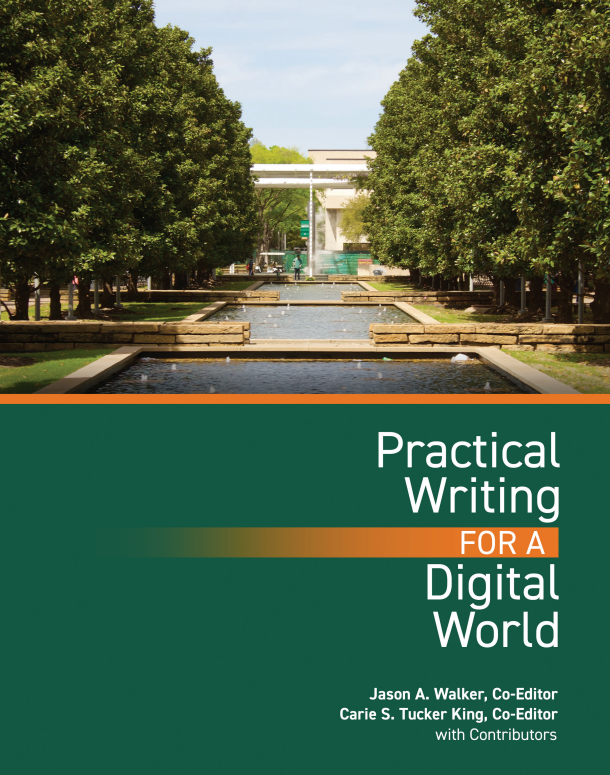
Practical Writing for a Digital World
Edition: 1
Copyright: 2026
Pages: 174
Choose Your Format
$39.99 USD
List of Figures and Tables
Co-editors
Contributing Authors
Acknowledgments
Preface
Chapter 1—Finding the Power, Purpose, and Responsibilities of Writing
Chapter 2—Identifying and Using Rhetorical Appeals
Chapter 3—Creating and Structuring an Effective Argument with Integrity
Chapter 4—Exploring to Find Relevant Evidence
Chapter 5—Analyzing Texts and Presenting Evidence
Chapter 6—Attributing Your Resources
Chapter 7—Thinking Critically about and Synthesizing Resources
Chapter 8—Improving Arguments with Stronger Writing
Chapter 9—Reflecting, Reviewing, Editing, Revising, and Proofreading
Chapter 10—Writing in College, Graduate School, and the Workplace
APPENDIXES
Appendix A—Logical Fallacies
Appendix B —Types of Visuals to Present Information (Adapted from Indeed Editorial Team)

Carie S. King is a Clinical Assistant Professor at The University of Texas at Dallas. She teaches students in engineering/computer science, pre-med, and communication. Prior to teaching, Lambert was a medical editor at The University of Texas Medical Branch, Wright State University, and Creighton University.
She also taught at the University of North Texas. Lambert holds a BA in English (journalism) from Baylor University, a MA in Technical Writing from the University of North Texas, and a PhD in Technical Communication and Rhetoric from Texas Tech University. She also completed a postdoctoral study in ethics, medicine, and communication at the Center for Ethics and Spirituality at the Texas Tech University Health Sciences Center. Prior to teaching, she served as a medical editor and communication consultant at The University of Texas Medical Branch at Galveston, Creighton University, Wright State University, and Northwestern University.
List of Figures and Tables
Co-editors
Contributing Authors
Acknowledgments
Preface
Chapter 1—Finding the Power, Purpose, and Responsibilities of Writing
Chapter 2—Identifying and Using Rhetorical Appeals
Chapter 3—Creating and Structuring an Effective Argument with Integrity
Chapter 4—Exploring to Find Relevant Evidence
Chapter 5—Analyzing Texts and Presenting Evidence
Chapter 6—Attributing Your Resources
Chapter 7—Thinking Critically about and Synthesizing Resources
Chapter 8—Improving Arguments with Stronger Writing
Chapter 9—Reflecting, Reviewing, Editing, Revising, and Proofreading
Chapter 10—Writing in College, Graduate School, and the Workplace
APPENDIXES
Appendix A—Logical Fallacies
Appendix B —Types of Visuals to Present Information (Adapted from Indeed Editorial Team)
Carie S. King is a Clinical Assistant Professor at The University of Texas at Dallas. She teaches students in engineering/computer science, pre-med, and communication. Prior to teaching, Lambert was a medical editor at The University of Texas Medical Branch, Wright State University, and Creighton University.
She also taught at the University of North Texas. Lambert holds a BA in English (journalism) from Baylor University, a MA in Technical Writing from the University of North Texas, and a PhD in Technical Communication and Rhetoric from Texas Tech University. She also completed a postdoctoral study in ethics, medicine, and communication at the Center for Ethics and Spirituality at the Texas Tech University Health Sciences Center. Prior to teaching, she served as a medical editor and communication consultant at The University of Texas Medical Branch at Galveston, Creighton University, Wright State University, and Northwestern University.