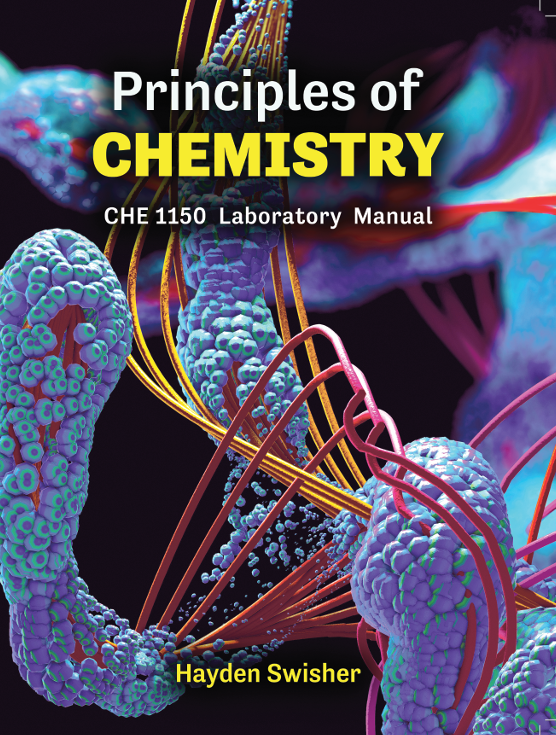
Principles of Chemistry Laboratory
Edition: 1
Copyright: 2024
Pages: 168
Edition: 1
Copyright: 2024
Pages: 168
Choose Your Format
$39.00 USD
Ebook
$21.00 USD
This laboratory manual provides a hands-on introduction to fundamental concepts in chemistry through a series of guided experiments. Students will develop essential laboratory skills, practice scientific methods, perform accurate measurements and data analysis, and investigate key topics including energy, chemical reactions, stoichiometry, equilibrium, spectroscopy, and intermolecular forces.
Introduction
Experiment 1: The Scientific Method
Experiment 2: Measurements and Significant Figures in Science
Experiment 3: Microsoft Excel for Scientists
Experiment 4: Exploring Energy in Molecules Through Phase Changes
Experiment 5: Exploring Energy in Molecules Through Calorimetry
Experiment 6: Separating Ions in Solution Using Solubility
Experiment 7: Determination of Empirical Formulas Using Mass
Experiment 8: Beer’s Law and Spectroscopy
Experiment 9: Recognizing and Balancing Chemical Reactions
Experiment 10: Determination of Percentage Base in Antacid Tablets Through Limiting Reagents
Experiment 11: Intermolecular Forces and Phase Changes
Experiment 12: Stoichiometry in Acid–Base Chemistry
Experiment 13: Le Chatelier and Equilibrium
Appendix 1 Solubility Rules
Appendix 2 Common Polyatomic Ions Symbols and Names
Appendix 3 Common Physical Constants
Works Cited
Hayden Swisher is a Lecturer of Chemistry in the Department of Chemistry and Biochemistry. He earned a Ph.D. in Biochemistry from the University of Colorado and a Bachelor of Science in Chemistry from Baker University. He emphasizes that chemistry is a broad discipline with applications across countless industries and aspects of everyday life, making it relevant regardless of a student's career path.