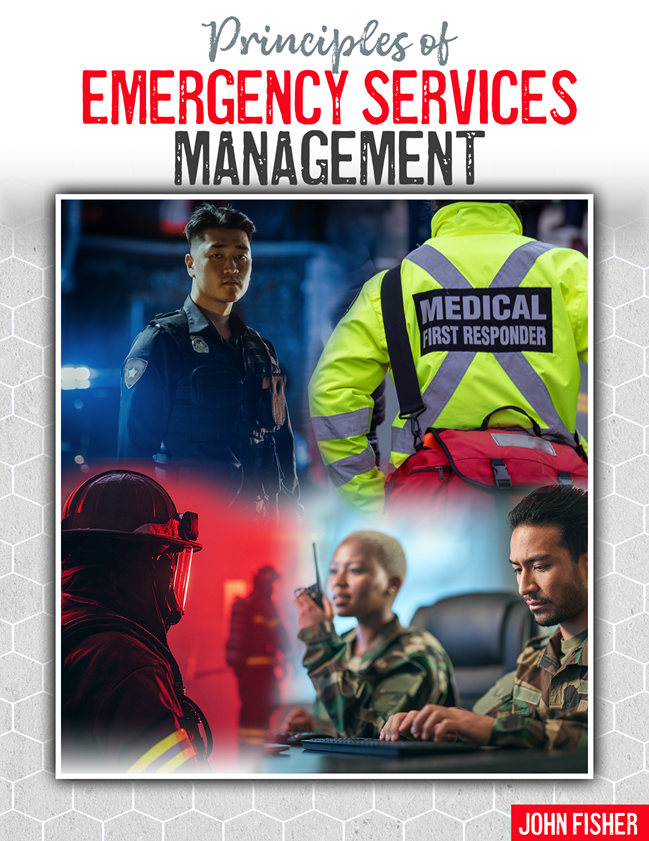
Principles of Emergency Services Management

Author(s): John Fisher

Edition: 1

Copyright: 2026

Pages: 160

Choose Your Format

Ebook

$49.00 USD

ISBN 9798319713728

Details Electronic Delivery EBOOK 180 days

Principles of Emergency Services Management examines the foundations of management and leadership in emergency services, with an emphasis on applying leadership theories, management functions, communication, problem-solving, and adaptive leadership to high-stakes environments. The text explores the LEAP framework—Legitimacy, Ethics, Affect, and Persistence—and its application to leadership interviews, emergency operations, organizational culture, supervision, and decision-making.

The book also addresses emergency services culture, ethical challenges, workforce and organizational issues, psychological safety, accountability, and leadership scalability during crises. Supporting sections provide practical tools for academic writing, leadership and cultural assessments, qualitative interviewing, professional standards, certification, and career development across fire service, EMS, law enforcement, wildland firefighting, emergency dispatch, and emergency management.

Introduction

Chapter 1 The Distinction Between Management and Leadership
Introduction
Part I. Understanding Management and Leadership
1. Definitions of Management and Leadership
2. Management as Coping With Complexity
3. Leadership as Coping With Change
Part II. Major Management Theories
4. Scientific Management
5. Administrative Theory
6. Bureaucracy
7. The Human Relations Movement
8. Systems Theory
Part III. Major Leadership Theories
9. Great Man and Trait Theories
10. Behavioral Leadership Theories
11. Contingency and Situational Leadership
12. Transactional Leadership
13. Transformational Leadership
14. Servant Leadership
15. Crisis Leadership and the LEAP Model
Part IV. Crossover Theories and Emergency Services Application
16. Theory X and Theory Y
17. The Managerial Grid
18. Applying the Theories in Emergency Services
19. Real-World Emergency Services Examples
Conclusion
Activities
References

Chapter 2 Interviewing Emergency Services Leaders: Applying the LEAP Framework
Introduction
Part I. Leadership Interviews in Emergency Services
1. Purpose of Leadership Interviews
2. Leadership Interviews as Applied Learning
3. Preparing for a Leadership Interview
4. Conducting the Interview Professionally
Part II. Overview of the LEAP Framework
5. Defining the LEAP Framework
6. Legitimacy in LEAP
7. Ethics in LEAP
8. Affect in LEAP
9. Persistence in LEAP
Part III. Legitimacy in Emergency Services Leadership
10. Defining Legitimacy
11. Legitimacy Beyond Rank
12. Power, Authority, and Trust
13. Leadership as a Relational Process
14. Application of Legitimacy in Emergency Services
Part IV. Ethics in Emergency Services Leadership
15. Defining Ethics in Emergency Services Leadership
16. Ethical Leadership in Daily Operations
17. Ethical Pressure During Emergencies
18. Accountability and Public Trust
19. Application of Ethics in Emergency Services
Part V. Affect in Emergency Services Leadership
20. Defining Affect
21. Affect and Emotional Intelligence
22. Affect and Followership
23. Affect and Psychological Safety
24. Application of Affect in Emergency Services
Part VI. Persistence in Emergency Services Leadership
25. Defining Persistence
26. Persistence and Resilience
27. Persistence and Naturalistic Decision-Making
28. Persistence During Long Incidents
Part VII. Applying the LEAP Model
29. The LEAP Model as a System
30. Applying LEAP to Interview Analysis
Conclusion
Activities
References

Chapter 3 Management Functions in the Emergency Services
Introduction
Part I. Main Concepts in Emergency Services Management
1. What Is Management?
2. Management and Leadership
3. Why Management Matters in Emergency Services
Part II. The Four Functions of Management
4. Planning
5. Organizing
6. Leading
7. Controlling
Part III. Incident Command System and Management Principles
8. Overview of ICS
9. Standardization and Common Terminology
10. Modular Organization and Span of Control
11. Management by Objectives, Delegation, and Accountability
12. Unity of Command, Chain of Command, and Integrated Communications
Part IV. Management Functions Applied to Public Safety Command
13. Fire, EMS, and Law Enforcement Applications
Conclusion
Activities
References

Chapter 4 Adaptive Leadership in High-Stakes Environments
Introduction
Part I. Foundations of Adaptive Leadership
1. Why Adaptive Leadership Matters
2. From Static Management to Situational Leadership
Part II. The SLII® Model
3. Directive and Supportive Leadership Behaviors
4. Follower Development Levels
5. Matching Leadership Style to Development Level
6. Risks of Mismatched Leadership
Part III. Leadership Styles in Emergency Services and Health Care
7. Autocratic, Democratic, and Laissez-Faire Leadership
8. Transformational, Transactional, Authentic, and Servant Leadership
Part IV. Applying Adaptive Leadership
9. Gray-Sky and Blue-Sky Leadership
10. Incident Command System and Gray-Sky Leadership
11. Leadership and Psychological Safety Culture
12. Leadership Flexibility and Performance
13. Self-Assessment and Leadership Growth
Conclusion
Activities
References

Chapter 5 Listening and Problem-Solving in the Emergency Services
Introduction
Part I: Understanding Problems in Emergency Services
1. The Interconnected Nature of Problems
2. Operational Problems
3. Organizational Problems
4. Personnel Problems
5. Overlapping Problem Areas
Part II: Problem Ownership and Supervisory Responsibility
6. Problem Categorization and Ownership
7. Agency Problems
8. Shared Problems
9. Personal Problems
10. The Continuum of Ownership
Part III: Communication Climate and Self-Awareness
11. Supportive and Defensive Communication Climates
12. Psychological Safety in Emergency Services
13. The Johari Window and Self-Awareness
Part IV: Listening Skills for Supervisors
14. Listening as an Active Leadership Skill
15. Attending Skills and the SOLER Model
16. Following Skills
17. Responses to Avoid
18. Reflecting Skills
Part V: Evaluating Communication Responses
19. Communication Response Evaluation Matrix
20. Integrating Listening Skills into Supervisory Practice
21. Reflective Practice and Communication Journals
Part VI: Structured Problem-Solving Models
22. The Purpose of Structured Problem-Solving
23. The Four-Step Supervisory Model
24. Egan’s Three-Stage Model
25. The Contingency Approach
26. Alternative Evaluation Matrix
Part VII: Performance, Accountability, and Management
27. Listening and Management by Objectives
28. Appraisal Interviews and Problem-Solving
Conclusion
Activities
References

Chapter 6 Emergency Culture, Ethics, and Human Behavior
Introduction
Part I. Main Concepts in Emergency Services Culture
1. What Is Organizational Culture?
2. Emergency Services as High-Reliability Organizations
3. The Bias for Action
4. Social Identity, Loyalty, and Unit Cohesion
5. Command at the Scene and Coordination Across Systems
Part II. Cultural Groups Within Emergency Services
6. The Tactical Triad: Shared Features
7. Law Enforcement Culture: Suspicion, Authority, and Autonomy
8. Fire Service Culture: Tradition, Crew Identity, and the Station Family
9. EMS Culture: Public Safety, Health Care, and Identity Conflict
10. Emergency Dispatch Culture: The Invisible Stress
11. Wildland Firefighting Culture: Endurance, Mobility, and Land Stewardship
12. Emergency Management Culture: Coordination, Policy, and Long-Term Recovery
Part III. Ethical and Leadership Challenges Across the Cultures
13. Coping Mechanisms: Humor, Detachment, and Stress
14. Noble Cause Corruption
15. Normalization of Deviance
16. Diversity, Inclusion, and Monoculture
17. Volunteer Culture
18. Public Information and the Media
19. Social Capital and Community Recovery
Part IV. Leadership Application
20. Navigating Cultural Currents With the LEAP Model
      Legitimacy (L)
      Ethics (E)
      Affect (A)
      Persistence (P)
Conclusion
Activities
References

Chapter 7 Issues in Emergency Services Management
Introduction
1. Recruitment and Retention of Minority Responders
2. Gender Dynamics and the “Old Boys’ Club”
3. The “Social Worker Versus Enforcer” Role Conflict
4. Accountability and the “Rogue Officer” Problem
5. Cultural Competency and Language Barriers
6. The “Us Versus Them” Mentality and Media Relations
7. Management of Spontaneous Volunteers
8. Blue Skies Versus Gray Skies: Leadership Scalability in Crisis
9. Rigid Command Structures in Complex Emergency Operations
10. Responder Mental Health and Organizational Resilience
Conclusion
Activities
References

Appendix A Guide to Academic Writing: APA Standards and Ethical AI Integration
The Importance of Academic Integrity
APA 7th Edition Formatting Standards
   General APA Formatting Requirements
   Title Page Organization
   Headings and Organization
   Common APA Heading Levels
   Tables and Figures
Ethical Use of Artificial Intelligence
   Acceptable Uses of AI
   Unacceptable Uses of AI
In-Text Citations and Source Integration
   Narrative Citation Example
   Parenthetical Citation Example
   APA Citation Guidelines
Quoting and Synthesis
Constructing the Reference List
    Reference List Requirements
Submission and Professional Presentation
Recommended Academic Writing Resources
   Helpful Resources
Conclusion
Reference

Appendix B LEAP Assessment
The LEAP Leadership Assessment for Emergency Services
   Part 1: LEGITIMACY (The License to Lead)
   Part 2: ETHICS (The Moral Compass)
   Part 3: AFFECT (The Emotional Connection)
   Part 4: PERSISTENCE (Steadiness and Reliability)
   Scoring Summary
   Interpretation Guide
   References

Appendix C Cultural Assessment for Emergency Responders
Introduction and Instructions
How to Take the Assessment
Emergency Services: Cultural Situational Judgment Test
Grading Key and Performance Evaluation
   Scoring Matrix
   Performance Tiers
   Scenario Explanations and Learning Points
Follow-Up Activity: Cultural Intelligence Development Plan
   Purpose
   Part 1: Self-Reflection and Data Analysis
   Part 2: Evidence-Based Improvement Strategies
   Part 3: Your Action Plan
References for Further Reading

Appendix D Mastering Inquiry: Using Open-Ended Questions in Emergency Services
Introduction: Building Better Conversations
Why Open-Ended Questions Matter
   Benefits of Open-Ended Questions
How to Create Effective Open-Ended Questions
   Strategies for Writing Better Questions
Application to Emergency Services
Using Reflection Models in Emergency Services
   Examples Using the DEAL Model
Choosing the Best Learning Environment
Conclusion
References

Appendix E Qualitative Interviewing in Emergency Services Management
Types of Interview Structures
   Structured Interviews
   Unstructured Interviews
   Semistructured Interviews
Developing an Effective Interview Guide
   Main Questions
   Follow-Up Questions
   Probing Questions
Building Rapport and Trust
Open-Ended Questioning
The Importance of Active Listening
   Paraphrasing
   Minimal Encouragers
   Intentional Silence
Common Interviewing Mistakes
   Leading Questions
   Double-Barreled Questions
   Judging or Correcting Participants
   Overusing “Why” Questions
Ethical Considerations
   Informed Consent
   Confidentiality
   Psychological Safety
Documentation and Recording
Applications in Emergency Services Management
   After-Action Reviews
   Leadership Assessments
   Wellness and Mental Health Assessments
   Community Preparedness Studies
   Training Evaluations
Conclusion
References

Appendix F Standards, Certification, and Professional Development in Emergency Services
Introduction
1. Professional Standards and Management Expectations
    Fire Service Standards
    Emergency Medical Services Standards
    Law Enforcement Standards
    Wildland Firefighting Standards
    Emergency Dispatch Standards
    Emergency Management Standards
2. Certification Requirements By Emergency Service Discipline
    Fire Service Certification
    EMS Certification and Licensure
    Law Enforcement Certification
    Wildland Firefighter Qualification
    Emergency Dispatcher Certification
    Emergency Management Certification
    Summary of Certification Authority
3. Professional Advancement and Education Pathways
    Fire Service Advancement
    EMS Advancement
    Law Enforcement Advancement
   Wildland Firefighter Advancement
    Dispatcher Advancement
    Emergency Management Advancement
    Summary of Certification Authority
Conclusion
Certification, Accreditation, and Standards Organizations

John Fisher

Dr. John R. Fisher is a professor in the Department of Emergency Services at Utah Valley University. Before coming to UVU, he taught management and communications at Northwest Missouri State University, Boise State University, Athabasca University, and the University of Alberta. John began his career as a newspaper reporter/photographer, reporting the court and police beats and covering emergency services. For eight years, he was a public administrator in the Alberta government, working in policy analysis, public information, and legislative affairs. As a disaster team member and PIO for the Red Cross, he has been deployed to several national disasters. He has a BA and an MA from Brigham Young University and a PhD from the University of Alberta. His principal areas of research are mass media coverage of disaster public policy, disaster preparedness and community resilience, and applied learning online for adult learners. 

Principles of Emergency Services Management examines the foundations of management and leadership in emergency services, with an emphasis on applying leadership theories, management functions, communication, problem-solving, and adaptive leadership to high-stakes environments. The text explores the LEAP framework—Legitimacy, Ethics, Affect, and Persistence—and its application to leadership interviews, emergency operations, organizational culture, supervision, and decision-making.

The book also addresses emergency services culture, ethical challenges, workforce and organizational issues, psychological safety, accountability, and leadership scalability during crises. Supporting sections provide practical tools for academic writing, leadership and cultural assessments, qualitative interviewing, professional standards, certification, and career development across fire service, EMS, law enforcement, wildland firefighting, emergency dispatch, and emergency management.

Introduction

Chapter 1 The Distinction Between Management and Leadership
Introduction
Part I. Understanding Management and Leadership
1. Definitions of Management and Leadership
2. Management as Coping With Complexity
3. Leadership as Coping With Change
Part II. Major Management Theories
4. Scientific Management
5. Administrative Theory
6. Bureaucracy
7. The Human Relations Movement
8. Systems Theory
Part III. Major Leadership Theories
9. Great Man and Trait Theories
10. Behavioral Leadership Theories
11. Contingency and Situational Leadership
12. Transactional Leadership
13. Transformational Leadership
14. Servant Leadership
15. Crisis Leadership and the LEAP Model
Part IV. Crossover Theories and Emergency Services Application
16. Theory X and Theory Y
17. The Managerial Grid
18. Applying the Theories in Emergency Services
19. Real-World Emergency Services Examples
Conclusion
Activities
References

Chapter 2 Interviewing Emergency Services Leaders: Applying the LEAP Framework
Introduction
Part I. Leadership Interviews in Emergency Services
1. Purpose of Leadership Interviews
2. Leadership Interviews as Applied Learning
3. Preparing for a Leadership Interview
4. Conducting the Interview Professionally
Part II. Overview of the LEAP Framework
5. Defining the LEAP Framework
6. Legitimacy in LEAP
7. Ethics in LEAP
8. Affect in LEAP
9. Persistence in LEAP
Part III. Legitimacy in Emergency Services Leadership
10. Defining Legitimacy
11. Legitimacy Beyond Rank
12. Power, Authority, and Trust
13. Leadership as a Relational Process
14. Application of Legitimacy in Emergency Services
Part IV. Ethics in Emergency Services Leadership
15. Defining Ethics in Emergency Services Leadership
16. Ethical Leadership in Daily Operations
17. Ethical Pressure During Emergencies
18. Accountability and Public Trust
19. Application of Ethics in Emergency Services
Part V. Affect in Emergency Services Leadership
20. Defining Affect
21. Affect and Emotional Intelligence
22. Affect and Followership
23. Affect and Psychological Safety
24. Application of Affect in Emergency Services
Part VI. Persistence in Emergency Services Leadership
25. Defining Persistence
26. Persistence and Resilience
27. Persistence and Naturalistic Decision-Making
28. Persistence During Long Incidents
Part VII. Applying the LEAP Model
29. The LEAP Model as a System
30. Applying LEAP to Interview Analysis
Conclusion
Activities
References

Chapter 3 Management Functions in the Emergency Services
Introduction
Part I. Main Concepts in Emergency Services Management
1. What Is Management?
2. Management and Leadership
3. Why Management Matters in Emergency Services
Part II. The Four Functions of Management
4. Planning
5. Organizing
6. Leading
7. Controlling
Part III. Incident Command System and Management Principles
8. Overview of ICS
9. Standardization and Common Terminology
10. Modular Organization and Span of Control
11. Management by Objectives, Delegation, and Accountability
12. Unity of Command, Chain of Command, and Integrated Communications
Part IV. Management Functions Applied to Public Safety Command
13. Fire, EMS, and Law Enforcement Applications
Conclusion
Activities
References

Chapter 4 Adaptive Leadership in High-Stakes Environments
Introduction
Part I. Foundations of Adaptive Leadership
1. Why Adaptive Leadership Matters
2. From Static Management to Situational Leadership
Part II. The SLII® Model
3. Directive and Supportive Leadership Behaviors
4. Follower Development Levels
5. Matching Leadership Style to Development Level
6. Risks of Mismatched Leadership
Part III. Leadership Styles in Emergency Services and Health Care
7. Autocratic, Democratic, and Laissez-Faire Leadership
8. Transformational, Transactional, Authentic, and Servant Leadership
Part IV. Applying Adaptive Leadership
9. Gray-Sky and Blue-Sky Leadership
10. Incident Command System and Gray-Sky Leadership
11. Leadership and Psychological Safety Culture
12. Leadership Flexibility and Performance
13. Self-Assessment and Leadership Growth
Conclusion
Activities
References

Chapter 5 Listening and Problem-Solving in the Emergency Services
Introduction
Part I: Understanding Problems in Emergency Services
1. The Interconnected Nature of Problems
2. Operational Problems
3. Organizational Problems
4. Personnel Problems
5. Overlapping Problem Areas
Part II: Problem Ownership and Supervisory Responsibility
6. Problem Categorization and Ownership
7. Agency Problems
8. Shared Problems
9. Personal Problems
10. The Continuum of Ownership
Part III: Communication Climate and Self-Awareness
11. Supportive and Defensive Communication Climates
12. Psychological Safety in Emergency Services
13. The Johari Window and Self-Awareness
Part IV: Listening Skills for Supervisors
14. Listening as an Active Leadership Skill
15. Attending Skills and the SOLER Model
16. Following Skills
17. Responses to Avoid
18. Reflecting Skills
Part V: Evaluating Communication Responses
19. Communication Response Evaluation Matrix
20. Integrating Listening Skills into Supervisory Practice
21. Reflective Practice and Communication Journals
Part VI: Structured Problem-Solving Models
22. The Purpose of Structured Problem-Solving
23. The Four-Step Supervisory Model
24. Egan’s Three-Stage Model
25. The Contingency Approach
26. Alternative Evaluation Matrix
Part VII: Performance, Accountability, and Management
27. Listening and Management by Objectives
28. Appraisal Interviews and Problem-Solving
Conclusion
Activities
References

Chapter 6 Emergency Culture, Ethics, and Human Behavior
Introduction
Part I. Main Concepts in Emergency Services Culture
1. What Is Organizational Culture?
2. Emergency Services as High-Reliability Organizations
3. The Bias for Action
4. Social Identity, Loyalty, and Unit Cohesion
5. Command at the Scene and Coordination Across Systems
Part II. Cultural Groups Within Emergency Services
6. The Tactical Triad: Shared Features
7. Law Enforcement Culture: Suspicion, Authority, and Autonomy
8. Fire Service Culture: Tradition, Crew Identity, and the Station Family
9. EMS Culture: Public Safety, Health Care, and Identity Conflict
10. Emergency Dispatch Culture: The Invisible Stress
11. Wildland Firefighting Culture: Endurance, Mobility, and Land Stewardship
12. Emergency Management Culture: Coordination, Policy, and Long-Term Recovery
Part III. Ethical and Leadership Challenges Across the Cultures
13. Coping Mechanisms: Humor, Detachment, and Stress
14. Noble Cause Corruption
15. Normalization of Deviance
16. Diversity, Inclusion, and Monoculture
17. Volunteer Culture
18. Public Information and the Media
19. Social Capital and Community Recovery
Part IV. Leadership Application
20. Navigating Cultural Currents With the LEAP Model
      Legitimacy (L)
      Ethics (E)
      Affect (A)
      Persistence (P)
Conclusion
Activities
References

Chapter 7 Issues in Emergency Services Management
Introduction
1. Recruitment and Retention of Minority Responders
2. Gender Dynamics and the “Old Boys’ Club”
3. The “Social Worker Versus Enforcer” Role Conflict
4. Accountability and the “Rogue Officer” Problem
5. Cultural Competency and Language Barriers
6. The “Us Versus Them” Mentality and Media Relations
7. Management of Spontaneous Volunteers
8. Blue Skies Versus Gray Skies: Leadership Scalability in Crisis
9. Rigid Command Structures in Complex Emergency Operations
10. Responder Mental Health and Organizational Resilience
Conclusion
Activities
References

Appendix A Guide to Academic Writing: APA Standards and Ethical AI Integration
The Importance of Academic Integrity
APA 7th Edition Formatting Standards
   General APA Formatting Requirements
   Title Page Organization
   Headings and Organization
   Common APA Heading Levels
   Tables and Figures
Ethical Use of Artificial Intelligence
   Acceptable Uses of AI
   Unacceptable Uses of AI
In-Text Citations and Source Integration
   Narrative Citation Example
   Parenthetical Citation Example
   APA Citation Guidelines
Quoting and Synthesis
Constructing the Reference List
    Reference List Requirements
Submission and Professional Presentation
Recommended Academic Writing Resources
   Helpful Resources
Conclusion
Reference

Appendix B LEAP Assessment
The LEAP Leadership Assessment for Emergency Services
   Part 1: LEGITIMACY (The License to Lead)
   Part 2: ETHICS (The Moral Compass)
   Part 3: AFFECT (The Emotional Connection)
   Part 4: PERSISTENCE (Steadiness and Reliability)
   Scoring Summary
   Interpretation Guide
   References

Appendix C Cultural Assessment for Emergency Responders
Introduction and Instructions
How to Take the Assessment
Emergency Services: Cultural Situational Judgment Test
Grading Key and Performance Evaluation
   Scoring Matrix
   Performance Tiers
   Scenario Explanations and Learning Points
Follow-Up Activity: Cultural Intelligence Development Plan
   Purpose
   Part 1: Self-Reflection and Data Analysis
   Part 2: Evidence-Based Improvement Strategies
   Part 3: Your Action Plan
References for Further Reading

Appendix D Mastering Inquiry: Using Open-Ended Questions in Emergency Services
Introduction: Building Better Conversations
Why Open-Ended Questions Matter
   Benefits of Open-Ended Questions
How to Create Effective Open-Ended Questions
   Strategies for Writing Better Questions
Application to Emergency Services
Using Reflection Models in Emergency Services
   Examples Using the DEAL Model
Choosing the Best Learning Environment
Conclusion
References

Appendix E Qualitative Interviewing in Emergency Services Management
Types of Interview Structures
   Structured Interviews
   Unstructured Interviews
   Semistructured Interviews
Developing an Effective Interview Guide
   Main Questions
   Follow-Up Questions
   Probing Questions
Building Rapport and Trust
Open-Ended Questioning
The Importance of Active Listening
   Paraphrasing
   Minimal Encouragers
   Intentional Silence
Common Interviewing Mistakes
   Leading Questions
   Double-Barreled Questions
   Judging or Correcting Participants
   Overusing “Why” Questions
Ethical Considerations
   Informed Consent
   Confidentiality
   Psychological Safety
Documentation and Recording
Applications in Emergency Services Management
   After-Action Reviews
   Leadership Assessments
   Wellness and Mental Health Assessments
   Community Preparedness Studies
   Training Evaluations
Conclusion
References

Appendix F Standards, Certification, and Professional Development in Emergency Services
Introduction
1. Professional Standards and Management Expectations
    Fire Service Standards
    Emergency Medical Services Standards
    Law Enforcement Standards
    Wildland Firefighting Standards
    Emergency Dispatch Standards
    Emergency Management Standards
2. Certification Requirements By Emergency Service Discipline
    Fire Service Certification
    EMS Certification and Licensure
    Law Enforcement Certification
    Wildland Firefighter Qualification
    Emergency Dispatcher Certification
    Emergency Management Certification
    Summary of Certification Authority
3. Professional Advancement and Education Pathways
    Fire Service Advancement
    EMS Advancement
    Law Enforcement Advancement
   Wildland Firefighter Advancement
    Dispatcher Advancement
    Emergency Management Advancement
    Summary of Certification Authority
Conclusion
Certification, Accreditation, and Standards Organizations

John Fisher

Dr. John R. Fisher is a professor in the Department of Emergency Services at Utah Valley University. Before coming to UVU, he taught management and communications at Northwest Missouri State University, Boise State University, Athabasca University, and the University of Alberta. John began his career as a newspaper reporter/photographer, reporting the court and police beats and covering emergency services. For eight years, he was a public administrator in the Alberta government, working in policy analysis, public information, and legislative affairs. As a disaster team member and PIO for the Red Cross, he has been deployed to several national disasters. He has a BA and an MA from Brigham Young University and a PhD from the University of Alberta. His principal areas of research are mass media coverage of disaster public policy, disaster preparedness and community resilience, and applied learning online for adult learners.