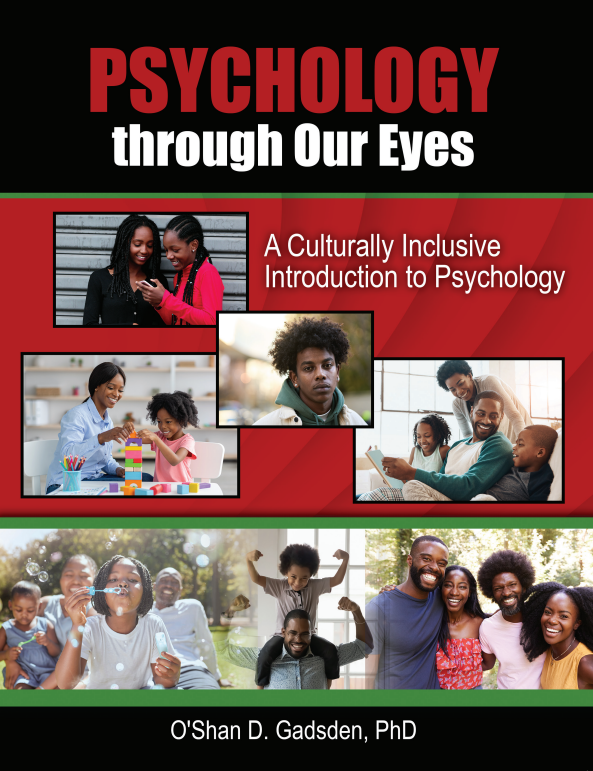
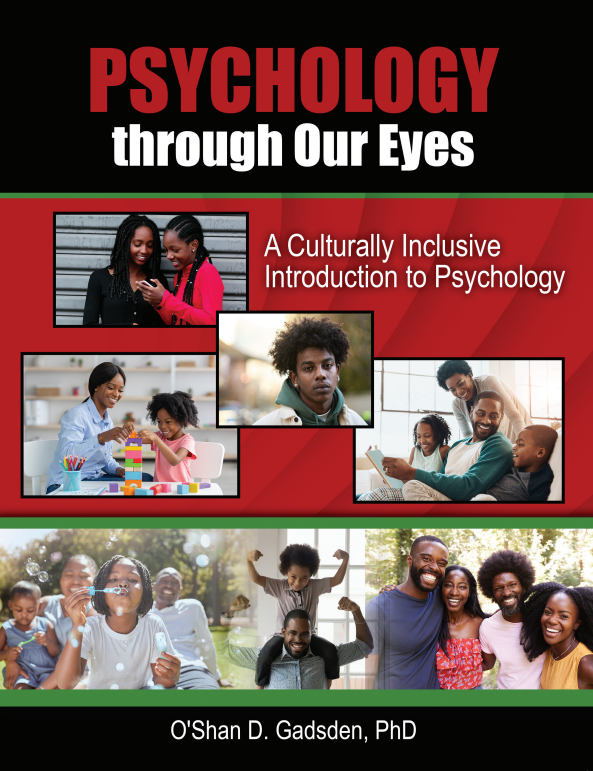
Psychology Through Our Eyes: A Culturally Inclusive Introduction to Psychology
Edition: 0
Copyright: 2025
Pages: 430
Edition: 0
Copyright: 2025
Choose Your Format
Choose Your Platform | Help Me Choose


Print Package
$96.30 USD
Ebook Package
$85.60 USD
Psychology Through Our Eyes is the first undergraduate textbook of its kind. It is a culturally inclusive, Black-centered, and decolonial introduction to psychology that challenges the Eurocentric assumptions that have long dominated the field. While written as a comprehensive undergraduate psychology text, it also serves as a critical resource for practitioners, community leaders, educators, healers, and parents who engage the psychological and educational realities of Black and Brown individuals.
This book does not simply “add diversity” to psychology it re-centers the discipline around the histories, voices, and lived experiences of Black and Brown communities. Through critique and reconstruction, the text pushes readers to interrogate how psychological knowledge has been produced, whose realities have been silenced, and how culturally grounded approaches can transform how we understand cognition, behavior, personality, and mental health.
Chapter Highlights
Chapter 1: Psychological History and Research Methods: Black-Centered & Decolonial Perspectives
Exposes how psychology has historically erased, pathologized, or exploited Black and Brown communities while uplifting African, diasporic, and Indigenous intellectual traditions as legitimate sources of psychological knowledge. Offers decolonial research practices that prioritize community voice, narrative, and healing-centered inquiry.
Chapter 2: Human Growth and Development: Moving Beyond a Universal Phenomenon/Perspective
Critiques Eurocentric developmental models (e.g., Piaget, Erikson) that claim universality but exclude Black cultural contexts. Introduces developmental frameworks rooted in interdependence, communalism, spirituality, and resilience across the African diaspora, redefining what it means to “grow” and “develop.”
Chapter 3: Biological Bases of Behavior
Challenges deficit models that reduce behavior in Black populations to “biological predispositions.” Reinterprets neuroscience and physiology through epigenetics, stress biology, and the impact of racism, colonialism, and systemic oppression on the body and brain. Highlights resilience and healing practices that counteract intergenerational trauma.
Chapter 4: Learning and Memory: Cultural Considerations
Critiques standardized Western models of learning and memory that marginalize oral traditions, ancestral knowledge, and collective storytelling. Reframes memory as communal and cultural, showing how Black learners adapt, resist, and thrive in oppressive educational structures.
Chapter 5: Personality: An Intersectional Perspective
Challenges the universality of personality theories developed in white, Western contexts. Offers intersectional approaches that recognize how Black identity is shaped by systemic racism, colonial gender norms, spirituality, and collective responsibility, while proposing liberatory frameworks for understanding personality.
Chapter 6: Stress, Coping, and Health: Variables & Outcomes for Black Populations
Critiques medicalized models of stress and coping that ignore structural racism and cultural resilience. Reframes Black stress not only as an individual challenge but as a collective struggle against oppression. Introduces culturally rooted coping practices such as spirituality, communal healing, and activism as protective health strategies.
Chapter 7: Social Psychology
Interrogates classic theories of conformity, prejudice, and group dynamics through the lens of anti-Black racism, colonial legacies, and systemic violence. Reimagines social psychology by centering resistance, solidarity, and community organizing as critical social processes.
Chapter 8: Motivation and Emotions
Critiques Western individualistic models of motivation and emotion that minimize spirituality, relationality, and collective survival. Elevates Black-centered understandings of drive, joy, struggle, and hope—framing them as essential for liberation and intergenerational resilience.
Chapter 9: Consciousness
Challenges narrow definitions of consciousness by including African and diasporic spiritualities, altered states, and metaphysical traditions. Frames Black consciousness not just as awareness of self, but as political, cultural, and ancestral awakening rooted in survival and liberation.
Chapter 10: Psychological Disorders: Cultural or Intrapsychically Located?
Critiques Western diagnostic systems that often pathologize Black behavior and ignore systemic causes of distress. Examines the cultural, historical, and political dimensions of mental health while offering decolonial approaches to diagnosis and treatment that emphasize healing, resilience, and liberation.
Psychology Through Our Eyes is not just a textbook, it is a radical reimagining of psychology that affirms Black and Brown lives, critiques colonial legacies, and offers culturally grounded frameworks for healing, learning, and thriving.
Preface
Chapter 1
PSYCHOLOGICAL HISTORY AND RESEARCH METHODS: BLACK-CENTERED & DECOLONIAL PERSPECTIVES
Chapter 2
HUMAN GROWTH AND DEVELOPMENT: MOVING BEYOND A UNIVERSAL PHENOMEON/PERSPECTIVE
Chapter 3
BIOLOGICAL BASES OF BEHAVIOR
Chapter 4
LEARNING AND MEMORY: CULTURAL CONSIDERATIONS
Chapter 5
PERSONALITY: AN INTERSECTIONAL PERSPECTIVE
Chapter 6
STRESS, COPING AND HEALTH: VARIABLES & OUTCOMES FOR BLACK POPULATIONS
Chapter 7
SOCIAL PSYCHOLOGY
Chapter 8
MOTIVATION AND EMOTIONS
Chapter 9
CONSCIOUSNESS
Chapter 10
PSYCHOLOGICAL DISORDERS: CULTURAL OR INTRAPSYCHICALLY LOCATED
Glossary

Scholar • Healer • Thought Leader
Dr. O’Shan D. Gadsden currently the CEO and Founder of The PsychoSpiritualCollective, a leading consulting firm that provides clinical-educational-assessment-organizational consultation-media services at the intersection of mental health, spirituality, and cultural politics. He is also the former Associate Professor and Chair of the Psychology Department at Hampton University. He earned his M.A. in Clinical Psychology from Teachers College, Columbia University, and his Ph.D. in Counseling Psychology (APA Accredited program) from Howard University, specializing in Black masculinity development and emotional intimacy.
For over 20 years, Dr. Gadsden has advanced the mental, emotional, cultural, and spiritual health of marginalized communities, especially Black men, by blending relational-cultural psychoanalysis, metaphysical-spirituality, Black-centered, constructivist, and decolonized frameworks in his scholarship-research, teaching, clinical practice, and consultation.
His impact extends beyond academia. He co-edited a groundbreaking Journal of Black Sexuality & Relationships special issue on Black male trauma and identity, and spent three years on the international JustHealBro Tour, engaging Black men in over 35 cities across the U.S. and abroad in transformative dialogues on healing, masculinity, and joy.
Dr. Gadsden is the authored multiple peer-reviewed articles, books chapters, and two books (Psychology through our eyes: A culturally inclusive Introduction to psychology). This latest book, Sacred Sons: A Healing Blueprint for Black Masculinities pushes the field toward culturally rooted, spiritually integrated, and socially just paradigms of psychological-clinical-spiritual healing for Black males.
Over the last 20 years, Dr. Gadsden has been productive in the following areas of Leadership & Impact:
- Academic Leadership: Serving as chair of the Psychology Department at Hampton University.
- Clinical Leadership: Served as Training Director at a Black community-based clinic & Program Coordinator of a School-Based Testing/Therapy at a clinic.
- Scholarship: Scholarship (e.g., books, articles, public scholarships) Black male mental-emotional-cultural-spiritual health. •
- Community Engagement: JustHealBro Tour & national healing dialogues.
- Thought Leadership: Decolonized, Black-centered frameworks for identity & healing.
Bridging scholarship, spirituality, and activism, Dr. Gadsden centers Black lived experience as the foundation for collective healing.
Psychology Through Our Eyes is the first undergraduate textbook of its kind. It is a culturally inclusive, Black-centered, and decolonial introduction to psychology that challenges the Eurocentric assumptions that have long dominated the field. While written as a comprehensive undergraduate psychology text, it also serves as a critical resource for practitioners, community leaders, educators, healers, and parents who engage the psychological and educational realities of Black and Brown individuals.
This book does not simply “add diversity” to psychology it re-centers the discipline around the histories, voices, and lived experiences of Black and Brown communities. Through critique and reconstruction, the text pushes readers to interrogate how psychological knowledge has been produced, whose realities have been silenced, and how culturally grounded approaches can transform how we understand cognition, behavior, personality, and mental health.
Chapter Highlights
Chapter 1: Psychological History and Research Methods: Black-Centered & Decolonial Perspectives
Exposes how psychology has historically erased, pathologized, or exploited Black and Brown communities while uplifting African, diasporic, and Indigenous intellectual traditions as legitimate sources of psychological knowledge. Offers decolonial research practices that prioritize community voice, narrative, and healing-centered inquiry.
Chapter 2: Human Growth and Development: Moving Beyond a Universal Phenomenon/Perspective
Critiques Eurocentric developmental models (e.g., Piaget, Erikson) that claim universality but exclude Black cultural contexts. Introduces developmental frameworks rooted in interdependence, communalism, spirituality, and resilience across the African diaspora, redefining what it means to “grow” and “develop.”
Chapter 3: Biological Bases of Behavior
Challenges deficit models that reduce behavior in Black populations to “biological predispositions.” Reinterprets neuroscience and physiology through epigenetics, stress biology, and the impact of racism, colonialism, and systemic oppression on the body and brain. Highlights resilience and healing practices that counteract intergenerational trauma.
Chapter 4: Learning and Memory: Cultural Considerations
Critiques standardized Western models of learning and memory that marginalize oral traditions, ancestral knowledge, and collective storytelling. Reframes memory as communal and cultural, showing how Black learners adapt, resist, and thrive in oppressive educational structures.
Chapter 5: Personality: An Intersectional Perspective
Challenges the universality of personality theories developed in white, Western contexts. Offers intersectional approaches that recognize how Black identity is shaped by systemic racism, colonial gender norms, spirituality, and collective responsibility, while proposing liberatory frameworks for understanding personality.
Chapter 6: Stress, Coping, and Health: Variables & Outcomes for Black Populations
Critiques medicalized models of stress and coping that ignore structural racism and cultural resilience. Reframes Black stress not only as an individual challenge but as a collective struggle against oppression. Introduces culturally rooted coping practices such as spirituality, communal healing, and activism as protective health strategies.
Chapter 7: Social Psychology
Interrogates classic theories of conformity, prejudice, and group dynamics through the lens of anti-Black racism, colonial legacies, and systemic violence. Reimagines social psychology by centering resistance, solidarity, and community organizing as critical social processes.
Chapter 8: Motivation and Emotions
Critiques Western individualistic models of motivation and emotion that minimize spirituality, relationality, and collective survival. Elevates Black-centered understandings of drive, joy, struggle, and hope—framing them as essential for liberation and intergenerational resilience.
Chapter 9: Consciousness
Challenges narrow definitions of consciousness by including African and diasporic spiritualities, altered states, and metaphysical traditions. Frames Black consciousness not just as awareness of self, but as political, cultural, and ancestral awakening rooted in survival and liberation.
Chapter 10: Psychological Disorders: Cultural or Intrapsychically Located?
Critiques Western diagnostic systems that often pathologize Black behavior and ignore systemic causes of distress. Examines the cultural, historical, and political dimensions of mental health while offering decolonial approaches to diagnosis and treatment that emphasize healing, resilience, and liberation.
Psychology Through Our Eyes is not just a textbook, it is a radical reimagining of psychology that affirms Black and Brown lives, critiques colonial legacies, and offers culturally grounded frameworks for healing, learning, and thriving.
Preface
Chapter 1
PSYCHOLOGICAL HISTORY AND RESEARCH METHODS: BLACK-CENTERED & DECOLONIAL PERSPECTIVES
Chapter 2
HUMAN GROWTH AND DEVELOPMENT: MOVING BEYOND A UNIVERSAL PHENOMEON/PERSPECTIVE
Chapter 3
BIOLOGICAL BASES OF BEHAVIOR
Chapter 4
LEARNING AND MEMORY: CULTURAL CONSIDERATIONS
Chapter 5
PERSONALITY: AN INTERSECTIONAL PERSPECTIVE
Chapter 6
STRESS, COPING AND HEALTH: VARIABLES & OUTCOMES FOR BLACK POPULATIONS
Chapter 7
SOCIAL PSYCHOLOGY
Chapter 8
MOTIVATION AND EMOTIONS
Chapter 9
CONSCIOUSNESS
Chapter 10
PSYCHOLOGICAL DISORDERS: CULTURAL OR INTRAPSYCHICALLY LOCATED
Glossary
Scholar • Healer • Thought Leader
Dr. O’Shan D. Gadsden currently the CEO and Founder of The PsychoSpiritualCollective, a leading consulting firm that provides clinical-educational-assessment-organizational consultation-media services at the intersection of mental health, spirituality, and cultural politics. He is also the former Associate Professor and Chair of the Psychology Department at Hampton University. He earned his M.A. in Clinical Psychology from Teachers College, Columbia University, and his Ph.D. in Counseling Psychology (APA Accredited program) from Howard University, specializing in Black masculinity development and emotional intimacy.
For over 20 years, Dr. Gadsden has advanced the mental, emotional, cultural, and spiritual health of marginalized communities, especially Black men, by blending relational-cultural psychoanalysis, metaphysical-spirituality, Black-centered, constructivist, and decolonized frameworks in his scholarship-research, teaching, clinical practice, and consultation.
His impact extends beyond academia. He co-edited a groundbreaking Journal of Black Sexuality & Relationships special issue on Black male trauma and identity, and spent three years on the international JustHealBro Tour, engaging Black men in over 35 cities across the U.S. and abroad in transformative dialogues on healing, masculinity, and joy.
Dr. Gadsden is the authored multiple peer-reviewed articles, books chapters, and two books (Psychology through our eyes: A culturally inclusive Introduction to psychology). This latest book, Sacred Sons: A Healing Blueprint for Black Masculinities pushes the field toward culturally rooted, spiritually integrated, and socially just paradigms of psychological-clinical-spiritual healing for Black males.
Over the last 20 years, Dr. Gadsden has been productive in the following areas of Leadership & Impact:
- Academic Leadership: Serving as chair of the Psychology Department at Hampton University.
- Clinical Leadership: Served as Training Director at a Black community-based clinic & Program Coordinator of a School-Based Testing/Therapy at a clinic.
- Scholarship: Scholarship (e.g., books, articles, public scholarships) Black male mental-emotional-cultural-spiritual health. •
- Community Engagement: JustHealBro Tour & national healing dialogues.
- Thought Leadership: Decolonized, Black-centered frameworks for identity & healing.
Bridging scholarship, spirituality, and activism, Dr. Gadsden centers Black lived experience as the foundation for collective healing.