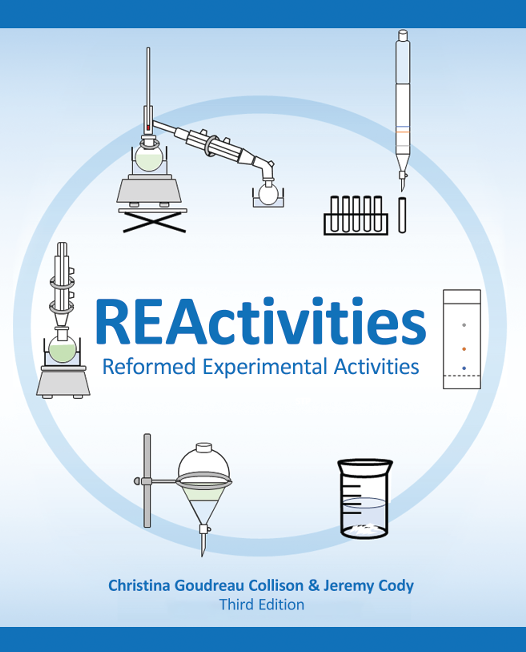
REActivities: Reformed Experimental Activities
Edition: 3
Copyright: 2025
Pages: 290
Choose Your Format
Choose Your Platform | Help Me Choose
$59.00 USD
Key Features for the Instructor:
- REActivities use a small deliberate set of materials and reagents simplifying chemical stores and lab preparation. Updated- Dichloromethane has been eliminated as a solvent throughout the lab manual.
- REActivities feature the signature self-start allowing students to begin working the moment they arrive in the lab. The self-start eliminates the need for pre-lab lectures and maximizes the use of lab time.
- Stop sign icons are utilized to force student-instructor interactions. These structured occurrences are strategically implemented for technique validation or guided discussions.
- Instructor manuals and online resources offer helpful guidance for institutions delivering many lab sections with a variety of instructors. The student-guided pedagogy ensures a uniform approach across sections and facilitates facile instructor training experience.
Three sets of post-lab questions are included for each REActivity allowing instructors to cycle through assigning different sets.
Benefits to the student:
- REActivities has students work with the same compounds across both semesters mirroring more closely to a research experience. Comfort with the materials shifts the focus to the technique or reaction being conducted.
- REActivities offers a value-added greener and sustainable laboratory experience. For example, synthetically prepared material is saved for another lab section to use when learning the recrystallization technique. It is not thrown away.
- REActivities has incorporated practice time for each technique lab so students have the freedom to explore and gain confidence in their skills. Practice time reduces student instances of human error claims when analyzing the data. Students focus on more relevant concepts pertaining to the experiment given their comfort with the learned lab skills.
- REActivities has students revisit techniques repeatedly throughout validating the importance of each technique covered. Repetition also gives students the opportunity to refine their laboratory notebook entries, aligning more with the practicing organic chemist’s notebook.
- REActivities guides students through prompted partner work minimizing idle time and ensuring that the conceptual knowledge governing the lab activity is considered while performing the lab technique or reaction. The carefully timed in-lab questions help connect the students’ hands to their brains - why they are doing what they are doing in the experimental procedure.
- REActivities offers an organized framework for comparing observations with neighboring student groups enriching the data collection for conclusion writing.
- REActivities offers pre-lab videos so students can prepare or even follow along while conducting their own experiment.
Acknowledgements
Organic REActivity
Waste Management
Featured Compounds
First Day of Lab
Recrystallization/Melting Point
Solvent Pair Recrystallization
Thin Layer Chromatography
Column Chromatography
Stereochemistry
Liquid-Liquid Extraction
NMR and IR
Distillation
Substitution Reactions
Bromination of an Alkene
Data Analysis of an Organic Reaction
Elimination to an Alkyne
TEMPO Oxidation
Wittig Reaction
Electrophilic Aromatic Substitution
Saponification Reaction
Perkin Reaction (Aldol Condensation)
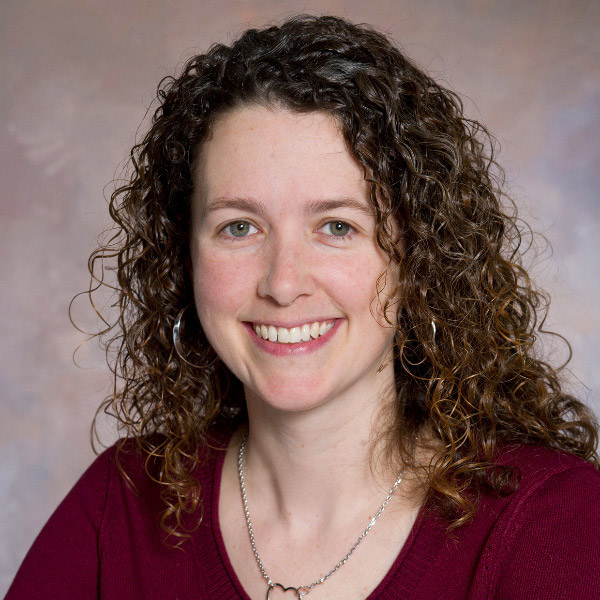
My research group comprises a robust and diverse group of students from various majors both within and outside the college of science at RIT. My group is largely populated by undergraduate students with only one MS student at any given time. My research focuses largely in the area of Discipline-Based Education Research (DBER) in the areas of organic chemistry, and lab pedagogies. One major project in our group is the Sign Language Incorporation in Chemistry Education (SLICE).
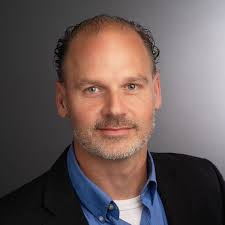
Jeremy A. Cody teaches undergraduate and graduate courses in organic chemistry and enjoys helping students develop both a strong conceptual understanding of chemistry and the confidence to apply it in real-world settings. He also previously served as Associate Head of the School and continues to be actively involved in curriculum development and student-focused initiatives.
Dr. Cody’s research focuses on designing and building molecules with useful properties, combining ideas from organic chemistry, materials science, and biology. His work includes the synthesis of complex natural products, the development of squaraine dyes for organic solar cells, and the design of dye systems for biological imaging and therapeutic applications. He frequently collaborates with students on research projects, with many contributing as co-authors on publications and presentations at national meetings. In addition to his scientific research, he is deeply interested in how students learn chemistry and has helped develop innovative, hands-on laboratory curricula (REActivities) that make organic chemistry more engaging and accessible.
Before joining RIT, Dr. Cody worked in the pharmaceutical industry at Albany Molecular Research Inc., where he helped design and scale up chemical processes used to produce drug candidates. This experience continues to shape his teaching, especially in courses focused on practical chemistry and industrial applications.
Dr. Cody earned his Ph.D. in Organic Chemistry from the University of Rochester, where he worked on the synthesis of complex biologically active molecules, and his B.S. in Biochemistry from Indiana University of Pennsylvania.
Across his teaching, research, and mentoring, Dr. Cody is committed to helping students connect chemistry to meaningful applications—whether in graduate school, industry, or beyond.
Key Features for the Instructor:
- REActivities use a small deliberate set of materials and reagents simplifying chemical stores and lab preparation. Updated- Dichloromethane has been eliminated as a solvent throughout the lab manual.
- REActivities feature the signature self-start allowing students to begin working the moment they arrive in the lab. The self-start eliminates the need for pre-lab lectures and maximizes the use of lab time.
- Stop sign icons are utilized to force student-instructor interactions. These structured occurrences are strategically implemented for technique validation or guided discussions.
- Instructor manuals and online resources offer helpful guidance for institutions delivering many lab sections with a variety of instructors. The student-guided pedagogy ensures a uniform approach across sections and facilitates facile instructor training experience.
Three sets of post-lab questions are included for each REActivity allowing instructors to cycle through assigning different sets.
Benefits to the student:
- REActivities has students work with the same compounds across both semesters mirroring more closely to a research experience. Comfort with the materials shifts the focus to the technique or reaction being conducted.
- REActivities offers a value-added greener and sustainable laboratory experience. For example, synthetically prepared material is saved for another lab section to use when learning the recrystallization technique. It is not thrown away.
- REActivities has incorporated practice time for each technique lab so students have the freedom to explore and gain confidence in their skills. Practice time reduces student instances of human error claims when analyzing the data. Students focus on more relevant concepts pertaining to the experiment given their comfort with the learned lab skills.
- REActivities has students revisit techniques repeatedly throughout validating the importance of each technique covered. Repetition also gives students the opportunity to refine their laboratory notebook entries, aligning more with the practicing organic chemist’s notebook.
- REActivities guides students through prompted partner work minimizing idle time and ensuring that the conceptual knowledge governing the lab activity is considered while performing the lab technique or reaction. The carefully timed in-lab questions help connect the students’ hands to their brains - why they are doing what they are doing in the experimental procedure.
- REActivities offers an organized framework for comparing observations with neighboring student groups enriching the data collection for conclusion writing.
- REActivities offers pre-lab videos so students can prepare or even follow along while conducting their own experiment.
Acknowledgements
Organic REActivity
Waste Management
Featured Compounds
First Day of Lab
Recrystallization/Melting Point
Solvent Pair Recrystallization
Thin Layer Chromatography
Column Chromatography
Stereochemistry
Liquid-Liquid Extraction
NMR and IR
Distillation
Substitution Reactions
Bromination of an Alkene
Data Analysis of an Organic Reaction
Elimination to an Alkyne
TEMPO Oxidation
Wittig Reaction
Electrophilic Aromatic Substitution
Saponification Reaction
Perkin Reaction (Aldol Condensation)
My research group comprises a robust and diverse group of students from various majors both within and outside the college of science at RIT. My group is largely populated by undergraduate students with only one MS student at any given time. My research focuses largely in the area of Discipline-Based Education Research (DBER) in the areas of organic chemistry, and lab pedagogies. One major project in our group is the Sign Language Incorporation in Chemistry Education (SLICE).
Jeremy A. Cody teaches undergraduate and graduate courses in organic chemistry and enjoys helping students develop both a strong conceptual understanding of chemistry and the confidence to apply it in real-world settings. He also previously served as Associate Head of the School and continues to be actively involved in curriculum development and student-focused initiatives.
Dr. Cody’s research focuses on designing and building molecules with useful properties, combining ideas from organic chemistry, materials science, and biology. His work includes the synthesis of complex natural products, the development of squaraine dyes for organic solar cells, and the design of dye systems for biological imaging and therapeutic applications. He frequently collaborates with students on research projects, with many contributing as co-authors on publications and presentations at national meetings. In addition to his scientific research, he is deeply interested in how students learn chemistry and has helped develop innovative, hands-on laboratory curricula (REActivities) that make organic chemistry more engaging and accessible.
Before joining RIT, Dr. Cody worked in the pharmaceutical industry at Albany Molecular Research Inc., where he helped design and scale up chemical processes used to produce drug candidates. This experience continues to shape his teaching, especially in courses focused on practical chemistry and industrial applications.
Dr. Cody earned his Ph.D. in Organic Chemistry from the University of Rochester, where he worked on the synthesis of complex biologically active molecules, and his B.S. in Biochemistry from Indiana University of Pennsylvania.
Across his teaching, research, and mentoring, Dr. Cody is committed to helping students connect chemistry to meaningful applications—whether in graduate school, industry, or beyond.