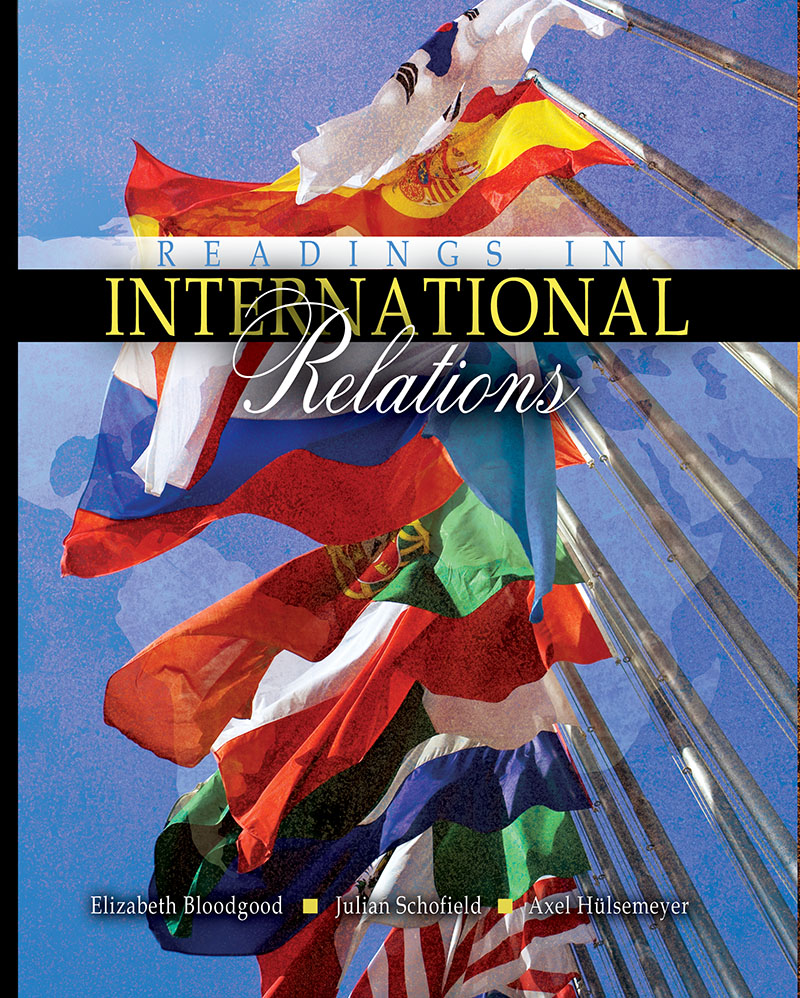
Readings in International Relations
Edition: 1
Copyright: 2011
Pages: 548
Choose Your Format
$96.03 USD
The Readings in International Relations introduces students to the major theories, concepts, and debates that shape the study of international politics and global affairs. Through a collection of classic and contemporary readings by influential scholars and political leaders, the book examines theoretical approaches such as realism, liberalism, constructivism, and feminism while exploring the dynamics of power, conflict, cooperation, globalization, international organizations, and human rights. By presenting foundational texts alongside modern perspectives, the reader helps students understand the competing explanations for how states and other international actors interact in an increasingly interconnected world.
Throughout the book, readers analyze topics including balance of power, diplomacy, war, international security, political economy, globalization, climate change, humanitarian intervention, and the role of non-state actors in global governance. Primary source readings from prominent thinkers—including Thucydides, Thomas Hobbes, Immanuel Kant, Hans Morgenthau, Kenneth Waltz, Alexander Wendt, and others—encourage critical analysis of historical and contemporary international issues. By integrating political theory with real-world case studies and global challenges, the text develops students' analytical, critical thinking, and decision-making skills while providing a strong foundation in the study of international relations and world politics.
PART I Theoretical Approaches to International Relations
INTRODUCTION
REALISM AND BALANCE OF POWER
The Melian Dialogue, Thucydides
Of the Natural Condition of Mankind as Concerning their Felicity and Misery, Thomas Hobbes
Six Principles of Political Realism, Hans J. Morganthal
The International System and Balances of Power, Kenneth Waltz
Alliances: Balancing and BandWagoning, Stephen Walt
Anarchy and the Limits of Cooperation, Joseph M. Grieco
The Sources of Soviet Conduct, George F. Kennan (X)
LIBERALISM
Containing the Definitive Articles for Perpetual Peace Among States, Immanuel Kant
Fourteen Points Address, Woodrow Wilson
Complex Interdependence, Robert Keohane and Joseph Nye
Liberalism and World Politics, Michael Doyle
CONSTRUCTIVISM AND FEMINISM
Anarchy is What States Make of It, Alexander Wendt
International Norm Dynamics and Political Change, Martha Finnemore and Kathryn Sikkink
Feminist Perspectives on National Security, J. Ann Tickner
PART II International Institutions and Cooperation
INTRODUCTION
RATIONAL CHOICE THEORIES OF COOPERATION
Explaining Cooperation Under Anarchy, Kenneth A. Oye
The Tragedy of the Commons, Garrett Hardin
INTERNATIONAL ORGANIZATIONS
Functionalism, Ernst B. Haas
The Political Origins of the UN Security Council's Ability to Legitimize the Use of Force, Erik Voeten
The Responsibility to Protect, Gareth Evans and Mohamed Sahnoun
PART Ill Force and War
INTRODUCTION
FORCE AND STATECRAFT
The Diplomacy of Violence, Thomas C. Schelling
The Clash of Civilizations?, Samuel P. Huntington
The Strategic Logic of Suicide Terrorism, Robert A. Pape
What is Economic Statecraft?, Robert Baldwin
WAR
Cooperation Under the Security Dilemma, Robert Jervis
Peace, Stability, and Nuclear Weapons, Kenneth N. Waltz
Possible and Impossible Solutions to Ethnic Civil Wars, Chaim Kaufmann
PART IV International Political Economy
INTRODUCTION
APPROACHES TO POLITICAL ECONOMY
The Study of International Political Economy, Robert Gilpin
The Domestic Sources of Foreign Economy Political, Michael J. Hiscox
GLOBALIZATION
The Trading World, Richard Rosecrance
The Globalization of the Economy, Jeffrey Frankel
Globalization and Governance, Kenneth N. Waltz
Competitiveness: A Dangerous Obsession, Paul Krugman
The Five Wars of Globalization, Moises Nairn
PART V Non-State Actors in International Relations
INTRODUCTION
ENVIRONMENTAL POLITICS
What is a Transnational Advocacy Network?, Margaret Keck and Kathryn Sikkink
Toward Effective International Cooperation on Climate Change: Numbers, Interests and Institutions, David G. Victor
HUMANITARIAN INTERVENTION
AND HUMAN RIGHTS
What are Human Rights?, Rhoda E. Howard and Jack Donnelly
Universal Declaration of Human Rights
Merchants of Morality, Clifford Bob
The Case for Universal Jurisdiction, Kenneth Roth

Dr. Beth Bloodgood is interested in the emergence and influence of non-governmental organizations (INGOs) and the political power of information and data. Her SSHRC-funded research (with Wendy Wong, Toronto, and Sarah Stroup, Middlebury) in partnership with Ajah examines NGO lifecycles and populations cross-nationally and over time in order to understand the relationships between national regulations, nonprofit data environments, and nonprofit regulators. The Global Registry of Nonprofit Data Sources (GRNDS) can be found at grnds.org and on the GRNDS Dataverse
Dr. Julian Spencer-Churchill (Schofield)’s research focuses on security and strategic studies, which means the study of state and non-state power, as well as the causes of war and peace. He has published on topics covering every continent except Europe. His principal research focus is on arms racing and its impact on war causation, the sharing of nuclear weapons, naval strategy, and military doctrine and planning. His field research has included work at the US Pentagon and State Department, Egypt, Indonesia, Bangladesh, India, and most frequently, Pakistan. His teaching focuses on strategic analysis, the procurement and deployment of nuclear weapons, the strategic studies of China, and causes of war and peace. He employs quantitative methodology, including operations research, statistics and games theory in all of his courses. He was an army engineer officer between 1988 and 2003.

Ph.D. University of Calgary (2002)
Master's University of Potsdam (1996)
Bachelor University of Hamburg (1993)
Dr. Axel Huelsemeyer teaches International Political Economy – with a focus on global and regional integration in trade and finance – as well as European Politics. Within the Department, Professor Huelsemeyer has acted as the very first Honor’s Adviser and Undergraduate Program Director (2004-2006), and as Graduate Program Director (2006-2008). More recently, he had been a committee member of the Graduate Curriculum.
The Readings in International Relations introduces students to the major theories, concepts, and debates that shape the study of international politics and global affairs. Through a collection of classic and contemporary readings by influential scholars and political leaders, the book examines theoretical approaches such as realism, liberalism, constructivism, and feminism while exploring the dynamics of power, conflict, cooperation, globalization, international organizations, and human rights. By presenting foundational texts alongside modern perspectives, the reader helps students understand the competing explanations for how states and other international actors interact in an increasingly interconnected world.
Throughout the book, readers analyze topics including balance of power, diplomacy, war, international security, political economy, globalization, climate change, humanitarian intervention, and the role of non-state actors in global governance. Primary source readings from prominent thinkers—including Thucydides, Thomas Hobbes, Immanuel Kant, Hans Morgenthau, Kenneth Waltz, Alexander Wendt, and others—encourage critical analysis of historical and contemporary international issues. By integrating political theory with real-world case studies and global challenges, the text develops students' analytical, critical thinking, and decision-making skills while providing a strong foundation in the study of international relations and world politics.
PART I Theoretical Approaches to International Relations
INTRODUCTION
REALISM AND BALANCE OF POWER
The Melian Dialogue, Thucydides
Of the Natural Condition of Mankind as Concerning their Felicity and Misery, Thomas Hobbes
Six Principles of Political Realism, Hans J. Morganthal
The International System and Balances of Power, Kenneth Waltz
Alliances: Balancing and BandWagoning, Stephen Walt
Anarchy and the Limits of Cooperation, Joseph M. Grieco
The Sources of Soviet Conduct, George F. Kennan (X)
LIBERALISM
Containing the Definitive Articles for Perpetual Peace Among States, Immanuel Kant
Fourteen Points Address, Woodrow Wilson
Complex Interdependence, Robert Keohane and Joseph Nye
Liberalism and World Politics, Michael Doyle
CONSTRUCTIVISM AND FEMINISM
Anarchy is What States Make of It, Alexander Wendt
International Norm Dynamics and Political Change, Martha Finnemore and Kathryn Sikkink
Feminist Perspectives on National Security, J. Ann Tickner
PART II International Institutions and Cooperation
INTRODUCTION
RATIONAL CHOICE THEORIES OF COOPERATION
Explaining Cooperation Under Anarchy, Kenneth A. Oye
The Tragedy of the Commons, Garrett Hardin
INTERNATIONAL ORGANIZATIONS
Functionalism, Ernst B. Haas
The Political Origins of the UN Security Council's Ability to Legitimize the Use of Force, Erik Voeten
The Responsibility to Protect, Gareth Evans and Mohamed Sahnoun
PART Ill Force and War
INTRODUCTION
FORCE AND STATECRAFT
The Diplomacy of Violence, Thomas C. Schelling
The Clash of Civilizations?, Samuel P. Huntington
The Strategic Logic of Suicide Terrorism, Robert A. Pape
What is Economic Statecraft?, Robert Baldwin
WAR
Cooperation Under the Security Dilemma, Robert Jervis
Peace, Stability, and Nuclear Weapons, Kenneth N. Waltz
Possible and Impossible Solutions to Ethnic Civil Wars, Chaim Kaufmann
PART IV International Political Economy
INTRODUCTION
APPROACHES TO POLITICAL ECONOMY
The Study of International Political Economy, Robert Gilpin
The Domestic Sources of Foreign Economy Political, Michael J. Hiscox
GLOBALIZATION
The Trading World, Richard Rosecrance
The Globalization of the Economy, Jeffrey Frankel
Globalization and Governance, Kenneth N. Waltz
Competitiveness: A Dangerous Obsession, Paul Krugman
The Five Wars of Globalization, Moises Nairn
PART V Non-State Actors in International Relations
INTRODUCTION
ENVIRONMENTAL POLITICS
What is a Transnational Advocacy Network?, Margaret Keck and Kathryn Sikkink
Toward Effective International Cooperation on Climate Change: Numbers, Interests and Institutions, David G. Victor
HUMANITARIAN INTERVENTION
AND HUMAN RIGHTS
What are Human Rights?, Rhoda E. Howard and Jack Donnelly
Universal Declaration of Human Rights
Merchants of Morality, Clifford Bob
The Case for Universal Jurisdiction, Kenneth Roth
Dr. Beth Bloodgood is interested in the emergence and influence of non-governmental organizations (INGOs) and the political power of information and data. Her SSHRC-funded research (with Wendy Wong, Toronto, and Sarah Stroup, Middlebury) in partnership with Ajah examines NGO lifecycles and populations cross-nationally and over time in order to understand the relationships between national regulations, nonprofit data environments, and nonprofit regulators. The Global Registry of Nonprofit Data Sources (GRNDS) can be found at grnds.org and on the GRNDS Dataverse
Dr. Julian Spencer-Churchill (Schofield)’s research focuses on security and strategic studies, which means the study of state and non-state power, as well as the causes of war and peace. He has published on topics covering every continent except Europe. His principal research focus is on arms racing and its impact on war causation, the sharing of nuclear weapons, naval strategy, and military doctrine and planning. His field research has included work at the US Pentagon and State Department, Egypt, Indonesia, Bangladesh, India, and most frequently, Pakistan. His teaching focuses on strategic analysis, the procurement and deployment of nuclear weapons, the strategic studies of China, and causes of war and peace. He employs quantitative methodology, including operations research, statistics and games theory in all of his courses. He was an army engineer officer between 1988 and 2003.
Ph.D. University of Calgary (2002)
Master's University of Potsdam (1996)
Bachelor University of Hamburg (1993)
Dr. Axel Huelsemeyer teaches International Political Economy – with a focus on global and regional integration in trade and finance – as well as European Politics. Within the Department, Professor Huelsemeyer has acted as the very first Honor’s Adviser and Undergraduate Program Director (2004-2006), and as Graduate Program Director (2006-2008). More recently, he had been a committee member of the Graduate Curriculum.