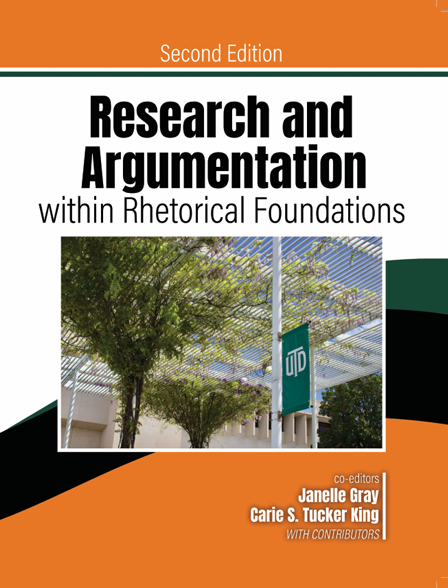
Research and Argumentation within Rhetorical Foundations
Edition: 2
Copyright: 2026
Pages: 216
Choose Your Format
$31.00 USD
First-year-writing college courses provide students with foundations for writing throughout their studies and their professional achievements. Writing allows students the opportunity to critically consider the purpose for their texts, to identify their readers, to plan their document, to iteratively work through the document, and to practice the writing process. Writing also gives students a voice -- the opportunity to put their ideas, their values, and their findings in writing. But creating these texts requires training -- on the writing process, rhetorical appeals, types of arguments, and processes for researching.
This book delivers an opportunity for a community of learners to learn together how to improve their writing, craft an effective message, research for evidence, and create a strong foundation for future writings. With input form undergraduate students and graduate writing instructors, we create this workbook for research and argumentation.
List of Figures
List of Contributors
Acknowledgments
Preface
Chapter 1— Define Rhetoric and Personalize the Writing Process
Chapter 2— Consider Rhetorical Appeals and the Rhetorical Situation
Chapter 3— Choose Your Argument Type and Structure
Chapter 4— Start Your Research Process to Identify and Evaluate Sources
Chapter 5— Analyze Your Sources, Enter the Conversation, and Build Rebuttals
Chapter 6— Attribute Your Sources and Choose Annotation Types
Chapter 7— King-Gray_189528Build Coherence in Your Draft and Your Message
Chapter 8— Present Evidence and Analysis and Engage in the Recursive Creative Process
Chapter 9— Employ the Review Process
Chapter 10— Discover Rhetorical Uses in Upper-Level Courses and Professional Settings
APPENDIXES
Appendix A—Basic Capitalization Rules
Appendix B—Basic Punctuation Rules
Appendix C—Eight Parts of Speech in the English Language
Appendix D—Basic Grammar Rules
Appendix E—Anatomy of a Sentence in English
Appendix F—Common Errors in First-Year Writing
Appendix G—Rhetorical Fallacies of Logic
Appendix H—Rhetorical Fallacies of Emotion
Appendix I—Additional Exercises
Janelle Gray is a PhD candidate, creative writer, and instructor. Her portfolio contains works of prose, poetry, theater, and TV/film. Her research and interdisciplinary methodology explore the connections between creative works, history, and actions toward justice and equity in creative and academic spaces.
Carie S. Tucker King, PhD, is Clinical Professor and Director of Rhetoric at UT Dallas. Her research encompasses pedagogy, science writing, and rhetoric, and she supports students and teaches writing and communication. Her publications include The Rhetoric of Breast Cancer (Lexington Studies) and Amplifying Voices in UX (SUNY Press).