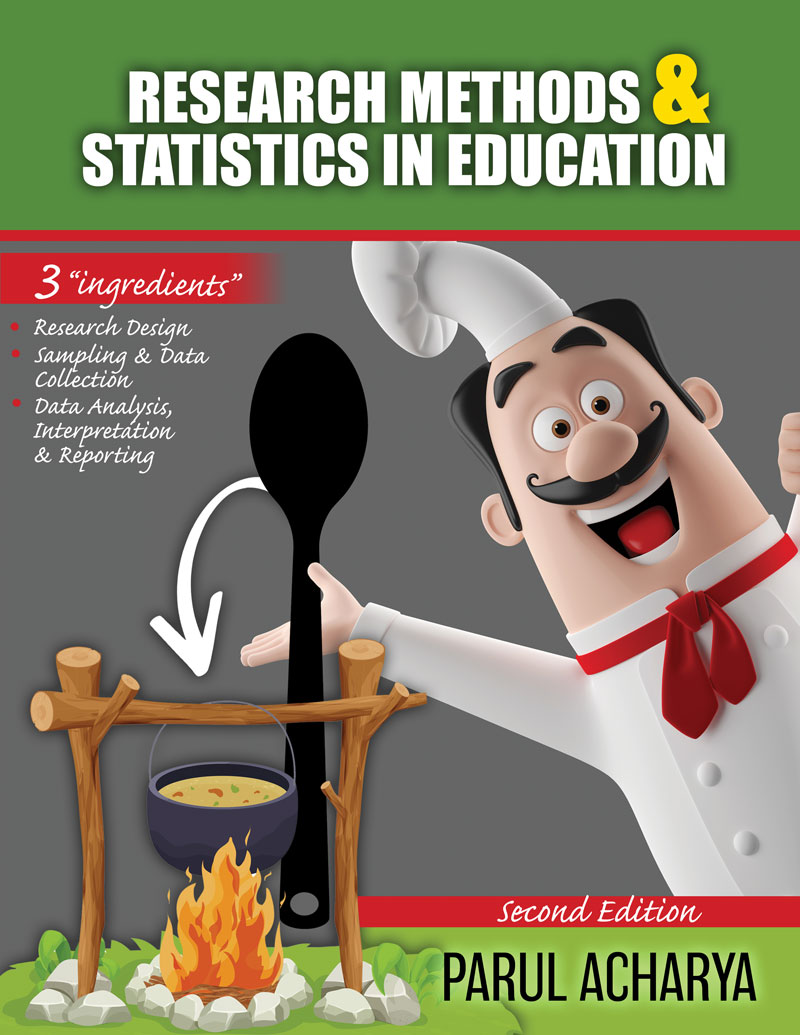
Research Methods and Statistics in Education
Edition: 2
Copyright: 2025
Edition: 2
Copyright: 2025
Choose Your Format
Choose Your Platform | Help Me Choose


Ebook Package
$79.99 USD
Print Package
$119.99 USD
This textbook can be used in an undergraduate or graduate course in research methods and data analysis. The textbook explains the basic building blocks of a research study in easy-to-understand language and shows the application of each concept through several examples. The examples are inspired by practical situations for the user to seamlessly connect the concepts to real-world cases. The book comes with a companion website which has numerous resources in the form of practice exercises and quizzes for each chapter, SPSS real-world data sets with research scenarios, worksheets, captioned video lectures for statistical models in Chapter 5, and glossary of terms. Chapter 1 is dedicated to writing a research study of problem statement, purpose statement, research questions, and hypotheses (null and research), which are explained through examples. The common terms used in research design, sampling, data collection, and data analysis are defined to help the reader familiarize with the language utilized in a research study. Chapter 2 on the review of literature provides steps to find relevant research articles related to the problem and purpose statement as well as examples to summarize a quantitative and qualitative research article. Chapter 3 discusses the main types of quantitative and qualitative research designs. The quantitative designs include descriptive research, causal-comparative research, experimental designs (causal-comparative, randomized controlled trials, and quasi-experimental), and correlational research. The qualitative research designs include phenomenology, ethnography, symbolic interactionism, and grounded theory. Chapter 4 focuses on sampling (random and purposive) designs, types of validity and reliability, and commonly used data collection procedures (e.g., tests, surveys, and interviews). Chapter 5 explains the two main types of data analysis procedures—descriptive statistics (measures of central tendency and measures of dispersion) and inferential statistics (univariate [statistical models with one dependent variable] and multivariate [statistical models with more than one dependent variable]).
SPECIAL FEATURES:
• A section on Glossary of Terms that are commonly used in research designs, sampling methods, data collection procedures, and data analysis models. The terms appear as hover-over definitions wherever they are used throughout the book.
• The exercises at the end of each chapter contain practice questions that are designed to test the reader’s knowledge, comprehension, and application of the concepts.
• Knowledge check questions are provided within each chapter to assess the reader’s comprehending of the topics covered in the subsections.
• The book contains over 100 research scenarios from various academic disciplines, which are practical and real-world examples that the reader can practice to test their comprehension on various aspects of research design, sampling, data collection methods, and data analysis procedures.
• The book contains around 60 SPSS datasets in Chapter 5, which can be used as practice questions and/or homework assignments.
• Coverage of a variety of univariate (t-tests, ANOVA, and linear regression) and multivariate (MANOVA, MANCOVA, exploratory factor analysis, discriminant analysis, and multinomial logistic regression) statistical models in Chapter 5, which includes both parametric and nonparametric models. Each statistical model is thoroughly explained, and its application is demonstrated through a step-by-step procedure in SPSS.
• Captioned videos to demonstrate the application of each statistical model in SPSS through a dataset.
• APA-style write-ups are included for each statistical model to summarize the key results in SPSS outputs.
• Hand calculations of t-test, ANOVA, and simple regression models would help the reader to gain a deep appraisal and a solid foundation of the mechanics involved in each statistical model.
• A list of references at the end of Chapter 3 (research designs), Chapter 4 (sampling and data collection), and Chapter 5 (data analysis) to locate additional information and resources on a specific topic.
• An objective-based, summative quiz at the end of each chapter that tests the reader’s knowledge on all the topics covered in each chapter.
• There are 15 worksheets that the reader can use to apply the concepts of constructs, variables, research design, sampling, data collection, and data analysis.
• An objective-based cumulative quiz that assesses all the content covered in each chapter. This cumulative quiz can be administered as an end-of-course final exam.
• A resource section at the end of the book on dissertation and scholarly writing, as well as quantitative and qualitative research.
Chapter 1 Building Blocks of a Research Study
Definition of Research
Objectives of Research
General Kinds of Research
Frameworks
Process of Aligning a Research Study to a Theoretical Framework
Problem Statement
Purpose Statement
Research Questions
Hypothesis
Common Terms Used in Research Design
Common Terms Used in Sampling and Data Collection
Common Terms Used in Data Analysis
References
Chapter 2 Review of Research Literature
Purpose/Objectives
Sources for Literature Review
Steps in Review of Literature
Process of Conducting a Systematic Literature Review
Common Structure of Reviewing a Research Study
Examples of Research Article Review
References
Chapter 3 Research Designs
Descriptive Research
Quantitative Research Design
Example Research Scenarios
Qualitative Research Design
References
Chapter 4 Sampling and Data Collection
Sampling Designs
Probability-Based Sampling Designs
Non-Probability-Based Sampling Designs
Examples of Sampling Designs
Constructs
Variables
Types of Variables
Validity and Reliability
Data Collection Methods
References
Chapter 5 Data Analysis
Descriptive Statistics
Inferential Statistics
Parametric Statistical Models
Non-Parametric Statistical
Models
Data Visualization
Reference
Appendices
Dr. Parul Acharya holds a Ph.D. in Educational Statistics with emphasis on research methods, psychometrics, data analysis, and program evaluation from the University of Central Florida. Dr. Acharya is a certified qualitative research methodologist. She has a multi-disciplinary academic background with degrees in Health Science, Kinesiology, Business Administration, Logistics/Supply Chain Management, Educational Statistics, Data Science, and Instructional Technology. She is currently working as a Professor at Columbus State University, Columbus, Georgia in the College of Education and Health Professions. She teaches graduate-level courses in research methods, statistics, data analytics, and program evaluation. Dr. Acharya has served as a Chairperson and/or Statistician for over 40 completed doctoral dissertations. She has published 30 peer-reviewed research articles. Parul has worked as a Principal Evaluator on research projects for the National Science Foundation (NSF) and the US Department of Education (USDOE). She regularly works on NSF and USDOE review panels as a subject matter expert of assessment and program evaluation. Dr. Acharya currently holds leadership positions within the special interest groups and Divisions of American Educational Research Association (AERA). Her research interests include: Technological issues with online teaching and student learning; STEM/STEAM-based intervention studies; Perceived Behavioral Interventions and Supports (PBIS); Pre-K to KG assessment, instruction and learning issues; Program Evaluation; Psychometrics (Scale Development and Validation); Monte Carlo Simulatio Studies; Scoping Review; Systematic Review. In the past, Dr. Acharya has worked in the Accountability, Assessment and Research Department in large school districts within the state of Florida as an Assessment and Program Evaluation Analyst.