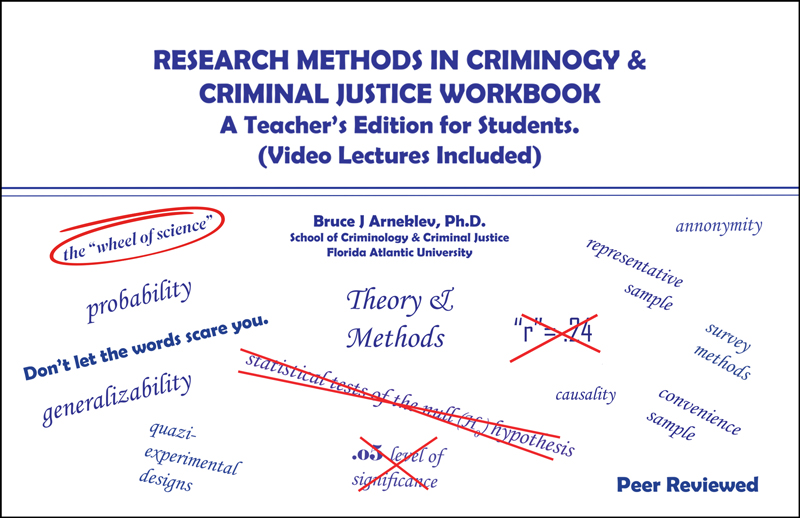
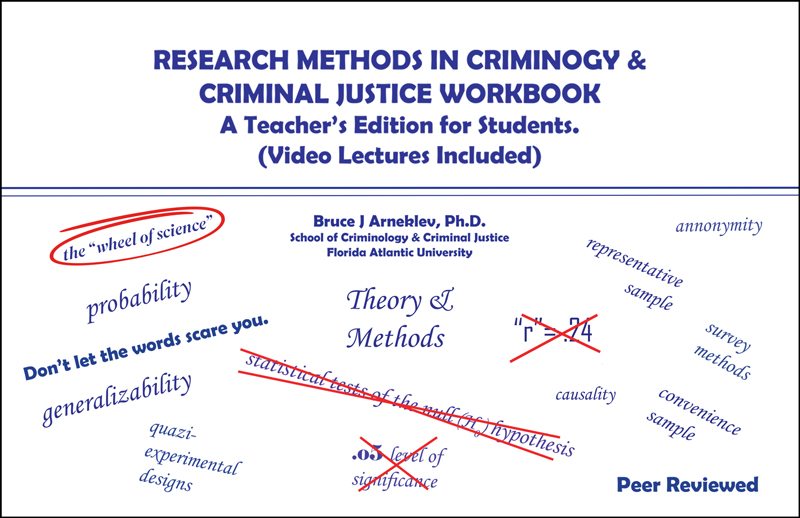
Research Methods in Criminology and Criminal Justice: An Interactive Workbook
Edition: 1
Copyright: 2026
Pages: 278
Choose Your Format
Website
$80.00 USD
Research Methods in Criminology and Criminal Justice: An Interactive Workbook provides a comprehensive introduction to the principles and practices of social science research within criminology and criminal justice. It begins by establishing the foundations of the scientific method, including theory development, causality, conceptualization, operationalization, and research design. It then explores key research methodologies, such as surveys, sampling, quantitative and qualitative analysis, experimental and quasi-experimental approaches, and evaluation research. The text concludes by developing students' ability to critically read and interpret academic research, equipping them with the knowledge and skills needed to design, conduct, and evaluate research in criminology and criminal justice.
Part I – Criminology and Criminal Justice and the Social Scientific Method
Chapter 1 – Introduction to Research Methods in Criminology and Criminal Justice and to the Social Scientific Method
Chapter 2 – Casual Human Inquiry and Social Scientific Inquiry
Chapter 3 – Theory
Chapter 4 – The Entire “Process” of Constructing and Testing a ₮heory
Chapter 5 – Causality: The Prediction of “Outcomes/Events”
Chapter 6 – Conceptualization and Operationalization: The Transformation of Theoretical “Concepts” into Measurable/ Observable “Variables”
Chapter 7 – Tightening-Up the Research Project: Decisions to Make
Part II – Criminology and Criminal Justice and the Social Scientific Method
Chapter 8 – Criteria for Comparing the Advantages and Disadvantages of the Different Methods for Collecting Data
Chapter 9 – Survey Methods
Chapter 10 – Sampling
Chapter 11 – The Logic of Quantitative Data Analysis (o Survey Data)
Chapter 12 – Experimental Methods
Chapter 13 – Qualitative Methods
Chapter 14 – Evaluation Research and Quasi-Experimental Methods
Chapter 15 – Reading Academics Articles
Dr. Bruce J. Arneklev is an Associate Professor in the School of Criminology & Criminal Justice (SCCJ) at Florida Atlantic University (FAU). His research interests include criminological theory testing especially theories including and/or related to the concept of “low self-control.” He has developed original quantitative measures for concepts such as “low self-control,” the “desire to control ‘low self-control’,” “curiosity,” and “exploratory deviance.” A portion of his present research looks at whether curiosity may be an overlooked concept in crime/deviance decision making process. His research has been published in journals such as Criminology, Journal of Research in Crime & Delinquency, Journal of Quantitative Criminology and Deviant Behavior.
Dr. Arneklev teaches classes in Criminology, Methods of Research in Criminology & Criminal Justice, Law, Crime, and the Criminal Justice System, and Understanding Criminal Behavior (at the graduate level). Dr. Arneklev serves as a member of FAU’s Steering Committee, the University’s Faculty Senate, the University’s Intercollegiate Athletics Committee, and he is Chair of the Student-Athlete Well-Being Committee at FAU. He is also a strong believer in student engagement and has been the faculty adviser for FAU’s Tae Kwon Do Club for the past 25 years.
Recently Dr. Arneklev published a unique research methods textbook entitled Research Methods in Criminology & Criminal Justice Workbook: A Teacher’s Edition for Students (ISBN: 9798385113620), which is completely organized around the scientific method. Students that read the text learn rather quickly that the scientific method can be envisioned through the examination of the “Wheel of Science.” Therefore, every chapter is related to this underlying theme, which students can envision as they read the text. In other methods textbooks students typically read from one chapter to another and there is nothing that links those chapters together. Therefore, students are typically forced to memorize definitions for unique concepts in one chapter, perhaps get tested on them, then they can forget about them as they move on to the next chapter for more useless memorization. This type of “learning” can be a very frustrating not to mention being a rather boring way to study methods of research. With the scientific method as the underlying theme for the entire text, all of the chapters are related to one another and students understand their linkage. So, for example, in the later half of the text, students will read a chapter on survey methods, another chapter on experimental methods, and another chapter on qualitative methods. All of these chapters deal with “methods for data collection,” which is Step #3 of the Wheel of Science call Data Collection. In research methods, we use such “data” to empirically evaluate our “theories,” for example, about what causes involvement in crime. And guess what? In the first half of the text, “theories” are discussed, which are developed in Step #1 of the Wheel of Science which is call Theories. Therefore, all of the chapters in the textbook are logically linked together.
One final note for the students using this textbook to keep in mind as you begin your study of the Wheel of Science and the scientific method is that most of the chapters in this textbook evolved out of lectures that Dr. Arneklev has given over the course of the 30 plus years that he has been teaching Methods of Research in Criminology and Criminal Justice. Therefore, when you see that you will be asked to read at least two chapters a week (and even more during the summer semester) they are not the traditional length of other chapters in other textbooks (e.g., where an intructor might assign and/or discuss only certain parts of the chapter). The chapters in the new textbook have been streamlined already. Therefore, you will be able to cover the amount of material assigned. I hope that eases your mind a little bit! What also may help, as you will find out soon, is that Dr. Arneklev has already included his Video Lectures within each of the chapters of the new textbook. In each of these Video Lectures, Dr. Arneklev will literally be explaing things to you as you work your way through each of the chapters! So, you will not really be reading and figuring things out on your own. Pretty innovative (and rather cool)! 😉