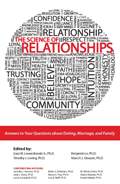
The Science of Relationships: Answers to Your Questions about Dating, Marriage and Family
Edition: 1
Copyright: 2011
Pages: 258
Edition: 1
Copyright: 2011
Pages: 264
Choose Your Format
Ebook
$33.19 USD
$58.72 USD
If you could ask any question about relationships, marriage, family, or parenting, what would you ask? Coincidentally, we've been working on a book (that big title up there) that answers 40 of the most common questions. The book is edited by the creators of ScienceOfRelationships.com, and includes contributions from the authors and many of their colleagues.
The key difference between this book and the other books on relationships out there is that all of the contributors are relationship scientists and teachers at colleges/universities who are true experts on relationships. We take that expertise, add in a little research, and present things in an easy to read format.
Some of the questions answered include:
- What makes someone hot, and others not?
- Are we meant to be monogamous?
- Why do people stay in bad relationships?
- My family and friends don’t like my partner. Should I listen to them?
- How long should I wait before sleeping with my partner?
- Will having kids ruin our relationship?
- Will my partner cheat?
- ...and many more...
Science of Relationships website http://www.scienceofrelationships.com/
Click here to read an author interview with The Denver Post.
Click here to view a discussion with Dr. Jennifer Harman about her research.
Introduction: Why do we need another book on relationships?
Contributors: Editors
Chapter 1: Attraction & Relationship Initiation
Q1. What makes someone hot, and others not?
Q2. How can I tell if someone is interested in me?
Q3. What’s the best way to meet someone?
Q4. Does ‘playing hard to get’ work?
Chapter 2: Intimacy & Attachment
Q5. Are some people more ready for relationships than others?
Q6. Is it possible to ‘fix’ a partner?
Q7. Isn’t being too close to a partner a bad thing?
Q8. Is there any truth behind the saying that we “marry our father (or mother)”?
Chapter 3: Love
Q9. What is love?
Q10. Is love really blind?
Q11. Does love last forever?
Q12. Are we meant to be monogamous?
Chapter 4: Commitment & Long-Term Relationships
Q13. How do I know if I’ve found “Ms./Mr. Right”?
Q14. Why do people stay in bad relationships?
Q15. I read somewhere that the ‘family is under attack.’ What does this mean, and is it true?
Q16. Should homosexuals be allowed to marry?
Q17. Is relationship (premarital) counseling useful?
Q18. Once a cheater, always a cheater?
Q19. Isn’t a little jealousy a good thing?
Q20. How long should a breakup affect me?
Chapter 5: Power & Conflict
Q21. Why does one person in a relationship tend to always get his or her way?
Q22. Will my husband resent me if I make more money than he does?
Q23. What do most couples fight about?
Q24. Should I really ‘forgive and forget’ when my partner is insensitive?
Chapter 6: Cognition
Q25. I have high expectations for my relationship. Is that bad?
Q26. My family doesn’t like my partner. Should I listen to them?
Q27. I believe for a relationship to work, partners must be soulmates. Am I right?
Chapter 7: Sex
Q28. Does sex lead to love, or does love lead to sex? Is one ‘direction’ better?
Q29. Will we stop having sex once we’re married?
Q30. How have sexual attitudes changed over time?
Q31. How long should I wait before sleeping with my partner?
Chapter 8: Living Together
Q32. Should I live with my partner before we get married?
Q33. Are people less happy after they get married?
Q34. Should we combine our money?
Q35. Is there a good way to fight?
Chapter 9: Expanding the Family
Q36. Is there a ‘good’ time to have kids?
Q37. Will having kids ruin our relationship?
Q38. What will happen to us if my partner or I are not able to have kids?
Q39. Am I wrong for not wanting to have kids?
Chapter 10: Parenting
Q40. Will I be a good parent?
Q41. What happens when both parents don’t agree on how to parent?
Q42. Is there a best way to discipline my kids?
Q43. Should I spank my kids?
Q44. I want to keep working after I have a baby. Am I a bad mother (or father) for putting my child in childcare?
Epilogue
Contributors: Editors
Dr. Loving received his Ph.D. in Social Psychology from Purdue University in 2001. He is currently an Associate Professor in The University of Texas at Austin’s Department of Human Development and Family Sciences. Prior to arriving at Texas, he received post-doctoral training at The Ohio State University College of Medicine in Psychoneuroimmunology. Dr. Loving’s research addresses the mental and physical health impact of relationship transitions, with a particular focus on affectively positive transitions (e.g., falling in love) and the role network members serve as relationship partners adapt to these transitions. He is currently an Associate Editor of Personal Relationships and a member of the editorial board for the Journal of Personality and Social Psychology and is a co-founder of www. ScienceOfRelationships.com. His work has been published in the Journal of Personality and Social Psychology, Personal Relationships, Psychosomatic Medicine, Psychoneuroendocrinology, and Archives of General Psychiatry. In addition, he teaches a large introductory course on family relationships and has received numerous teaching awards for his teaching excellence.
Dr. Lewandowski received his Ph.D. in Social/Health Psychology from the State University of New York at Stony Brook in 2002. Gary is an Associate Professor at Monmouth University, where he teaches courses in Intimate Relationships and Research Methodology, and he is a co-founder of www.ScienceOfRelationships.com. Currently, he is a member of the editorial board for the Journal of Social and Personal Relationships. His research has been published in a number of scholarly journals and focuses on romantic relationships, including interpersonal attraction, relationship maintenance, infidelity, and break-ups. His research has been featured in a number of media outlets including: local newspapers, The New York Times, CNN, Science Daily, United Press International, Woman’s World, Marie Claire, WebMD, Self Magazine, Woman’s Day, Cosmopolitan Magazine, Ladies Home Journal, Women’s Health, Men’s Health, and USA Today.
Dr. Campbell earned his Ph.D. in Social Psychology from Texas A&M University in 2001 and is currently an Associate Professor of psychology at the University of Western Ontario. He is a recognized expert in the fields of inter- personal relationships, research design and data analysis, and evolutionary psychology. Lorne’s work includes an impressive list of published research articles and chapters, and he has been the recipient of many research grants and awards. From 2008-09 Lorne was a Harrington Faculty Fellow at the University of Texas at Austin. He is on the editorial board of Journal of Personality and Social Psychology and Personality and Social Psychology Bulletin and is currently the editor of the journal Personal Relationships. Dr. Campbell has also discussed research regarding interpersonal relationships with many media outlets, including print media, national and local radio programs, and national and local television programs.
Dr. Rafaeli received his Ph.D. from Northwestern University in Clinical and Personality Psychology in 2001. He is currently the head of the adult clinical psychology program at Bar-Ilan University, and serves as a research scientist at Barnard College, Columbia University. Eshkol’s research addresses affective and relational processes in typical individuals as well as in ones suffering from psychopathology – primarily personality disorders. His clinical training was predominantly cognitive behavioral, with an internship at McLean Hospital/Harvard Medical School, and additional training in structural family therapy at the Minuchin Center for Family Therapy. He is a founder of the Israeli Institute of Schema Therapy and co-authored the book Schema Therapy: Distinctive Features with Jeffrey Young and David Bernstein.
Dr. Neff received her Ph.D. in Social Psychology from the University of Florida in 2002 and is currently an Assistant Professor in the Department of Human Development and Family Sciences at the University of Texas at Austin. She is an expert on marital relationships and her research focuses on identifying the factors that contribute to marital well-being and dissolution. She currently has funding from National Science Foundation to examine how stressors outside the marriage (e.g. work stress, financial strains) may influence relationship processes and outcomes during the early years of marriage.
Dr. Mashek earned her Ph.D. in Social/Health Psychology from the State University of New York at Stony Brook in 2002, and is currently an Associate Professor of Psychology at Harvey Mudd college. Her research interests include the experience of feeling too close to intimate others, processes involved in confusing the self with close others, and extending close relationship theory to the community domain. Her research has been highlighted in high-profile media outlets including The New York Times, Time Magazine, and USA Today. Deb is an award-winning teacher and regularly contributes to psychology textbook projects. Her edited volume, Empirical Research in Teaching and Learning, blends her research interests with her passion for teaching.
Dr. Gleason received her Ph.D. at New York University in Social and Organizational Psychology in 2004 and is currently an assistant professor in Human Development and Family Sciences at the University of Texas at Austin. Her research focuses on how couples navigate stressful circumstances such a chronic illness and the transition to parenthood. She is currently teaching a senior level course on how families navigate important transitions such as marriage, parenthood, divorce, and bereavement.
Dr. Edelstein is an Assistant Professor of Psychology at the University of Michigan. She received her Ph.D. in Social/Personality Psychology from the University of California, Davis, in 2005, and completed a postdoctoral fellowship in the Department of Psychology and Social Behavior at the University of California, Irvine. Her research focuses on close relationships in adulthood, particularly individual differences in the way that people regulate their emotions and behavior in close relationships and the physiological implications of these differences. Robin teaches graduate and undergraduate courses in close relationships, and she is currently serving on the editorial board of Personal Relationships and Social Psychological and Personality Science.
Dr. Oriña is a developmental social psychologist whose program of research examines processes that help individuals maintain and enhance the quality of their adult romantic relationships. Currently, she is on the editorial board of Psychological Science, Journal of Personality and Social Psychology, Personality and Social Psychology Bulletin, and Personal Relationships. Her primary interests involve studying romantic relationships within a developmental context. By understanding prior developmental history in conjunction with proximal factors, she believes that we will achieve a deeper and more nuanced understanding of current relationship functioning and dynamics. Additional research interests include social influence in romantic relationships, attachment theory, interdependence theory, empathic accuracy, power, and trust.
Dr. Davis earned her Ph.D. in Social Psychology from the University of North Carolina in 2000 and is currently an Associate Professor of psychology at Virginia Commonwealth University, where she teaches courses on interpersonal relationships, social psychology, and the teaching of psychology. Her research examines close relationship processes such as attitude alignment, forgiveness, and sacrifice. She also is interested in non-interpersonal relationships such as interdependence with the natural world.
Dr. Le earned his Ph.D. in Social Psychology from Purdue University in 2003 and is currently an Associate Professor of psychology at Haverford College. He has been doing research on close relationships since 1996, and his current work involves commitment, the experience of geographic separation in relationships, and relationship maintenance, as well as how social networks influence dating relationships. Currently, he is a member of the editorial board for the journal Personal Relationships and a co-founder of www.ScienceOfRelationships.com.
Dr. Frye received her Ph.D. in Social Psychology from the University of Florida in 2002 and is currently an Associate Professor at Long Island University Post. Her research interests include factors related to the use of physical aggression within romantic relationships, and while at the University of Florida she contributed to the design and management of two four-year longitudinal studies of newlywed marriage. Nancy has published articles on marital processes and development in journals such as Journal of Personality and Social Psychology and Personality and Social Psychology Bulletin.
Dr. Harman received her Ph.D. at the University of Connecticut in Social Psychology in 2005 and is currently an Assistant Professor of psychology at Colorado State University. In addition, she has graduate training in psychological counseling at Teacher’s College, Columbia University, and post-graduate training in Gestalt psychotherapy. She worked for several years as a counselor and counseling supervisor before finishing her doctorate, and she now studies interpersonal processes in intimate relationships. Specifically, Jennifer examines relationship behaviors (e.g., sexual risk taking, communication problems) that put people at risk for physical and psychological health problems.