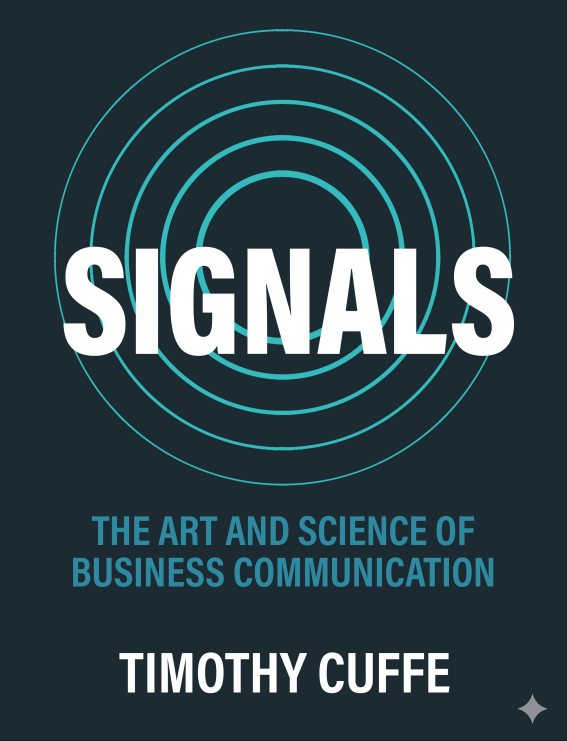
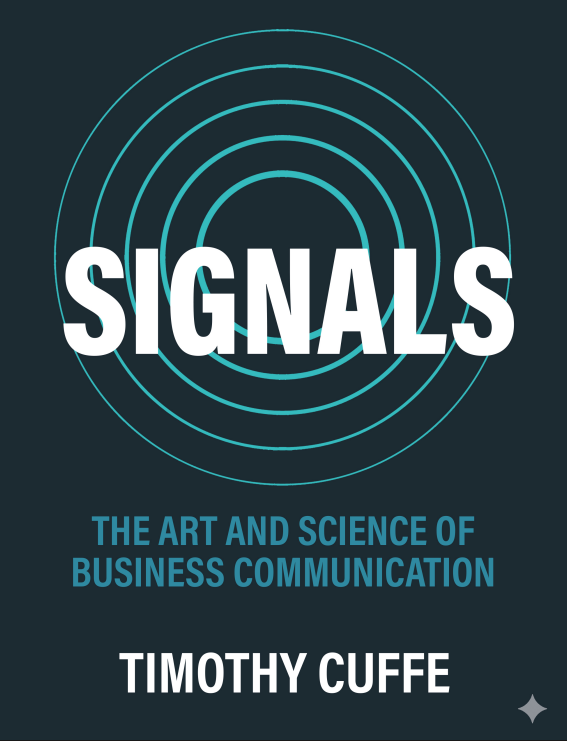
Signals: The Art and Science of Business Communication

Author(s): Timothy Cuffe

Edition: 1

Copyright: 2026

Pages: 185

Choose Your Format

Choose Your Platform | Help Me Choose

Ebook

$65.00 USD

ISBN 9798319700070

Details Electronic Delivery EBOOK 180 days

Business success is rarely determined by what you know. It’s determined by how clearly, credibly, and ethically you communicate what you know, especially when stakes are high, audiences are diverse, and decisions must be made quickly. 

The Art and Science of Business Communication reframes communication not as a “soft skill,” but as a core leadership discipline. Grounded in behavioral science, psychology, and real-world case studies to explore how people actually interpret messages and why even well-intentioned communication so often fails. Readers learn how to analyze audiences, anticipate cognitive bias, listen strategically, write with purpose, and communicate ethically across cultures, channels, and power structures. Each chapter blends clear frameworks with practical tools, reflection prompts, and scenarios drawn from global institutions, regulated industries, and everyday professional environments. From writing emails that get results to navigating difficult conversations, influencing stakeholders, and presenting with impact, the focus is always on communication that leads to action. 

Key features include:

  • Clear, accessible explanations grounded in real business contexts
  • Practical frameworks for audience analysis, ethical communication, persuasion, and influence
  • Case studies spanning finance, consulting, technology, and public institutions
  • Exercises, reflection prompts, and applied assignments suitable for classroom or self-study
  • Coverage of modern communication challenges, including digital communication, bias, and AI

Acknowledgments 
Preface 
The Purpose of This Book 
Introduction 

CHAPTER 1 Why Communication Matters in Business 

CHAPTER 2 Understanding Your Audience 

CHAPTER 3 The Psychology Behind Communication—Navigating the Human Landscape for Strategic Impact 

CHAPTER 4 Beyond Active Listening: The Foundation of Communication 

CHAPTER 5 The Essentials of Business Writing: Mastering Impact and Influence 

CHAPTER 6 Jargon—the Double-Edged Sword 

CHAPTER 7 Ethical Principles of Communication in Business 

CHAPTER 8 Persuasion 

CHAPTER 9 Writing for Impact 

CHAPTER 10 Storytelling in Business Communication 

CHAPTER 11 The World is Your Office: Cross-Cultural Communication and Context 

CHAPTER 12 Digital Presence and Professional Branding

CHAPTER 13 Delivering High-Impact Presentations 

CHAPTER 14 Conflict Resolution and Difficult Conversations

Timothy Cuffe

Timothy Cuffe is a Professor of Law and Business at the University of British Columbia, where he teaches business communication, leadership, and strategic narrative. Since 2017, he has worked closely with undergraduate and graduate students to bridge the gap between academic theory and professional practice, emphasizing clarity, ethical persuasion, audience awareness, and real-world decision-making in complex organizational environments. 

Alongside his academic work, Timothy is a strategic advisor with global experience spanning financial services, consulting, and the public and nonprofit sectors. Over the course of his international career, he has advised senior leadership teams at some of the world’s largest institutions, including McKinsey & Company, HSBC, Citibank, and Barclays, on stakeholder engagement, executive communications, reputation management, and investor relations. 

Timothy’s professional background includes senior leadership roles across North America, Europe, and Asia-Pacific, where he led corporate relations, communications, and market positioning initiatives for global financial institutions. His experience translating complex financial, strategic, and regulatory issues into clear, credible narratives directly informs the applied frameworks and case studies throughout this book. 

As both an educator and practitioner, Timothy is committed to equipping the next generation of leaders with communication skills that are not only persuasive, but principled—grounded in clarity, empathy, and professional responsibility.

Business success is rarely determined by what you know. It’s determined by how clearly, credibly, and ethically you communicate what you know, especially when stakes are high, audiences are diverse, and decisions must be made quickly. 

The Art and Science of Business Communication reframes communication not as a “soft skill,” but as a core leadership discipline. Grounded in behavioral science, psychology, and real-world case studies to explore how people actually interpret messages and why even well-intentioned communication so often fails. Readers learn how to analyze audiences, anticipate cognitive bias, listen strategically, write with purpose, and communicate ethically across cultures, channels, and power structures. Each chapter blends clear frameworks with practical tools, reflection prompts, and scenarios drawn from global institutions, regulated industries, and everyday professional environments. From writing emails that get results to navigating difficult conversations, influencing stakeholders, and presenting with impact, the focus is always on communication that leads to action. 

Key features include:

  • Clear, accessible explanations grounded in real business contexts
  • Practical frameworks for audience analysis, ethical communication, persuasion, and influence
  • Case studies spanning finance, consulting, technology, and public institutions
  • Exercises, reflection prompts, and applied assignments suitable for classroom or self-study
  • Coverage of modern communication challenges, including digital communication, bias, and AI

Acknowledgments 
Preface 
The Purpose of This Book 
Introduction 

CHAPTER 1 Why Communication Matters in Business 

CHAPTER 2 Understanding Your Audience 

CHAPTER 3 The Psychology Behind Communication—Navigating the Human Landscape for Strategic Impact 

CHAPTER 4 Beyond Active Listening: The Foundation of Communication 

CHAPTER 5 The Essentials of Business Writing: Mastering Impact and Influence 

CHAPTER 6 Jargon—the Double-Edged Sword 

CHAPTER 7 Ethical Principles of Communication in Business 

CHAPTER 8 Persuasion 

CHAPTER 9 Writing for Impact 

CHAPTER 10 Storytelling in Business Communication 

CHAPTER 11 The World is Your Office: Cross-Cultural Communication and Context 

CHAPTER 12 Digital Presence and Professional Branding

CHAPTER 13 Delivering High-Impact Presentations 

CHAPTER 14 Conflict Resolution and Difficult Conversations

Timothy Cuffe

Timothy Cuffe is a Professor of Law and Business at the University of British Columbia, where he teaches business communication, leadership, and strategic narrative. Since 2017, he has worked closely with undergraduate and graduate students to bridge the gap between academic theory and professional practice, emphasizing clarity, ethical persuasion, audience awareness, and real-world decision-making in complex organizational environments. 

Alongside his academic work, Timothy is a strategic advisor with global experience spanning financial services, consulting, and the public and nonprofit sectors. Over the course of his international career, he has advised senior leadership teams at some of the world’s largest institutions, including McKinsey & Company, HSBC, Citibank, and Barclays, on stakeholder engagement, executive communications, reputation management, and investor relations. 

Timothy’s professional background includes senior leadership roles across North America, Europe, and Asia-Pacific, where he led corporate relations, communications, and market positioning initiatives for global financial institutions. His experience translating complex financial, strategic, and regulatory issues into clear, credible narratives directly informs the applied frameworks and case studies throughout this book. 

As both an educator and practitioner, Timothy is committed to equipping the next generation of leaders with communication skills that are not only persuasive, but principled—grounded in clarity, empathy, and professional responsibility.
