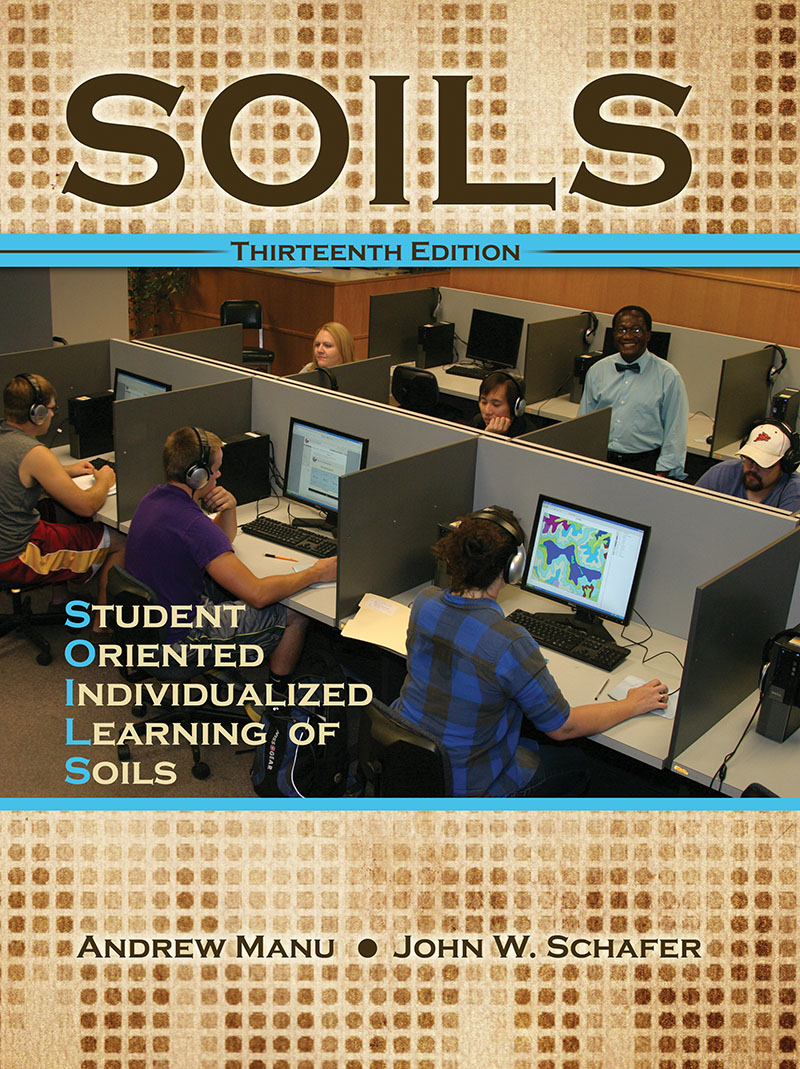
Soils: Student Oriented Individualized Learning of Soils
Edition: 13
Copyright: 2013
Pages: 346
Edition: 13
Copyright: 2013
Pages: 346
Choose Your Format
Ebook
$57.89 USD
$79.00 USD
Soils: Student Oriented Individualized Learning of Soils provides an introduction to soil science, covering soil physical, chemical, and biological properties; soil formation and classification; parent materials; soil water and erosion; soil taxonomy; soil organisms and organic matter; nutrient management; soil fertility; and sustainable practices for maintaining productive soils.
Preface
UNIT 1 Introduction, Density and Pore Space
UNIT 2 The Soil Profile
UNIT 3 A Closer Look at the Soil Solids - Soil Texture
UNIT 4 The Significance of Soil Texture and Soil Structure
UNIT 5 Managing Soil Physical Properties
UNIT 6 Rocks and Minerals
UNIT 7 Transported Sediments as Parent Materials - Ice and Water
UNIT 8 Transported Sediments as Parent Materials - Wind and Gravity
Horizons of Soil Taxonomy
UNIT 9 Soil Taxonomy - The Six Levels of Classification
UNIT 10 Soil Development and Soil Taxonomy - Moisture, Entisols, Inceptisols and Mollisols
UNIT 11 Vegetation, Alfisols, Climate (Temperature) and Ultisols
UNIT 12 Topography and Soil Erosion
UNIT 13 Soil Erosion and Its Control
UNIT 14 Soil Water I
UNIT 15 Soil Water II
UNIT 16 The Amount of Water in the Soil
UNIT 17 Surface Chemistry
UNIT 18 Amending the Soil - pH Dependent Cation Exchange
UNIT 19 Silicate Clays
UNIT 20 Oxisols, Spodosols, Vertisols, Andisols, Aridisols, Salty Soils and Gelisols
UNIT 21 Soil Organisms
UNIT 22 Soil Organic Matter and Histosols
UNIT 23 Assessing Nutrient Needs
UNIT 24 Phosphorus and Potassium
UNIT 25 Nitrogen
UNIT 26 Calcium, Magnesium and Sulfur -- Soil Taxonomy Revisited
UNIT 27 Micronutrients and Manure Management
UNIT 28 Meeting Fertility Needs