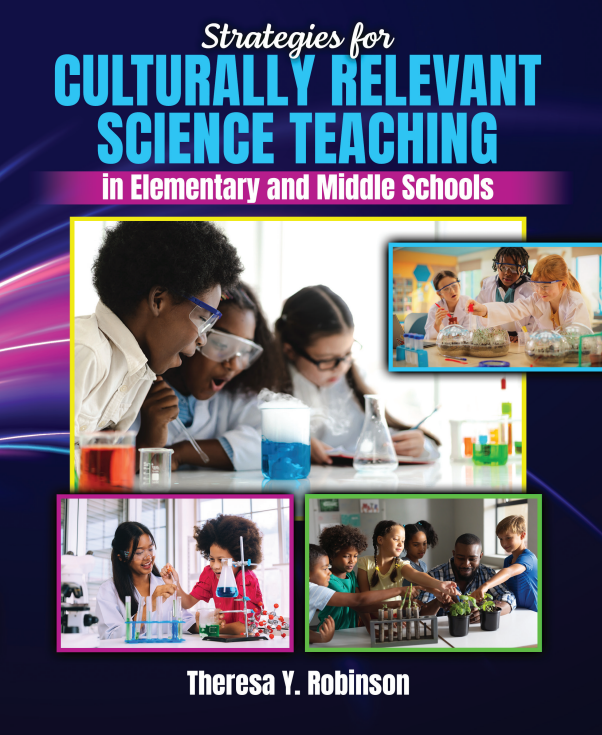
Strategies for Culturally Relevant Science Teaching in Elementary and Middle Schools
Edition: 1
Copyright: 2025
Pages: 206
Edition: 1
Copyright: 2025
Choose Your Format
$80.00 USD
Ebook
$40.00 USD
Now Available!
Strategies for Culturally Relevant Science Teaching in Elementary and Middle School offers a comprehensive guide for current and future educators committed to meaningful, equitable, and effective science teaching. Grounded in personal reflection, educational theory, and classroom practice, it supports teachers in developing their identity as science educators while equipping them with practical strategies to engage all learners.
Chapter 1, My Science Story, invites educators to reflect on their own experiences with science and to help students discover and articulate their personal science stories. By recognizing how identity and lived experiences shape learning, teachers can foster stronger connections between students and scientific inquiry. Chapter 2, Understanding Science Standards for the Next Generation, provides an overview of the National Science Education Standards and their historical development, followed by an in-depth look at the Framework for K–12 Science Education. Emphasis is placed on equity, diversity, and access, as well as the three dimensions of science learning—disciplinary core ideas, science and engineering practices, and crosscutting concepts—to support rigorous and inclusive instruction. Chapter 3, Classroom Environment and Culture, explores the role of democratic education, teacher self-efficacy, and critical thinking in science classrooms. It highlights the importance of social-emotional development and presents strategies for integrating science and social-emotional learning. The chapter also addresses practical considerations such as creating a caring classroom climate and designing an effective classroom setup that supports collaboration and inquiry. Chapter 4, Culturally Relevant Science Teaching, focuses on teaching practices that honor students’ cultural backgrounds and lived experiences. It reviews effective instructional models such as the 5E Model and the Learning Cycle, and introduces the SALK Model as a framework for culturally relevant science instruction. Chapter 5, Language and Literacy in Science Teaching, emphasizes the critical role of language in science learning. Topics include bilingual education, content-based literacy instruction, and the use of children’s literature and young adult literature to support comprehension. The chapter also highlights writing-to-learn strategies as tools for deepening scientific understanding. Chapter 6, Assessment for Student Learning, defines assessment as an ongoing process that informs instruction and supports student growth. It discusses strategies for preparing students for tests and quizzes and outlines effective ways to use formative and summative assessments to enhance learning rather than simply measure it. Chapter 7, Family and Community Engagement in Science, underscores the importance of partnerships beyond the classroom. It explores ways to involve families in science learning, encourages science activities at home, and highlights community-based science experiences that extend learning and reinforce the relevance of science in everyday life.
Together, these chapters present a holistic, student-centered approach to science education—one that integrates standards-based instruction, cultural relevance, literacy, assessment, and community engagement to support all students as capable and confident science learners
Contents
Foreword—Bryan A. Brown, Stanford University
Introduction
How This Book Will Be Useful
What Is Science?
The Process-Product Model of Science
Science, Technology, Engineering, and Mathematics (STEM)
Features of This Book
Chapter 1 My Science Story
Early STEM Experiences
My First Science Teacher
School-Community Science Connections
Culturally Relevant, Responsive, Sustaining, and Affirming
Chapter 2 Understanding Science Standards for the Next Generation
Equity in Science Education
National Science Education Standards, Historical Perspectives
Framework for K-12 Science Education
Three Dimensions for Science Learning
Interpreting the ‘Standards’
The 5E Instructional Model
Science Lesson Planning
Chapter 3 Classroom Environment & Culture
Democracy and Education
Teacher Self-Efficacy in Teaching Science
Critical Thinking Skills and Abilities
Social-Emotional Development and Learning
STEM and Social-Emotional Development
Science and Social-Emotional Learning Strategies for Teachers
Cooperative Learning and Group Work
Social-Emotional Learning in Science Education
Establishing a Caring Classroom Environment
Establishing and Maintaining Safe, Caring, Participatory, and Well Managed Classrooms
Classroom Setup Essentials
Essential Science Equipment
Chapter 4 Culturally Relevant Science Instruction
Culturally Relevant Science Education
Culturally Relevant Pedagogy
Models of Effective Science Teaching
The S.A.L.K. Model for Culturally Relevant Science Teaching
Case Study: Science as a Cultural Accomplishment
Chapter 5 Language and Literacy
Language and Success in Science Learning
Multilingual Learners
Bilingual Education
Case Study: A Case for Bilingual Science Education
Content-Based Literacy Instruction
Reading to Learn Science
Children’s Literature, and Young Adult Literature
Writing to Learn Science
Claim, Evidence, and Reasoning (CER) framework
Digital Literacy
Chapter 6 Assessment for Student Learning
Theory/Conceptual Framework
What Is Assessment?
Part 1: Parts of the Light Microscope
Part 2: Letter “e”
Preparing Students for Tests and Quizzes
Suggestions for Creating Tests and Quizzes
Grading
Case Study: A Case for Understanding Student Assessment Data
Chapter 7 Engaging Family and Community in Science
Family Involvement in Science
Science Activities at Home
Science in the Community
Case Study: Louisisana’s Cancer Alley
Index
Theresa Y. Robinson Ph.D, Chicago Public Schools graduate has dedicated her career to the advancement of equality of opportunity for all learners in STEM education for over 20 years. She earned a B.S. in Biological Sciences and Secondary Education and a Ph.D. in Curriculum and Instruction with an emphasis in science and environmental education from Southern Illinois University-Carbondale. She has taught grades 9-12 science in Chicago Public Schools, and served as a Program Coordinator and Program Director in higher education for grades 5-12 teacher licensure programs. She currently serves as the Director of Community Education for the Rush Education and Career Hub at Rush University Medical Center, Chicago. Dr. Robinson has written several articles, book chapters, and presented locally and nationally on topics related to the importance of culturally relevant pedagogies in STEM teaching and learning. She served as the Principal Investigator for the 5 years fully funded National Science Foundation (NSF) Noyce STEM Teacher Scholarship Program to provide support for preservice science and math teachers. In 2023, Dr. Robinson founded the nonprofit organization George Washington Carver: Center for the Advancement of Science Education to provide high quality science, technology, engineering, and mathematics (STEM) education for students and their families, especially those from under-resourced communities. She is an active member of the National Science Teachers Association (NSTA), National Association for Research in Science Teaching (NARST), and American Educational Research Association (AERA).
"5 STAR Review. This book is a vital guide for teachers, highlighting the foundational skills and culturally relevant strategies needed to spark science genius in students from all backgrounds. Dr. Robinson proves that science education is most effective when rooted in community, serving as a powerful engine for long-term economic development. It is a must-read for educators committed to inclusive, high-impact STEM instruction."
Kendra Mallory, M.Ed., S.T.E.A.M. Integration Specialist, Ruggles Elementary S.T.E.A.M. School
"Strategies for Culturally Relevant Science Teaching in Elementary and Middle School speaks directly to the work good teachers do every day. The book asks teachers to examine their own science stories and to use those reflections to connect learning to students’ lives. It ties the Framework for K–12 Science Education to classroom culture, democratic pedagogy, language and literacy, assessment, and community engagement in ways that feel practical and grounded.
Dr. Robinson presents familiar instructional models, including the 5E and the SALK models, and shows how they can be adapted to honor students’ backgrounds. The chapters on language and literacy offer useful strategies for learners and writing‑to‑learn practices that deepen understanding. Assessment is framed as formative and instructional rather than punitive. The final chapter on family and community partnerships reminds us that learning does not stop at the classroom door.
I plan to share this book with colleagues and to use its strategies. It offers concrete tools for centering student voice, cultural relevance, and sustained environmental learning. I look forward to sharing these ideas into the classroom and into conversations with others."
Jen Cullerton Johnson, award-winning author, educator, and speaker; author of The Green Literacy Handbook