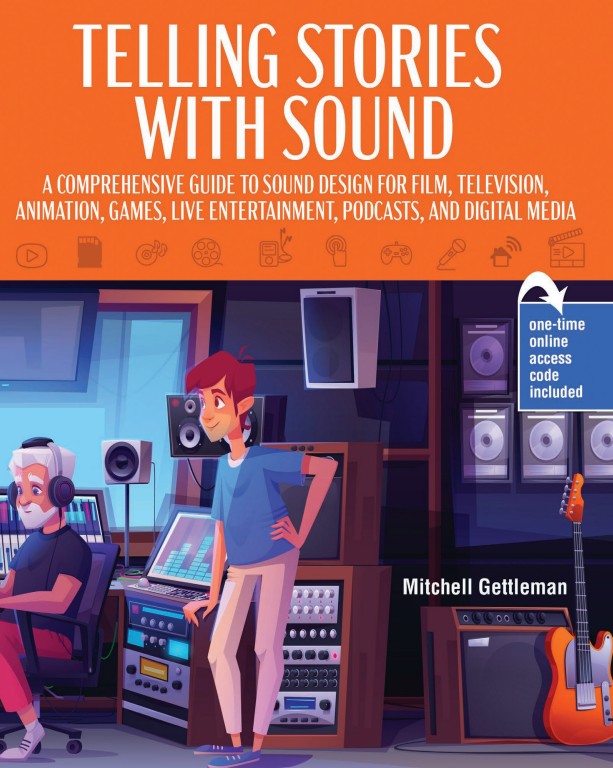
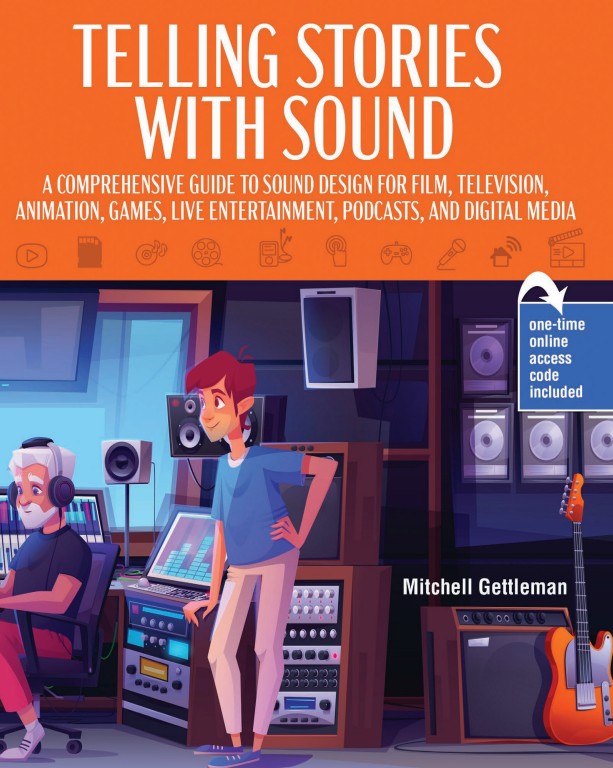
Telling Stories with Sound: A Comprehensive Guide to Sound Design for Film, Television, Animation, Games, Live Entertainment, Podcasts, and Digital Media
Edition: 1
Copyright: 2026
Pages: 558
Edition: 1
Copyright: 2026
Pages: 350
Choose Your Format
$90.00 USD
Ebook
$45.00 USD
Telling Stories with Sound invites students into the dynamic world of sound design—where storytelling, collaboration, and technology meet. Written in an accessible and engaging style, the textbook brings sound to life across film, television, games, theater, themed entertainment, podcasts, and emerging media. Organized in five acts, the journey begins with the history and psychology of storytelling before moving into production workflows, microphone techniques, voiceover performance, Foley, music, and mixing—the building blocks that transform ideas into powerful sonic experiences.
Vibrant cartoons, illuminating diagrams, and carefully curated visuals appear throughout, helping students understand complex ideas with clarity and fun. Interactive QR codes and web links connect directly to behind-the-scenes content, professional interviews, and real-world examples, expanding learning beyond the page. Each chapter also provides study questions and hands-on assignments designed to reinforce key lessons through reflection and practice.
For instructors, the textbook is supported by a comprehensive suite of teaching resources, including act-level student quick-reference guides, chapter-by-chapter faculty teaching guides, sample assessments, weekly lesson plans, and implementation notes for a variety of course formats (lecture, lab, hybrid, and online). These materials are designed to make adoption frictionless—whether an instructor is building a new sound curriculum from scratch or integrating selected chapters into existing film, television, theater, or game courses and beyond.
Drawing on decades of professional experience across major studios, premium series, and leading universities, author Mitchell Gettleman brings both practical insight and pedagogical depth to every topic. For educators, the structured progression and applied learning framework make the book easy to integrate into sound design, film, television, game audio, and related courses. For students, the engaging visuals, creative challenges, and forward-looking perspective make mastering sound design both accessible and inspiring, encouraging them to listen deeply, collaborate meaningfully, and think critically about emerging technologies and ethics while celebrating the creativity, challenge, and joy of telling stories with sound.
Telling Stories with Sound includes a comprehensive package of instructor resources designed to make adoption and course transitions seamless.
Resources include:
- Faculty Overview Notes – Map the book’s five act structure to common course formats (semester, quarter, production focused, theory focused) so you can see alignment at a glance.
- Chapter insights – Provide key teaching points, context, and discussion prompts for each chapter to help you frame lectures and critiques.
- Pedagogy guides for in person, online, and hybrid courses – Offer recommendations on how to structure meetings, discussions, and projects across different delivery modes.
- Study questions, assignments, rubrics, and assessment tips – Supply ready to use activities and evaluation tools that can be dropped into your LMS or tailored to your own outcomes.
- Chapter tests – Give you a starting point for low stakes quizzes or higher stakes assessments that reinforce core concepts in each chapter.
- Student Quick Reference – Summarizes key concepts and designer takeaways for each act to support studying, critiques, and ongoing projects.
- Extensive glossary – Clarifies essential terms in sound design, storytelling, and production so students from different disciplines can engage with the material on equal footing.
These materials are designed to help you hit the ground running—whether you are building a new sound design course, refreshing an existing syllabus, or integrating sound more deeply into film, game, or theater curricula.
Foreword
Preface
Acknowledgments
ACT I: ORIGINS THE STORY BEHIND SOUND
Exploring the roots of storytelling, myth, and how story shapes meaning and emotion
CHAPTER 1: Once Upon a Time The Art and History of Storytelling
CHAPTER 2: Before the World Was Round Deepening Our Understanding of Story
CHAPTER 3: Thinking About Sound How Academics Frame Sound Design
ACT II: THE WORLDS WE BUILD SOUND DESIGN IN CONTEXT
Entering the creative arenas where sound design defines imagery, movement, and audience experience
CHAPTER 4: Sound Design in Action Part 1 Film and Television Workflows
CHAPTER 5: Sound Design in Action Part 2 Games, Theater, and Themed Entertainment
ACT III: THE LANGUAGE OF SOUND TOOLS, TECHNIQUES, AND PRACTICE
How microphones, recording methods, and sonic principles bring stories to life
CHAPTER 6: The Building Blocks of Sound Essential Concepts
CHAPTER 7: The Sonic Safari Choosing and Using the Right Microphones
CHAPTER 8: Production Sound Part 1 Capturing Dialogue for Film and Television
CHAPTER 9: Production Sound Part 2 Advanced Techniques and Challenges
ACT IV: THE SOUNDTRACK TAKES FLIGHT BRINGING THE STORY HOME
Where everything comes together: voices, effects, music, and emotional resonance
CHAPTER 10: Dialogue and Voiceover Part 1 The Royalty of Sound Design
CHAPTER 11: Dialogue and Voiceover Part 2 Games, Theme Parks, Animation, Podcasts, and Beyond
CHAPTER 12: Sound Effects and Foley From Explosions to Banana Peels
CHAPTER 13: Music and Mixing Scoring and Re-recording for Film, Television, and Visual Media
ACT V: LISTENING FORWARD LIVING IN A NOISY WORLD
Looking ahead to emerging media, evolving tools, ethics, and lifelong practice in sound design
CHAPTER 14: Final Thoughts on Telling Stories with Sound The Road Ahead
Glossary
Index
Mitchell Gettleman is a sound designer, composer, educator, and media producer with decades of experience across film, television, games, theater, themed entertainment, and digital media. For nearly a decade, he served as department chair of sound design at the Savannah College of Art and Design (SCAD), leading one of the most comprehensive sound design programs in the United States. In that role, he guided undergraduate and graduate study in sound design, music composition, and production. He has also held teaching appointments at the University of California, Los Angeles (UCLA), and Loyola Marymount University (LMU), and regularly presents talks, panels, and seminars on sound design and storytelling at universities and film festivals.
Gettleman’s 25-plus-year industry career includes positions at Todd-AO Studios and Warner Bros. Studios as a sound designer and supervising sound editor. He has earned ten Golden Reel Award nominations and a Primetime Emmy nomination for his work on acclaimed television series including Scrubs, Californication, The 100, and Better Things. His work as a sound designer also includes the notable films Sabrina and Rumor Has It. As a producer and director, he created original docuseries for the Golf Channel, Pipe Dreams and Chasing the Dream, and produced the feature film Always Say Goodbye, which won the Hollywood Discovery Award for Best Feature Film (Under $1 Million). His music compositions are featured on PBS documentaries produced by the UCLA Behavioral Sciences Media Lab.
He is the founder of Away We Go Productions, a media and game company focused on innovative, family-friendly content. Gettleman holds a degree in English Literature and Film History from the University of California, Berkeley, and completed graduate studies at UCLA in film, animation, and television.
- Activities
- Discussion Prompts
- Exercises
- Instructors Manual
- Outlines
- Study Guide
- Teaching Notes
- Test Bank