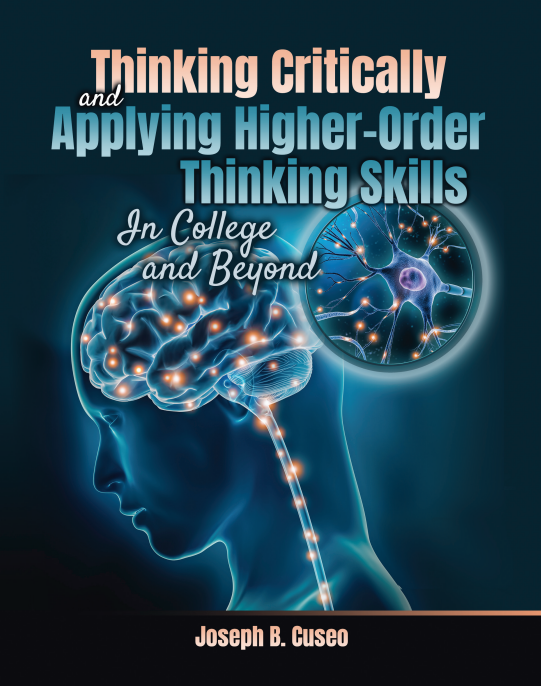
Thinking Critically and Applying Higher-Order Thinking Skills in College and Beyond
Edition: 1
Copyright: 2025
Pages: 416
Edition: 1
Copyright: 2025
Pages: 416
Choose Your Format
$90.00 USD
Ebook
$45.00 USD
Thinking Critically and Applying Higher-Order Thinking Skills in College and Beyond is:
Integrative
- Connects the dots between critical thinking and:
- Higher-order thinking skills, including creative thinking
- Deep learning strategies and metacognition
- Inductive, deductive, and moral reasoning
- Scientific and statistical reasoning
- Rhetoric and logical argumentation
- Information literacy and media literacy
- Liberal arts and general education
Substantive
- Draws on a solid body of referenced research and scholarship from multiple academic disciplines and cognitive development theories.
- Clearly defines for students what critical thinking is, why it is a critical skill, and how to apply it - in college and beyond.
- Illustrates and applies critical concepts to contemporary events and current controversial issues, including artificial intelligence (AI) - which is discussed across chapters.
Diversified
- Content delivered through a variety of instructional formats and learning modalities, including pre-chapter previews, summary boxes, concept maps, and graphic organizers.
- Content augmented by inspiring quotes from famous historical figures, insightful comments from leading scholars, and relevant experiences from the author.
Interactive
- Within-chapter questions intercept passive information processing and engage readers in active reflection on what they are reading.
- Post-chapter exercises promote consolidation and application of chapter content.
Preview of Content
Acknowledgments
About the Author
Chapter 1: Thinking, Critical Thinking, and Decision Making
The Process of Thinking
System 1 Thinking: Rapid, Reactive, Intuitive
System 2 Thinking: Slow, Reflective, Systematic
The Relationship Between Thought and Emotions
Up Thinking: The Emotional Tail Wagging the Rational Dog
What Is Critical Thinking?
Critical Thinking Criteria
Characteristics and Attributes of Critical Thinkers
Benefits of Critical Thinking
Critical Thinking and Decision-Making
Using Critical Thinking to Improve Decision-Making
Chapter Summary and Key Takeaways
Internet Resources
References
Exercises and Applications
Chapter 2: Higher-Order Thinking Skills - Application, Analysis, Synthesis, and Creativity
What Is Higher-Order Thinking?
The Relationship Between Critical Thinking and Higher-Order Thinking
The Relationship Between Knowledge and Higher-Order Thinking
Comprehension (Understanding)
The Importance of Critical Self-Reflection for Deep Learning and Comprehension
Application (Applied Thinking)
Analysis (Analytical Thinking)
Synthesis (Integrative Thinking)
Creativity (Creative Thinking)
Importance of Creative Thinking in Today’s World
The Relationship Between Creativity and Synthesis
The Relationship Between Creative Thinking and Critical Thinking
Strategies for Stimulating Creative Thinking
Using Higher-Order Thinking Skills to Improve Academic Performance in College
Chapter Summary and Key Takeaways
Internet Resources
References
Exercises and Applications
Chapter 3: Logic: Deductive, Inductive, and Analogical Reasoning
What Is a Logical Argument?
Argumentation Through Use of Deductive Reasoning
Using Critical Thinking to Evaluate Deductive Arguments
Key Criteria for Evaluating Deductive Arguments
Logical Fallacies
Cognitive Biases
Moving Beyond Binary Thinking: Progressing Through More Advanced Stages of Cognitive Development in College
Strategies for Avoiding Binary Thinking
Argumentation Through Use of Inductive Reasoning
The Importance of Inductive Reasoning
Abductive Reasoning
Analogical Reasoning
Critically Evaluating Analogical Arguments
Chapter Summary and Key Takeaways
Internet Resources
References
Exercises and Applications
Chapter 4: Moral & Ethical Reasoning - Critical Thinking about what is Right, Fair, and Just
Key Definitions and Distinctions
Morality and Ethics
Morality, Immorality, and Amorality
Values and Priorities
Virtues and Character
Moral Reasoning and Logical Reasoning
Moral Reasoning and Critical Thinking
Moral Theories and Principles
Moral Absolutism or Moral Relativism
Deontology or Utilitarianism
Divine Command or Humanism
Ethical Egoism or Ethical Altruism
Moral Dilemmas
Common Moral Dilemmas Involving Competing Core Values
Personal (Individual) Freedom and Social (Collective) Responsibility
Freedom of Speech and Protection From Speech
Freedom of Religion and Freedom From Religion
Honesty and Loyalty
Expiatory Punishment and Humane Justice
Simultaneously Protecting the Rights of One Group and the Rights of Other Groups
Chapter Summary and Key Takeaways
Internet Resources
References
Exercises and Applications
Chapter 5: Rhetoric and Rhetorical Devices - Effective and Deceptive Uses of Language in Argumentation and Persuasion
Rhetoric and Its Relation to Logic
The Origins of Rhetoric
Use of Metaphor as a Rhetorical Tool
Misuses of Rhetoric
Deceptive Rhetorical Devices
Chapter Summary and Key Takeaways
References
Exercises and Applications
Chapter 6: Statistical Reasoning - Thinking Critically about Statistics and Statistical Evidence
The Need for Critical Thinking About Statistics
Major Branches and Purposes of Statistics
Measures of Central Tendency
Proportions, Percents, Percentages, Percentage Points, and Percentiles: What’s the Difference?
Measures of Variance
Statistical Surveys and Polls
Sample Size
Representative Samples and Sampling Bias
Critically Evaluating Survey Questions
Thinking Critically About Statistical Findings Reported in Surveys and Polls
Statistical Correlations
Chapter Summary and Key Takeaways
Internet Resources
References
Exercises and Applications
Chapter 7: Cause–Effect Reasoning, the Experimental Method, and Scientific Evidence
What Is Cause–Effect Reasoning?
The Challenge and Complexity Associated With Determining Cause–Effect Relationships
Common Cause–Effect Reasoning Errors
The Scientific Method: A Systematic Procedure for Isolating Causes and Effects
Hypothesis Formulation
Controlled Studies: Creating Treatment and Control Groups
Testing the Statistical Significance of Scientific Findings
Critically Evaluating Scientific Research: Identifying Threats to Validity
Scientific Theories
The Philosophy of Science: Foundational Concepts and Principles of Scientific Inquiry
Pseudoscience (aka Bogus Science or Junk Science) and Misinformation Campaigns
Chapter Summary and Key Takeaways
Internet Resources
References
Exercises and Applications
Chapter 8: Information Literacy: Information Search and Critical Evaluation of Internet Sources
What Is Information Literacy?
Primary, Secondary, and Tertiary Sources of Information
Criteria for Judging the Quality of Information Sources
The Nature and Strength of “Evidence”
Forms of Evidence
Information-Search Strategies
Thinking Critically About Information Found on the Internet
Effective Internet-Search Strategies
Chapter Summary and Key Takeaways
Internet Resources
References
Exercises and Applications
Chapter 9: Media Literacy: Thinking Critically About News Media, Social Media, and Artificial Intelligence
Media Literacy Defined
The Purpose and Function of News Media
How News Media Influence Public Thought and Opinion
Limitations of News Media and News Reports
Strategies for Critically Examining and Evaluating News Sources
Media Literacy
Critically Evaluating Internet News
Critically Evaluating Social Media News
Artificial Intelligence (AI)
Chapter Summary and Key Takeaways
Internet Resources
References
Exercises and Applications
Chapter 10: Misinformation, Disinformation, and Conspiracy Theories
The Rise of Information Technology and Dissemination of False Information
Misinformation, Disinformation, and “Fake News”: What’s the Difference?
Why Do People Spread Disinformation?
Who are Likely to be Targets of Disinformation and Susceptible to Believing It?
Conspiracy Theories
Chapter Summary and Key Takeaways
Internet Resources
References
Exercises and Applications
Chapter 11: The Art of Constructive Argumentation and Civil Discourse: What to Do and Not to Do
Challenges to Constructive Conversations and Productive Dialogue
What Not to Do When Engaging in Argumentation and Civil Discourse
What to Do When Engaging in Productive Dialogue
Effective Questioning Strategies to Use While Listening
Refutation and Rebuttal Strategies
Chapter Summary and Key Takeaways
Internet Resources
References
Exercises and Applications
Chapter 12: Liberal Arts and General Education: Thinking Critically From Diverse Disciplines and Multiple Perspectives
The Meaning and Purpose of the Liberal Arts and General Education
Origins of the Liberal Arts Curriculum
Multidisciplinary Knowledge and Multiple Modes of Thinking Acquired Through the Liberal Arts
Humanities
Fine Arts
Mathematics
Natural Sciences
Social and Behavioral Sciences
The Importance of Interdisciplinary Thinking
Relationship Between Liberal Arts, Critical Thinking, and Higher-Order Thinking Skills
Myths and Misconceptions about the Liberal Arts
The Liberal Arts Promote Comprehensive and Complex Thinking From Multiple Perspectives
Broader Perspectives Developed by the Liberal Arts
Holistic Development: How the Liberal Arts Develop the “Whole Person”
Self-Awareness and Self-Development
The Self as a Multidimensional Being
The Self as an Integrated Human Being
Strategies for Maximizing the Positive Impact of the Liberal Arts
Chapter Summary and Key Takeaways
Internet Resources
References
Exercises and Applications
Glossary of Critical Thinking Terminology
Index

Joe Cuseo holds a doctoral degree in Educational Psychology and Assessment from the University of Iowa and is Professor Emeritus of Psychology. For more than 25 years, he directed the first-year seminar—a core college success course required of all new students.
He’s a 14-time recipient of the “faculty member of the year award” on his home campus—a student-driven award based on effective teaching and academic advising; a recipient of the “Outstanding First-Year Student Advocate Award” from the National Resource Center for The First-Year Experience and Students in Transition; and a recipient of the “Diamond Honoree Award” from the American College Personnel Association (ACPA) for contributions made to student development and the Student Affairs profession.
+++__Currently, Joe serves as an educational advisor and consultant for AVID—a nonprofit organization whose mission is to promote the college access and college success of underserved student populations. He has delivered hundreds of campus workshops and conference presentations across North America, as well as Europe, Asia, Australia, and the Middle East.
Thinking Critically and Applying Higher-Order Thinking Skills in College and Beyond is:
Integrative
- Connects the dots between critical thinking and:
- Higher-order thinking skills, including creative thinking
- Deep learning strategies and metacognition
- Inductive, deductive, and moral reasoning
- Scientific and statistical reasoning
- Rhetoric and logical argumentation
- Information literacy and media literacy
- Liberal arts and general education
Substantive
- Draws on a solid body of referenced research and scholarship from multiple academic disciplines and cognitive development theories.
- Clearly defines for students what critical thinking is, why it is a critical skill, and how to apply it - in college and beyond.
- Illustrates and applies critical concepts to contemporary events and current controversial issues, including artificial intelligence (AI) - which is discussed across chapters.
Diversified
- Content delivered through a variety of instructional formats and learning modalities, including pre-chapter previews, summary boxes, concept maps, and graphic organizers.
- Content augmented by inspiring quotes from famous historical figures, insightful comments from leading scholars, and relevant experiences from the author.
Interactive
- Within-chapter questions intercept passive information processing and engage readers in active reflection on what they are reading.
- Post-chapter exercises promote consolidation and application of chapter content.
Preview of Content
Acknowledgments
About the Author
Chapter 1: Thinking, Critical Thinking, and Decision Making
The Process of Thinking
System 1 Thinking: Rapid, Reactive, Intuitive
System 2 Thinking: Slow, Reflective, Systematic
The Relationship Between Thought and Emotions
Up Thinking: The Emotional Tail Wagging the Rational Dog
What Is Critical Thinking?
Critical Thinking Criteria
Characteristics and Attributes of Critical Thinkers
Benefits of Critical Thinking
Critical Thinking and Decision-Making
Using Critical Thinking to Improve Decision-Making
Chapter Summary and Key Takeaways
Internet Resources
References
Exercises and Applications
Chapter 2: Higher-Order Thinking Skills - Application, Analysis, Synthesis, and Creativity
What Is Higher-Order Thinking?
The Relationship Between Critical Thinking and Higher-Order Thinking
The Relationship Between Knowledge and Higher-Order Thinking
Comprehension (Understanding)
The Importance of Critical Self-Reflection for Deep Learning and Comprehension
Application (Applied Thinking)
Analysis (Analytical Thinking)
Synthesis (Integrative Thinking)
Creativity (Creative Thinking)
Importance of Creative Thinking in Today’s World
The Relationship Between Creativity and Synthesis
The Relationship Between Creative Thinking and Critical Thinking
Strategies for Stimulating Creative Thinking
Using Higher-Order Thinking Skills to Improve Academic Performance in College
Chapter Summary and Key Takeaways
Internet Resources
References
Exercises and Applications
Chapter 3: Logic: Deductive, Inductive, and Analogical Reasoning
What Is a Logical Argument?
Argumentation Through Use of Deductive Reasoning
Using Critical Thinking to Evaluate Deductive Arguments
Key Criteria for Evaluating Deductive Arguments
Logical Fallacies
Cognitive Biases
Moving Beyond Binary Thinking: Progressing Through More Advanced Stages of Cognitive Development in College
Strategies for Avoiding Binary Thinking
Argumentation Through Use of Inductive Reasoning
The Importance of Inductive Reasoning
Abductive Reasoning
Analogical Reasoning
Critically Evaluating Analogical Arguments
Chapter Summary and Key Takeaways
Internet Resources
References
Exercises and Applications
Chapter 4: Moral & Ethical Reasoning - Critical Thinking about what is Right, Fair, and Just
Key Definitions and Distinctions
Morality and Ethics
Morality, Immorality, and Amorality
Values and Priorities
Virtues and Character
Moral Reasoning and Logical Reasoning
Moral Reasoning and Critical Thinking
Moral Theories and Principles
Moral Absolutism or Moral Relativism
Deontology or Utilitarianism
Divine Command or Humanism
Ethical Egoism or Ethical Altruism
Moral Dilemmas
Common Moral Dilemmas Involving Competing Core Values
Personal (Individual) Freedom and Social (Collective) Responsibility
Freedom of Speech and Protection From Speech
Freedom of Religion and Freedom From Religion
Honesty and Loyalty
Expiatory Punishment and Humane Justice
Simultaneously Protecting the Rights of One Group and the Rights of Other Groups
Chapter Summary and Key Takeaways
Internet Resources
References
Exercises and Applications
Chapter 5: Rhetoric and Rhetorical Devices - Effective and Deceptive Uses of Language in Argumentation and Persuasion
Rhetoric and Its Relation to Logic
The Origins of Rhetoric
Use of Metaphor as a Rhetorical Tool
Misuses of Rhetoric
Deceptive Rhetorical Devices
Chapter Summary and Key Takeaways
References
Exercises and Applications
Chapter 6: Statistical Reasoning - Thinking Critically about Statistics and Statistical Evidence
The Need for Critical Thinking About Statistics
Major Branches and Purposes of Statistics
Measures of Central Tendency
Proportions, Percents, Percentages, Percentage Points, and Percentiles: What’s the Difference?
Measures of Variance
Statistical Surveys and Polls
Sample Size
Representative Samples and Sampling Bias
Critically Evaluating Survey Questions
Thinking Critically About Statistical Findings Reported in Surveys and Polls
Statistical Correlations
Chapter Summary and Key Takeaways
Internet Resources
References
Exercises and Applications
Chapter 7: Cause–Effect Reasoning, the Experimental Method, and Scientific Evidence
What Is Cause–Effect Reasoning?
The Challenge and Complexity Associated With Determining Cause–Effect Relationships
Common Cause–Effect Reasoning Errors
The Scientific Method: A Systematic Procedure for Isolating Causes and Effects
Hypothesis Formulation
Controlled Studies: Creating Treatment and Control Groups
Testing the Statistical Significance of Scientific Findings
Critically Evaluating Scientific Research: Identifying Threats to Validity
Scientific Theories
The Philosophy of Science: Foundational Concepts and Principles of Scientific Inquiry
Pseudoscience (aka Bogus Science or Junk Science) and Misinformation Campaigns
Chapter Summary and Key Takeaways
Internet Resources
References
Exercises and Applications
Chapter 8: Information Literacy: Information Search and Critical Evaluation of Internet Sources
What Is Information Literacy?
Primary, Secondary, and Tertiary Sources of Information
Criteria for Judging the Quality of Information Sources
The Nature and Strength of “Evidence”
Forms of Evidence
Information-Search Strategies
Thinking Critically About Information Found on the Internet
Effective Internet-Search Strategies
Chapter Summary and Key Takeaways
Internet Resources
References
Exercises and Applications
Chapter 9: Media Literacy: Thinking Critically About News Media, Social Media, and Artificial Intelligence
Media Literacy Defined
The Purpose and Function of News Media
How News Media Influence Public Thought and Opinion
Limitations of News Media and News Reports
Strategies for Critically Examining and Evaluating News Sources
Media Literacy
Critically Evaluating Internet News
Critically Evaluating Social Media News
Artificial Intelligence (AI)
Chapter Summary and Key Takeaways
Internet Resources
References
Exercises and Applications
Chapter 10: Misinformation, Disinformation, and Conspiracy Theories
The Rise of Information Technology and Dissemination of False Information
Misinformation, Disinformation, and “Fake News”: What’s the Difference?
Why Do People Spread Disinformation?
Who are Likely to be Targets of Disinformation and Susceptible to Believing It?
Conspiracy Theories
Chapter Summary and Key Takeaways
Internet Resources
References
Exercises and Applications
Chapter 11: The Art of Constructive Argumentation and Civil Discourse: What to Do and Not to Do
Challenges to Constructive Conversations and Productive Dialogue
What Not to Do When Engaging in Argumentation and Civil Discourse
What to Do When Engaging in Productive Dialogue
Effective Questioning Strategies to Use While Listening
Refutation and Rebuttal Strategies
Chapter Summary and Key Takeaways
Internet Resources
References
Exercises and Applications
Chapter 12: Liberal Arts and General Education: Thinking Critically From Diverse Disciplines and Multiple Perspectives
The Meaning and Purpose of the Liberal Arts and General Education
Origins of the Liberal Arts Curriculum
Multidisciplinary Knowledge and Multiple Modes of Thinking Acquired Through the Liberal Arts
Humanities
Fine Arts
Mathematics
Natural Sciences
Social and Behavioral Sciences
The Importance of Interdisciplinary Thinking
Relationship Between Liberal Arts, Critical Thinking, and Higher-Order Thinking Skills
Myths and Misconceptions about the Liberal Arts
The Liberal Arts Promote Comprehensive and Complex Thinking From Multiple Perspectives
Broader Perspectives Developed by the Liberal Arts
Holistic Development: How the Liberal Arts Develop the “Whole Person”
Self-Awareness and Self-Development
The Self as a Multidimensional Being
The Self as an Integrated Human Being
Strategies for Maximizing the Positive Impact of the Liberal Arts
Chapter Summary and Key Takeaways
Internet Resources
References
Exercises and Applications
Glossary of Critical Thinking Terminology
Index
Joe Cuseo holds a doctoral degree in Educational Psychology and Assessment from the University of Iowa and is Professor Emeritus of Psychology. For more than 25 years, he directed the first-year seminar—a core college success course required of all new students.
He’s a 14-time recipient of the “faculty member of the year award” on his home campus—a student-driven award based on effective teaching and academic advising; a recipient of the “Outstanding First-Year Student Advocate Award” from the National Resource Center for The First-Year Experience and Students in Transition; and a recipient of the “Diamond Honoree Award” from the American College Personnel Association (ACPA) for contributions made to student development and the Student Affairs profession.
+++__Currently, Joe serves as an educational advisor and consultant for AVID—a nonprofit organization whose mission is to promote the college access and college success of underserved student populations. He has delivered hundreds of campus workshops and conference presentations across North America, as well as Europe, Asia, Australia, and the Middle East.