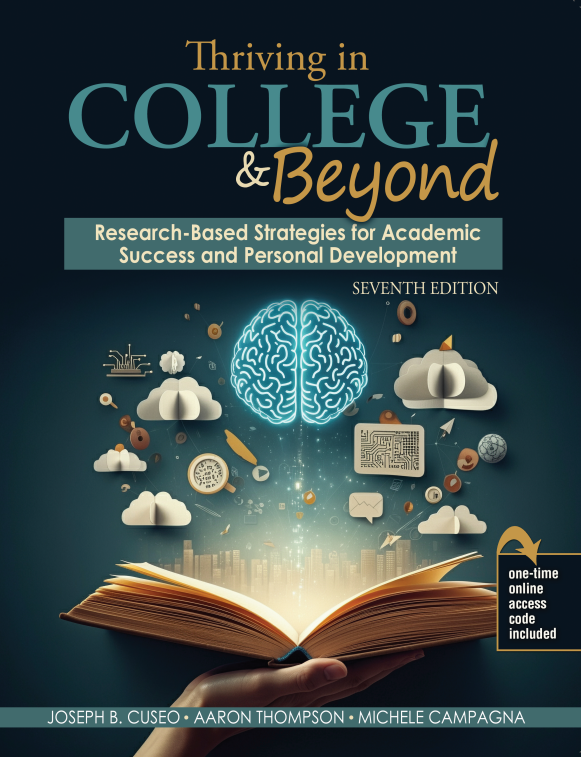
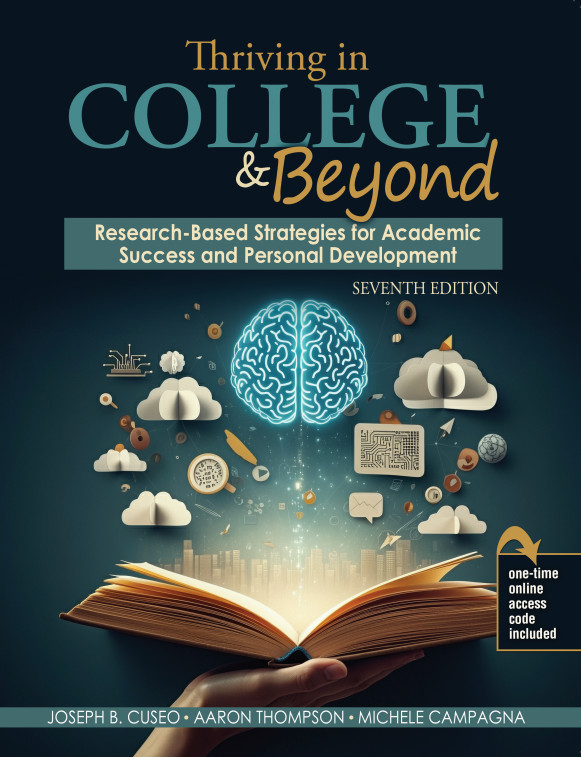
Thriving in College and Beyond: Research-Based Strategies for Academic Success and Personal Development
Edition: 7
Copyright: 2026
Pages: 348
Edition: 7
Copyright: 2026
Choose Your Format
Choose Your Platform | Help Me Choose


Ebook Package
$55.65 USD
Print Package
$82.95 USD
Thriving in College & Beyond: Research-Based Strategies for Academic Success and Personal Development covers the full range of topics and issues that impact student success. Its content is supported by hard data and poignant stories and is delivered through a variety of educational formats and learning modalities—including snapshot summaries, concept maps, content-relevant cartoons, inspirational quotes from successful students and influential people.
The book is:
1. Substantive
- Builds on a bedrock of robust research drawn from multiple academic disciplines and student development theories.
- Equips students with a comprehensive set of concrete, action-based strategies that specify what students should do to succeed in college, why it should be done, and inspiration to do it.
2. Holistic
- Focuses on the student as a whole person (social, emotional, physical, vocational, etc.), addressing both academic and “non-academic” elements of the college experience.
- Emphasizes lifelong learning practices that facilitate the transition to and through college, and promote success in life beyond college.
3. Interactive
- Pre-chapter questions activate thinking and prior knowledge about the upcoming topic.
- Within-chapter questions punctuate reading with opportunities for reflection.
- Post-chapter exercises consolidate knowledge acquired from the chapter and encourage practical application.
The new seventh edition features:
- Explicit, front-loaded coverage of the value of college and the benefits of general education
- Expanded coverage of critical thinking, higher-order thinking, and cognitive biases
- Emerging information on artificial intelligence, including its benefits, potential abuses, and current limitations.
- Augmented coverage of information literacy strategies for evaluating news sources, including news delivered via the internet and social media.
- Strategies for engaging in constructive conversations and productive dialogue with others holding different viewpoints or positions.
- Mental health coverage infused with positive psychology principles and mindfulness practices
- Updated research findings and internet resources relating to all chapter topics
Preface
Acknowledgments
About the Authors
Chapter 1: The Meaning, Purpose, and Value of a College Education
The Importance of the First-Year Experience
The Benefits of a First-Year Experience Course (a.k.a. College Success Course)
The Foundation of a College Education: General Education and the Liberal Arts
The Meaning and Purpose of the Liberal Arts
The Liberal Arts Curriculum
Major Bodies of Knowledge in the General Education Curriculum
Humanities
Fine Arts
Mathematics
Natural Sciences
Social and Behavioral Sciences
Physical Health and Wellness
Holistic Development: Developing the “Whole Person”
The Self as an Integrated Human Being
Internet Resources
References
Chapter 1 Exercises and Applications
Chapter 2: Capitalizing on Campus Resources
Using the Whole Campus to Develop Yourself as a Whole Person
Learning Center (a.k.a. Academic Resource Center or Academic Success Center)
Writing Center
Campus Library
Disability Services (a.k.a. Disability Resource Center)
Financial Aid Office
Academic Advisement
Career Development Center (a.k.a. Career Center)
Health and Wellness Center
Personal Counseling Center
Office of Student Life (Student Development)
Capitalizing on Social Resources
Connecting with Academic Advisors
Connecting with a Mentor
Connecting with Faculty
Connecting with Peers (Student–Student Interaction)
Internet Resources
References
Chapter 2 Exercises
Chapter 3: Goal Setting and Motivation
Moving from Intention to Action
The Relationship Between Goal Setting and Success
Characteristics of a Well-Defined and Well-Designed Goal
Strategies for Maintaining Motivation and Making Progress toward Goals
Characteristics of Successful People
Self-Efficacy
Growth Mindset
Grit
Internet Resources
References
Chapter 3 Exercises
Chapter 4: Time Management
prioritizing tasks, preventing procrastination, and promoting productivity
The Relationship between Setting Goals, Managing Time, and Managing Tasks
The Importance of Time Management for College Students
The Importance of Time Spent on Coursework Outside of Class
Strategies for Managing Time and Tasks
Developing a Time-Management Plan
Key Elements of an Effective Time-Management Plan
Making Productive Use of “Free Time”
Outside the Classroom
Combating Procrastination
Myths That Promote Procrastination
Strategies for Preventing and Overcoming Procrastination
Psychological Causes of Procrastination
Internet Resources
References
Chapter 4 Exercises
Chapter 5: Lecture Note-Taking and Reading Strategies
Key Skills for Acquiring Knowledge
The Importance of Class Time
The Importance of Active Classroom Listening and Note-Taking
Effective Lecture-Listening and Note-Taking Strategies
Pre-Lecture Strategies: What to Do Before Class
In-Class Strategies: What to do During Class
Post-Class Strategies: What to Do After Class
Strategic Reading
Pre-Reading Strategies: What to Do Before Reading
Strategies to Use During the Reading Process
Post-Reading Strategies: What to Do After Reading
Internet Resources
References
Chapter 5 Exercises
Chapter 6: Strategic Study Skills for Deep Learning
moving beyond memorization to comprehension
What is Deep Learning and Why is it Important?
Strategic Studying: Learning Deeply and Remembering Longer
Give Studying Undivided Attention
Make Meaningful Associations
Integrate Information from Lectures and Readings
Distribute Study Time across Separate Study Sessions
Use the “Part-to-Whole” Study Method
Capitalize on the Power of Visual Learning
Build Variety into the Study Process
Learn with Emotion
Learn Collaboratively
Self-Monitoring: Self-Assessment for Deep Learning
Internet Resources
References
Chapter 6 Exercises
Chapter 7: Thinking Critically and Making Logical Arguments
The Process of Thinking
System 1 Thinking: Rapid, Reactive, and Intuitive
System 2 Thinking: Slow, Reflective, and Systematic
Bottom-Up Thinking: The Emotional Tail Wagging the Rational Dog
What is Critical Thinking?
Characteristics and Attributes of Critical Thinkers
Benefits of Critical Thinking
Logical Fallacies
Major Types of Logical Fallacies
Cognitive Biases
Moving Beyond Binary Thinking: Progressing through More Advanced Stages of Cognitive Development in College
Strategies for Avoiding Binary Thinking
The Art of Constructive Argumentation and Civil Discourse: What to Do and Not to Do
What Not to Do When Engaging in Debate and Civil Discourse
What to Do when Engaging in Productive Dialogue
Internet Resources
References
Chapter 7 Exercises
Chapter 8: Higher-Order Thinking Skills
Moving to Higher Levels of Thinking: Application, Analysis, Synthesis, and Creativity
What is Higher-Order Thinking?
The Relationship Between Critical Thinking and Higher-Order Thinking
The Relationship between Knowledge and Higher-Order Thinking
Comprehension (Understanding)
Application (Applied Thinking)
Analysis (Analytical Thinking)
Synthesis (Integrative Thinking)
Creativity (Creative Thinking)
Importance of Creative Thinking in Today’s World
The Relationship between Creativity and Synthesis
The Relationship between Creative Thinking and Critical Thinking
Strategies for Stimulating Creative Thinking
Using Higher-Order Thinking Skills to Improve Academic Performance in College
Internet Resources
References
Chapter 8 Exercises and Applications
Chapter 9: Information Literacy and Artificial Intelligence
locating, evaluating, and using information effectively & ethically
What is Information Literacy?
Primary, Secondary, and Tertiary Sources of Information
Criteria for Judging the Quality of Information Sources
Scholarly
Credibility
Objectivity
Currency
Strategies for Conducting Information Searches for Research Reports
Cite Your Sources with Integrity
Effective Information-Search Strategies
Thinking Critically about Internet Information
Media Literacy
Limitations of News Media and News Reports
Oversimplification
Framing Bias
Negativity Bias
Availability Bias
Strategies for Critically Examining and Evaluating News Sources
Artificial Intelligence (AI)
Internet Resources
References
Chapter 9 Exercises and Applications
Chapter 10: Social and Emotional Intelligence
Relating to Others and Regulating Emotions
The Importance of Social and Emotional Intelligence
Listening: A Key Element of Social Intelligence
Active Listening Strategies
Interpersonal Relationship Skills (a.k.a. Human Relations Skills)
Managing Interpersonal Conflict
Strategies for Resolving Conflicts Assertively
Emotional Intelligence
Forms and Stages of Love
Stage 1. Passionate Love (Infatuation)
Stage 2. Mature Love
Becoming a Peer Leader
Myths about Leaders and Leadership
Positive Outcomes of Peer Leadership
Areas of Student Leadership in College
Internet Resources
References
Chapter 10 Exercises
Chapter 11: Psychological Wellness
Maintaining Mental Health and Experiencing Positive Emotions
Mental Health and Self-Esteem
Strategies for Preserving and Promoting Self-Esteem
Emotional Disorders
Stress and Anxiety
Symptoms (Signs) of Anxiety
Stress-Management Strategies
Depression
Symptoms (Signs) of Major Depression
Bipolar Disorder (a.k.a. Manic Depression)
Strategies for Coping with Milder Forms of Depression and Experiencing Positive Emotions
Eating Disorders
Alcohol Use among College Students
Alcohol Abuse
Unhealthy Relationships
Abusive Relationships
Sexual Assault (a.k.a. Sexual Violence)
Sexual Harassment
Internet Resources
References
Chapter 11 Exercises
Chapter 12: Educational Planning and Decision-Making
Making Wise Choices about Your College Courses, College Major, and Academic Pathway
To Be or Not to Be Decided: What Research Shows about Students’ Choice of a College Major
The Importance of Long-Range Educational Planning: Paving Your Academic Pathway
Factors to Consider When Choosing and Confirming Your Choice of a College Major
Learning Talents: Multiple Intelligences
Personal Values
Personal Interests
Strategies for Learning about Different Majors
Myths about the Relationship between Majors and Careers
Myth 1. When you choose your major, you’re choosing your career.
Myth 2. If you decide to continue your education beyond college, you have to continue in the same field as your major.
Myth 3. Because most college graduates are employed in business organizations or corporations, it’s best to major in business.
Myth 4. If you major in a liberal arts field, the only career available to you is teaching.
Internet Resources
References
Chapter 12 Exercises
Chapter 13: Career Exploration, Preparation, and Development
finding a path to your future profession
The Importance of Career Planning
Strategies for Career Exploration and Preparation
Step 1. Awareness of Self
Step 2. Awareness of Career Options
Step 3. Awareness of Career Options that Best “Fit” You
Step 4. Awareness of the Major Steps Needed to Reach Your Career Goals
Career Readiness
Self-Marketing: Packaging and Presenting Your Skills, Strengths, and Attributes
Course Transcript
Co-Curricular Experiences
Personal Resume
Portfolio
Letters of Recommendation (Letters of Reference)
Networking
Personal Interview
Internet Resources
References
Chapter 13 Exercises
Glossary and Dictionary of College Experience Terminology
Index

Joe Cuseo holds a doctoral degree in Educational Psychology and Assessment from the University of Iowa and is Professor Emeritus of Psychology. For more than 25 years, he directed the first-year seminar—a core college success course required of all new students.
He’s a 14-time recipient of the “faculty member of the year award” on his home campus—a student-driven award based on effective teaching and academic advising; a recipient of the “Outstanding First-Year Student Advocate Award” from the National Resource Center for The First-Year Experience and Students in Transition; and a recipient of the “Diamond Honoree Award” from the American College Personnel Association (ACPA) for contributions made to student development and the Student Affairs profession.
+++__Currently, Joe serves as an educational advisor and consultant for AVID—a nonprofit organization whose mission is to promote the college access and college success of underserved student populations. He has delivered hundreds of campus workshops and conference presentations across North America, as well as Europe, Asia, Australia, and the Middle East.

Aaron Thompson is a nationally recognized leader in higher education with a focus on policy, student success and organizational leadership and design. He serves as President of the Kentucky Council on Postsecondary Education and as professor of sociology in the Department of Educational Leadership and Policy Studies at Eastern Kentucky University. He recently served as interim president of Kentucky State University. Thompson holds a doctorate in sociology in areas of organizational behavior and race and gender relations.
His leadership experience spans 27 years across higher education, business and numerous non-profit boards. Thompson has researched, taught and consulted in areas of diversity, leadership, ethics, multicultural families, race and ethnic relations, student success, first-year students, retention, cultural competence and organizational design throughout his career.
As a highly sought after national speaker, Thompson has presented more than 800 workshops, seminars and invited lectures in areas of race and gender diversity, living an unbiased life, overcoming obstacles to gain success, creating a school environment for academic success, cultural competence, workplace interaction, leadership, organizational goal setting, building relationships, the first-year seminar, and a variety of other topics. He continues to serve as a consultant to educational institutions (elementary, secondary and postsecondary), corporations, non-profit organizations, police departments and other governmental agencies.
Thompson has published more than 30 publications and numerous research and peer reviewed presentations. He has authored or co-authored the following books: Changing Student Culture from the Ground Up, The Sociological Outlook, Infusing Diversity and Cultural Competence into Teacher Education, Peer to Peer Leadership: Changing Student Culture from the Ground Up. He also co-authored Thriving in College and Beyond: Research-Based Strategies for Academic Success, Thriving in the Community College and Beyond: Research-Based Strategies for Academic Success and Personal Development, Diversity and the College Experience, Focus on Success and Black Men and Divorce.

Michele Campagna, Ed.D., is the executive director of the Center for Advising and Student Transitions at Montclair State University in New Jersey. Dr. Campagna provides leadership for a comprehensive and holistic program designed to retain and engage first-year, freshman, sophomore, and transfer students. Dr. Campagna has over 20 years of experience teaching various types of first-year seminar courses and directing services for students in transition at both two-year and four-year institutions.
Dr. Campagna holds an Ed.D. in higher education and is a recipient of the “Outstanding First-Year Student Advocate Award” from the National Resource Center for the First-Year Experience and Students in Transition. She is the author of “New Student Experience: A Holistic and Collaborative Approach to First-Year Retention” in Exploring the Evidence: Campus-Wide Initiatives in the First College Year, published by the National Resource Center for the First-Year Experience and Students in Transition. Dr. Campagna has presented at many statewide and national conferences on designing and implementing student engagement and retention initiatives, strategic planning, assessment, and diversity.
Thriving in College & Beyond: Research-Based Strategies for Academic Success and Personal Development covers the full range of topics and issues that impact student success. Its content is supported by hard data and poignant stories and is delivered through a variety of educational formats and learning modalities—including snapshot summaries, concept maps, content-relevant cartoons, inspirational quotes from successful students and influential people.
The book is:
1. Substantive
- Builds on a bedrock of robust research drawn from multiple academic disciplines and student development theories.
- Equips students with a comprehensive set of concrete, action-based strategies that specify what students should do to succeed in college, why it should be done, and inspiration to do it.
2. Holistic
- Focuses on the student as a whole person (social, emotional, physical, vocational, etc.), addressing both academic and “non-academic” elements of the college experience.
- Emphasizes lifelong learning practices that facilitate the transition to and through college, and promote success in life beyond college.
3. Interactive
- Pre-chapter questions activate thinking and prior knowledge about the upcoming topic.
- Within-chapter questions punctuate reading with opportunities for reflection.
- Post-chapter exercises consolidate knowledge acquired from the chapter and encourage practical application.
The new seventh edition features:
- Explicit, front-loaded coverage of the value of college and the benefits of general education
- Expanded coverage of critical thinking, higher-order thinking, and cognitive biases
- Emerging information on artificial intelligence, including its benefits, potential abuses, and current limitations.
- Augmented coverage of information literacy strategies for evaluating news sources, including news delivered via the internet and social media.
- Strategies for engaging in constructive conversations and productive dialogue with others holding different viewpoints or positions.
- Mental health coverage infused with positive psychology principles and mindfulness practices
- Updated research findings and internet resources relating to all chapter topics
Preface
Acknowledgments
About the Authors
Chapter 1: The Meaning, Purpose, and Value of a College Education
The Importance of the First-Year Experience
The Benefits of a First-Year Experience Course (a.k.a. College Success Course)
The Foundation of a College Education: General Education and the Liberal Arts
The Meaning and Purpose of the Liberal Arts
The Liberal Arts Curriculum
Major Bodies of Knowledge in the General Education Curriculum
Humanities
Fine Arts
Mathematics
Natural Sciences
Social and Behavioral Sciences
Physical Health and Wellness
Holistic Development: Developing the “Whole Person”
The Self as an Integrated Human Being
Internet Resources
References
Chapter 1 Exercises and Applications
Chapter 2: Capitalizing on Campus Resources
Using the Whole Campus to Develop Yourself as a Whole Person
Learning Center (a.k.a. Academic Resource Center or Academic Success Center)
Writing Center
Campus Library
Disability Services (a.k.a. Disability Resource Center)
Financial Aid Office
Academic Advisement
Career Development Center (a.k.a. Career Center)
Health and Wellness Center
Personal Counseling Center
Office of Student Life (Student Development)
Capitalizing on Social Resources
Connecting with Academic Advisors
Connecting with a Mentor
Connecting with Faculty
Connecting with Peers (Student–Student Interaction)
Internet Resources
References
Chapter 2 Exercises
Chapter 3: Goal Setting and Motivation
Moving from Intention to Action
The Relationship Between Goal Setting and Success
Characteristics of a Well-Defined and Well-Designed Goal
Strategies for Maintaining Motivation and Making Progress toward Goals
Characteristics of Successful People
Self-Efficacy
Growth Mindset
Grit
Internet Resources
References
Chapter 3 Exercises
Chapter 4: Time Management
prioritizing tasks, preventing procrastination, and promoting productivity
The Relationship between Setting Goals, Managing Time, and Managing Tasks
The Importance of Time Management for College Students
The Importance of Time Spent on Coursework Outside of Class
Strategies for Managing Time and Tasks
Developing a Time-Management Plan
Key Elements of an Effective Time-Management Plan
Making Productive Use of “Free Time”
Outside the Classroom
Combating Procrastination
Myths That Promote Procrastination
Strategies for Preventing and Overcoming Procrastination
Psychological Causes of Procrastination
Internet Resources
References
Chapter 4 Exercises
Chapter 5: Lecture Note-Taking and Reading Strategies
Key Skills for Acquiring Knowledge
The Importance of Class Time
The Importance of Active Classroom Listening and Note-Taking
Effective Lecture-Listening and Note-Taking Strategies
Pre-Lecture Strategies: What to Do Before Class
In-Class Strategies: What to do During Class
Post-Class Strategies: What to Do After Class
Strategic Reading
Pre-Reading Strategies: What to Do Before Reading
Strategies to Use During the Reading Process
Post-Reading Strategies: What to Do After Reading
Internet Resources
References
Chapter 5 Exercises
Chapter 6: Strategic Study Skills for Deep Learning
moving beyond memorization to comprehension
What is Deep Learning and Why is it Important?
Strategic Studying: Learning Deeply and Remembering Longer
Give Studying Undivided Attention
Make Meaningful Associations
Integrate Information from Lectures and Readings
Distribute Study Time across Separate Study Sessions
Use the “Part-to-Whole” Study Method
Capitalize on the Power of Visual Learning
Build Variety into the Study Process
Learn with Emotion
Learn Collaboratively
Self-Monitoring: Self-Assessment for Deep Learning
Internet Resources
References
Chapter 6 Exercises
Chapter 7: Thinking Critically and Making Logical Arguments
The Process of Thinking
System 1 Thinking: Rapid, Reactive, and Intuitive
System 2 Thinking: Slow, Reflective, and Systematic
Bottom-Up Thinking: The Emotional Tail Wagging the Rational Dog
What is Critical Thinking?
Characteristics and Attributes of Critical Thinkers
Benefits of Critical Thinking
Logical Fallacies
Major Types of Logical Fallacies
Cognitive Biases
Moving Beyond Binary Thinking: Progressing through More Advanced Stages of Cognitive Development in College
Strategies for Avoiding Binary Thinking
The Art of Constructive Argumentation and Civil Discourse: What to Do and Not to Do
What Not to Do When Engaging in Debate and Civil Discourse
What to Do when Engaging in Productive Dialogue
Internet Resources
References
Chapter 7 Exercises
Chapter 8: Higher-Order Thinking Skills
Moving to Higher Levels of Thinking: Application, Analysis, Synthesis, and Creativity
What is Higher-Order Thinking?
The Relationship Between Critical Thinking and Higher-Order Thinking
The Relationship between Knowledge and Higher-Order Thinking
Comprehension (Understanding)
Application (Applied Thinking)
Analysis (Analytical Thinking)
Synthesis (Integrative Thinking)
Creativity (Creative Thinking)
Importance of Creative Thinking in Today’s World
The Relationship between Creativity and Synthesis
The Relationship between Creative Thinking and Critical Thinking
Strategies for Stimulating Creative Thinking
Using Higher-Order Thinking Skills to Improve Academic Performance in College
Internet Resources
References
Chapter 8 Exercises and Applications
Chapter 9: Information Literacy and Artificial Intelligence
locating, evaluating, and using information effectively & ethically
What is Information Literacy?
Primary, Secondary, and Tertiary Sources of Information
Criteria for Judging the Quality of Information Sources
Scholarly
Credibility
Objectivity
Currency
Strategies for Conducting Information Searches for Research Reports
Cite Your Sources with Integrity
Effective Information-Search Strategies
Thinking Critically about Internet Information
Media Literacy
Limitations of News Media and News Reports
Oversimplification
Framing Bias
Negativity Bias
Availability Bias
Strategies for Critically Examining and Evaluating News Sources
Artificial Intelligence (AI)
Internet Resources
References
Chapter 9 Exercises and Applications
Chapter 10: Social and Emotional Intelligence
Relating to Others and Regulating Emotions
The Importance of Social and Emotional Intelligence
Listening: A Key Element of Social Intelligence
Active Listening Strategies
Interpersonal Relationship Skills (a.k.a. Human Relations Skills)
Managing Interpersonal Conflict
Strategies for Resolving Conflicts Assertively
Emotional Intelligence
Forms and Stages of Love
Stage 1. Passionate Love (Infatuation)
Stage 2. Mature Love
Becoming a Peer Leader
Myths about Leaders and Leadership
Positive Outcomes of Peer Leadership
Areas of Student Leadership in College
Internet Resources
References
Chapter 10 Exercises
Chapter 11: Psychological Wellness
Maintaining Mental Health and Experiencing Positive Emotions
Mental Health and Self-Esteem
Strategies for Preserving and Promoting Self-Esteem
Emotional Disorders
Stress and Anxiety
Symptoms (Signs) of Anxiety
Stress-Management Strategies
Depression
Symptoms (Signs) of Major Depression
Bipolar Disorder (a.k.a. Manic Depression)
Strategies for Coping with Milder Forms of Depression and Experiencing Positive Emotions
Eating Disorders
Alcohol Use among College Students
Alcohol Abuse
Unhealthy Relationships
Abusive Relationships
Sexual Assault (a.k.a. Sexual Violence)
Sexual Harassment
Internet Resources
References
Chapter 11 Exercises
Chapter 12: Educational Planning and Decision-Making
Making Wise Choices about Your College Courses, College Major, and Academic Pathway
To Be or Not to Be Decided: What Research Shows about Students’ Choice of a College Major
The Importance of Long-Range Educational Planning: Paving Your Academic Pathway
Factors to Consider When Choosing and Confirming Your Choice of a College Major
Learning Talents: Multiple Intelligences
Personal Values
Personal Interests
Strategies for Learning about Different Majors
Myths about the Relationship between Majors and Careers
Myth 1. When you choose your major, you’re choosing your career.
Myth 2. If you decide to continue your education beyond college, you have to continue in the same field as your major.
Myth 3. Because most college graduates are employed in business organizations or corporations, it’s best to major in business.
Myth 4. If you major in a liberal arts field, the only career available to you is teaching.
Internet Resources
References
Chapter 12 Exercises
Chapter 13: Career Exploration, Preparation, and Development
finding a path to your future profession
The Importance of Career Planning
Strategies for Career Exploration and Preparation
Step 1. Awareness of Self
Step 2. Awareness of Career Options
Step 3. Awareness of Career Options that Best “Fit” You
Step 4. Awareness of the Major Steps Needed to Reach Your Career Goals
Career Readiness
Self-Marketing: Packaging and Presenting Your Skills, Strengths, and Attributes
Course Transcript
Co-Curricular Experiences
Personal Resume
Portfolio
Letters of Recommendation (Letters of Reference)
Networking
Personal Interview
Internet Resources
References
Chapter 13 Exercises
Glossary and Dictionary of College Experience Terminology
Index
Joe Cuseo holds a doctoral degree in Educational Psychology and Assessment from the University of Iowa and is Professor Emeritus of Psychology. For more than 25 years, he directed the first-year seminar—a core college success course required of all new students.
He’s a 14-time recipient of the “faculty member of the year award” on his home campus—a student-driven award based on effective teaching and academic advising; a recipient of the “Outstanding First-Year Student Advocate Award” from the National Resource Center for The First-Year Experience and Students in Transition; and a recipient of the “Diamond Honoree Award” from the American College Personnel Association (ACPA) for contributions made to student development and the Student Affairs profession.
+++__Currently, Joe serves as an educational advisor and consultant for AVID—a nonprofit organization whose mission is to promote the college access and college success of underserved student populations. He has delivered hundreds of campus workshops and conference presentations across North America, as well as Europe, Asia, Australia, and the Middle East.
Aaron Thompson is a nationally recognized leader in higher education with a focus on policy, student success and organizational leadership and design. He serves as President of the Kentucky Council on Postsecondary Education and as professor of sociology in the Department of Educational Leadership and Policy Studies at Eastern Kentucky University. He recently served as interim president of Kentucky State University. Thompson holds a doctorate in sociology in areas of organizational behavior and race and gender relations.
His leadership experience spans 27 years across higher education, business and numerous non-profit boards. Thompson has researched, taught and consulted in areas of diversity, leadership, ethics, multicultural families, race and ethnic relations, student success, first-year students, retention, cultural competence and organizational design throughout his career.
As a highly sought after national speaker, Thompson has presented more than 800 workshops, seminars and invited lectures in areas of race and gender diversity, living an unbiased life, overcoming obstacles to gain success, creating a school environment for academic success, cultural competence, workplace interaction, leadership, organizational goal setting, building relationships, the first-year seminar, and a variety of other topics. He continues to serve as a consultant to educational institutions (elementary, secondary and postsecondary), corporations, non-profit organizations, police departments and other governmental agencies.
Thompson has published more than 30 publications and numerous research and peer reviewed presentations. He has authored or co-authored the following books: Changing Student Culture from the Ground Up, The Sociological Outlook, Infusing Diversity and Cultural Competence into Teacher Education, Peer to Peer Leadership: Changing Student Culture from the Ground Up. He also co-authored Thriving in College and Beyond: Research-Based Strategies for Academic Success, Thriving in the Community College and Beyond: Research-Based Strategies for Academic Success and Personal Development, Diversity and the College Experience, Focus on Success and Black Men and Divorce.
Michele Campagna, Ed.D., is the executive director of the Center for Advising and Student Transitions at Montclair State University in New Jersey. Dr. Campagna provides leadership for a comprehensive and holistic program designed to retain and engage first-year, freshman, sophomore, and transfer students. Dr. Campagna has over 20 years of experience teaching various types of first-year seminar courses and directing services for students in transition at both two-year and four-year institutions.
Dr. Campagna holds an Ed.D. in higher education and is a recipient of the “Outstanding First-Year Student Advocate Award” from the National Resource Center for the First-Year Experience and Students in Transition. She is the author of “New Student Experience: A Holistic and Collaborative Approach to First-Year Retention” in Exploring the Evidence: Campus-Wide Initiatives in the First College Year, published by the National Resource Center for the First-Year Experience and Students in Transition. Dr. Campagna has presented at many statewide and national conferences on designing and implementing student engagement and retention initiatives, strategic planning, assessment, and diversity.