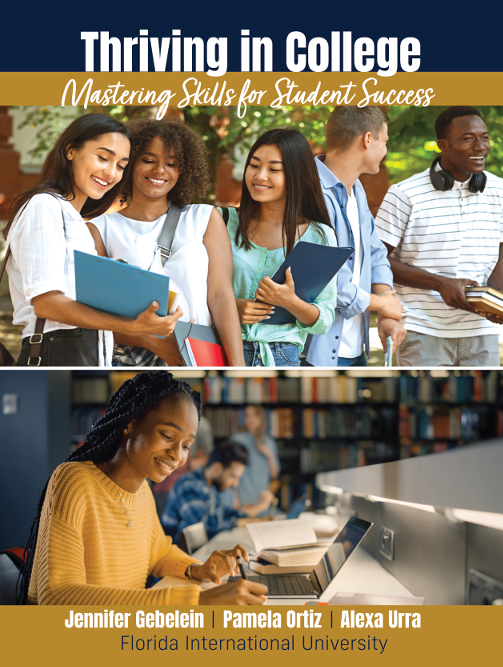
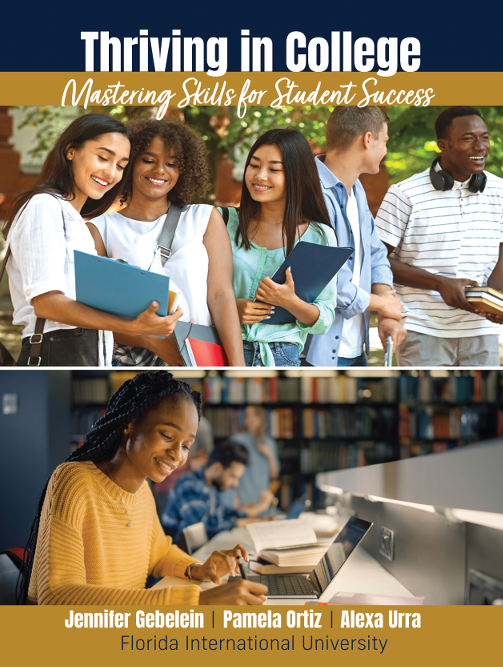
Thriving in College: Mastering Skills for Student Success
Edition: 1
Copyright: 2025
Edition: 1
Copyright: 2025
Pages: 170
Choose Your Format
Choose Your Platform | Help Me Choose


Ebook
$40.00 USD
$55.00 USD
This textbook is designed to guide both prospective and current Florida International University (FIU) students as they transition into the university environment and begin to shape their academic, professional, and personal journeys. With a student-centered approach, it equips learners with the essential tools and strategies to navigate the unique challenges of college life while maximizing the opportunities available at FIU. From understanding campus resources to developing strong study habits and setting career goals, this book provides a comprehensive roadmap for student success.
The content is thoughtfully designed and structured around important pillars such as; academic excellence, career readiness, and personal development. Students will have the opportunity to explore practical topics that include time management, effective communication, goal setting, critical thinking, financial literacy, and mental wellness. Each chapter blends research-based strategies with FIU-specific resources—such as tutoring center at the Center for Academic Success, advising services, internship and career readiness at the Career and Talent Development, and Panther Success Network empowering students to take full advantage of their university experience.
Beyond offering strategies, this textbook fosters self-reflection and long-term planning. Through interactive exercises, real-life student testimonials, and guided activities, readers are encouraged to identify their strengths, overcome barriers, and actively participate in shaping their future. Whether you are a first generation student or you are continuing a legacy, this textbook lays a strong foundation for becoming a successful, engaged, and resilient member of the FIU community and beyond!
Chapter 1 Introduction and Transitions
The Transition from High School to College
Introduction
What Happens During Your Last Year of High School and Your First Year of College? How Do You Really Change?
Social and Personal Transitions in College
Building New Relationships
Navigating Diverse Social Environments
Feeling Homesick
Developing Social Network and Structure
Independence and Self-Advocacy
Seeking Help When Needed
Academic Transitions in College
Differences in Academic Expectations
Increased Independence and Self-Discipline
Adjusting to a New Grading System
Time Management Skills
College Success in the First Year
Emotional and Mental Health
Importance of Seeking Support
Financial Transition and Gaining Knowledge
Understanding and Managing Finances
Developing Financial Responsibility
Orientation Programs
Academic Advising and Support Services
Wellness and Safety
Campus Safety Measures
Goal Setting and Motivation
What Do You Want to Get Out of Your College Experience?
S.M.A.R.T Goals
The S.M.A.R.T Method of Goal Setting
The Power of Self-Discipline
Chapter Wrap-Up: Connecting the Dots
Chapter 2 Formalizing Your Experiential Learning
Formalizing Your Experiential Learning
Introduction to Experiential Learning
Definition and Principles
Benefits of Experiential Learning to You!!
Improved Retention and Understanding
Development of Critical Thinking Skills and Problem-Solving Abilities
Increased Motivation and Engagement
Preparation for Future Careers
Types of Experiential Learning Activities
Internships and Shadowing Programs
Applied Learning Opportunities
Study Abroad Programs
Research Opportunities
Simulations and Role-Playing
Conclusion
Recap of the Importance of Experiential Learning
Encouragement for Ongoing Implementation and Innovation
Chapter Wrap-Up: Connecting the Dots
Chapter 3 Time, Stress, and Money Management
Introduction
Understanding the Relationship Between Goals and Time Management
Time Management Tips and Strategies
Goal Setting and Time Management
Plan Ahead: Make a Weekly Schedule
Use Tools That Work for You!
Using Your Breaks Wisely .
What’s Wasting Your Time?
Time Management Wrap-up: Be Realistic and Flexible
Introduction to Stress Management
Stress Management Tips and Strategies
Eating Mindfully and Staying Active
Seek Support and Establish Positive Relationships
Relaxation Techniques
Stress Management Wrap-up:
FIU Resources
FIU Student Health and Wellness
Basic Principles of Financial Literacy and Money Management
Introduction to Money Management
Finding Financial Resources in College
Money Management Wrap-up:
FIU Resources
FIU Office of Financial Aid
FIU Financial Wellness Program (FWP)
Chapter Wrap-Up: Connecting the Dots
Chapter 4 Harness the Science of Learning for your Brain
Personalizing How You Learn
Why You Should Care: Ditch the Cramming and Rediscover the Joy of Learning
The Myth of the “Natural Learner”
What Is the Science of Learning?
The Interdisciplinary Nature of Learning Science
Practical Strategies Derived from Learning Science
Why Is This Important for Students?
Mastering Efficient Learning
Boosting Academic Performance
Developing Lifelong Learning Skills
Making Learning More Enjoyable
Approaches to Learning That Students Can Apply
Retrieval Practice: Test Yourself to Remember More
Make Information Relevant and Personal: Connect New Knowledge to What You Already Know
Combine Memory Approaches: Use Multiple Learning Methods
Self-Awareness: Know How You Learn Best
Motivation and Mindset: Shift Your Perspective on Learning
Tips for Success:
Learning Strategies for Success
Effective Reading Techniques: Moving Beyond Just Highlighting and Rereading
Active Listening for Powerful Note-Taking
Collaboration and Group Work: Leveraging the Power of Teamwork
Technology as a Learning Tool: Using Apps and Online Resources to Your Advantage
Your Smartphone Can Be a Powerful Study Companion If Used Wisely
Flashcard Apps (Anki and Quizlet): Great for Spaced Repetition and Active Recall
Note-Taking Apps (Notion, OneNote, and Evernote): Organize Your Thoughts and Access Them Anywhere
Productivity Apps (Forest, Pomodoro Timers): Stay Focused and Manage Study Sessions Effectively
Creating a Study Environment That Works for You
Finding the Right Spot
Eliminating Distractions
Setting Up a Routine
Putting It All Together
Building a Personalized Study Plan
Optimizing Your Sleep and Exercise Routine
Stress Management for Optimal Learning
Embracing Lifelong Learning
Conclusion: The Future of Your Learning Journey
Chapter Wrap-Up: Connecting the Dots
Chapter 5 Content Retention and Preparing for Assessment
Introduction
Assess Your Own Learning Techniques
The Learning Process
Stages in the Learning and Memory Process
Developing Effective Study Skills
Effective Lecture-Listening and Note-Taking Strategies
Pre-Lecture Strategies: What to Do Before Class
Memorization and Our Senses
Helpful Tips to Remember
If You Have No Idea Where to Start, Follow These Guidelines
Checklist for General Studying Success
Preparing for Writing Assessments and Assignments
Organizing Your Ideas (Pre-Writing)
Test-Taking Skills
When Preparing for an Upcoming Test, Keep the Following in Mind
Chapter Wrap-Up: Connecting the Dots
Chapter 6 Critical Thinking at the College Level
Introduction
The Importance of Critical Thinking Skills for College Success
Creative Thinking
Applying Critical Thinking in College
Evaluate If Sources Are Reliable by Asking the Following Questions
Content Fact Check Using PEN
Chapter Wrap-Up: Connecting the Dots
Chapter 7 Developing Literacies for Student Success
Introduction—Beyond Traditional Reading and Writing Skills
The New Literacies: Digital, Critical, and Cultural
Ready to Level Up?
Interpersonal Literacies
Building and Maintaining Relationships
Communication in Diverse Contexts
Types of Digital Communication and Why They Matter
Public Online Speaking and Presentation Skills
Collaboration and Teamwork
Working in Diverse Teams
Online Collaboration
Why Strong Interpersonal Literacies Matter Now
Digital Literacy
Understanding Technology Tools
Information Literacy
Tips for Writing Well in the Digital Age
Yes, You Really Can Do It!
Data and Media Literacy
Critical Consumption of Media
Production of Media
Artificial Intelligence (and the Future of !) Literacies
What’s True and What’s Not?
What Is Plagiarism? And Is It Really Hurting Anyone If I Do It?
Final Thoughts on Data and Media Literacy
Adaptability and Lifelong Learning
Embracing Change
Self-Directed Learning
Final Thoughts on Adaptability and Lifelong Learning
Chapter Wrap-Up: Connecting the Dots
Chapter 8 Developing Social and Emotional Intelligence for Stronger Connections
Introduction
Intelligence — Not Just One Definition!
Emotional Intelligence: Understanding Yourself and Others
Social Intelligence: Navigating Relationships and Social Situations
Navigating University Life: Engaging with Professors, Advisors, and Other Helpful Staff at FIU
Engaging with Professors: More Than Just Attending Class
Working with Academic Advisors: Planning for Success
Navigating Financial Aid, Registration, and Other University Offices
Tips for Engaging with University Staff
Taking Initiative in Your College Journey with Professors, Advisors, and University Staff
Relationships: The Foundation of College Life
Key Aspects of Relationship-Building Include
How to Build Strong Relationships
Here Is Some Advice to Help You Meet People and Form Meaningful Friendships:
Balancing Mind and Body: Emotional and Physical Regulation for First-Year Success at FIU
The Connection Between Mind and Body
Stress Management Strategies for FIU Students
Where and How to Reach Out for Help at FIU
What’s Your Social and Emotional IQ?
Self-Check: How Strong Is Your Emotional Intelligence?
Seeing the World Through the Lens of Feelings
Shifting Your Perspective
Final Thoughts: Building a Stronger, Healthier You
Acceptance, Opportunity, and Belonging at FIU
Where and How Do I Fit In?
Ways to Find Your Place at FIU
Cultural Differences: What Are the Characteristics of Culture You May Never Have Considered?
What Is Culture?
Loneliness, Depression, and Anxiety: When Adjusting to College Feels Hard
Recognizing Signs of Emotional Struggles
How to Cope with Loneliness and Anxiety
What If I Feel Everything Is Going Wrong?
What to Do When College Feels Overwhelming
FIU Resources That Can Help
Academic Support
Mental Health and Well-Being
Financial and Basic Needs Assistance
Community and Belonging
Final Thoughts: You Belong at FIU!
Chapter Wrap-Up: Connecting the Dots
Chapter 9 Designing Your Academic Path
Introduction
The Benefits of Designing a Four-Year Plan With Your Major in Mind
Important Factors to Consider When Working on Your Academic Plan Design
Seeking Guidance and Establishing Communication with Key Individuals
The Power of Setting Semesterly and Yearly Objectives
Developing Effective Goals and Objectives
Strategies for Goal Implementation and Tracking
Overcoming Challenges
The Importance of Skills and Values Assessment for Choosing a Major in College
Activity 1. Skills and Values Inventory
Discover Your Path
Exploratory Advising at FIU Can Also Form Part of Your Roadmap to Success
Chapter Wrap-Up: Connecting the Dots
Chapter 10 Career Development
Introduction
Exploring Potential Career Fields and Conducting Market Research
Workplace Reality
Career Choices and Assessing Your Personal and Career Goals
Motivation and Drive in Career Choice
Understanding Motivation
Identifying Your Motivators
Tips for Selecting Majors and Minors
1. Explore your interests and passions
2. Research potential majors and minors
3. Consider your career goals
4. Assess your skills and abilities
5. Balance your interests and practicalities
6. Seek guidance and support
7. Don’t be afraid to change your mind .
Combining Majors and Minors: A Strategic Approach
Why combine majors and minors?
Factors to Consider
Internships and Externships: Gaining Practical Experience in the Real World
Internships Versus Externships
Ways in Which You Benefit from Internship and Externship Opportunities
Finding Internships and Externships and Getting Started with Your Career!
Preparing for an Internship or Externship Opportunities
How to Maximize Your Internship and Externship Opportunity
Immediate Outcomes of Internship and Externship Opportunities
Tips for Building a Captivating Resume and Cover Letter
Building a Strong Resume
Captivate Your Audience with a Strong Cover Letter
The Difference Between Job Interviews and Professional Field Interviews
Main Differences
Mastering Your Interview—On the Way to Career Success
Prepare, Practice, Prepare, Practice
Helpful Interview Tips
Interview is done, now what?
Chapter Wrap-Up: Connecting the Dots
Chapter 11 Believing in Yourself and Planning for Success
Thinking Positively About Your Future
Thinking Positively About Your Future Career
Optimism, Hope, and Future-Mindedness
Post-Graduation Goals and Visualizing Your Success
Designing Your Future With Goal Setting and Motivation
Remember to make the right choice

Dr. Jennifer Gebelein is the Director for Artificial Intelligence (AI) Integration and Faculty Success in the Center for the Advancement of Teaching (CAT) at Florida International University (FIU). In this role, Dr. Gebelein leads the integration of AI into the institution’s pedagogical practices and curriculum. Dr. Gebelein provides strategic leadership in the exploration and adoption of AI technologies to introduce and design curricula that incorporate AI, and ensures academic programs are forward-thinking and align with industry trends and FIU’s Strategic Plan. She collaborates with university leadership and other key stakeholders to create a framework outlining appropriate uses of AI in teaching, research, and learning, including addressing ethical considerations, academic integrity, and data privacy. In addition, she oversees the CAT educational technology workgroup with respect to the large-scale signature programs and projects, such as the Hybrid Initiative and other CAT technology focused initiatives including Faculty Feedback and Fundamentals of Online Teaching.
Dr. Gebelein has over 20 years of university leadership experience, from teaching STEM and Humanities courses to higher level administration of programmatic and pedagogic transformations. She is passionate about an individual's success in all learning environments and applying cutting edge approaches to proactively engage, retain and encourage a person's progression and achievement. She has incorporated this work ethic and passion into all her projects. The focus of her recent work has been on the marriage of technology and analytics related to big data trends and patterns for student success initiatives and university-wide projects.
Prior to stepping into her current AI-focused position, Dr. Gebelein was the Director for the Student Success Courses and student engagement of emerging technologies in and out the classroom, and the creation of learning opportunities. She led the student success team at FIU for over 6 years in that role and those experiences were a catalyst for this textbook.

Alexa Urra serves as the Associate Director of Academic Support Services for Student Success Operations & Strategy (SSOS) at Florida International University (FIU). In this role, she oversees a suite of University Student Success courses, including First Year Experience, Strategies for Success, Discover Your Major, Major & Career Exploration, and Post-Graduation. A proud FIU Panther, Alexa earned her Master of Science in Education, specializing in Adult Education and Human Resource Development, from Florida International University. She is also an alumna of the University of Miami, where she completed a Bachelor of Science in Communication and Public Relations.
With over a decade of experience in higher education, Alexa is deeply committed to supporting students at every stage of their academic journey—from enrollment to graduation. Her passion lies in teaching and mentoring students to achieve their full potential. Contributing to this textbook has been a significant milestone in Alexa’s career. She hopes it serves as a practical and empowering resource for both current and prospective college students, equipping them with the tools they need to thrive in higher education and beyond!

Pamela Ortiz serves as a Program Coordinator and Dual Enrollment Liaison/Mentor within Student Success Operations & Strategy (SSOS) at Florida International University (FIU). Since 2011, she has worked in the field of education across a variety of roles, including teaching and administration at both high schools and college levels. Much of her career has focused on higher education, with extensive experience in curriculum development, academic administration and instructional leadership—both in the United States and abroad in the Dominican Republic. Pamela holds a Bachelor of Arts in Humanities with a concentration in History from CUNY City College of New York and a master's degree in Higher Education Administration.
She has worked closely with high school seniors, particularly those from underserved backgrounds, to help them pursue and attain higher education opportunities. As co-author of Thriving in College: Mastering Skills for Student Success, Pamela is able to continue supporting students during their transition from high school to college by helping equip students with strategies and essential academic skills that will empower them to excel. She believes that with the right tools and support, every student has the potential to grow and succeed.
This textbook is designed to guide both prospective and current Florida International University (FIU) students as they transition into the university environment and begin to shape their academic, professional, and personal journeys. With a student-centered approach, it equips learners with the essential tools and strategies to navigate the unique challenges of college life while maximizing the opportunities available at FIU. From understanding campus resources to developing strong study habits and setting career goals, this book provides a comprehensive roadmap for student success.
The content is thoughtfully designed and structured around important pillars such as; academic excellence, career readiness, and personal development. Students will have the opportunity to explore practical topics that include time management, effective communication, goal setting, critical thinking, financial literacy, and mental wellness. Each chapter blends research-based strategies with FIU-specific resources—such as tutoring center at the Center for Academic Success, advising services, internship and career readiness at the Career and Talent Development, and Panther Success Network empowering students to take full advantage of their university experience.
Beyond offering strategies, this textbook fosters self-reflection and long-term planning. Through interactive exercises, real-life student testimonials, and guided activities, readers are encouraged to identify their strengths, overcome barriers, and actively participate in shaping their future. Whether you are a first generation student or you are continuing a legacy, this textbook lays a strong foundation for becoming a successful, engaged, and resilient member of the FIU community and beyond!
Chapter 1 Introduction and Transitions
The Transition from High School to College
Introduction
What Happens During Your Last Year of High School and Your First Year of College? How Do You Really Change?
Social and Personal Transitions in College
Building New Relationships
Navigating Diverse Social Environments
Feeling Homesick
Developing Social Network and Structure
Independence and Self-Advocacy
Seeking Help When Needed
Academic Transitions in College
Differences in Academic Expectations
Increased Independence and Self-Discipline
Adjusting to a New Grading System
Time Management Skills
College Success in the First Year
Emotional and Mental Health
Importance of Seeking Support
Financial Transition and Gaining Knowledge
Understanding and Managing Finances
Developing Financial Responsibility
Orientation Programs
Academic Advising and Support Services
Wellness and Safety
Campus Safety Measures
Goal Setting and Motivation
What Do You Want to Get Out of Your College Experience?
S.M.A.R.T Goals
The S.M.A.R.T Method of Goal Setting
The Power of Self-Discipline
Chapter Wrap-Up: Connecting the Dots
Chapter 2 Formalizing Your Experiential Learning
Formalizing Your Experiential Learning
Introduction to Experiential Learning
Definition and Principles
Benefits of Experiential Learning to You!!
Improved Retention and Understanding
Development of Critical Thinking Skills and Problem-Solving Abilities
Increased Motivation and Engagement
Preparation for Future Careers
Types of Experiential Learning Activities
Internships and Shadowing Programs
Applied Learning Opportunities
Study Abroad Programs
Research Opportunities
Simulations and Role-Playing
Conclusion
Recap of the Importance of Experiential Learning
Encouragement for Ongoing Implementation and Innovation
Chapter Wrap-Up: Connecting the Dots
Chapter 3 Time, Stress, and Money Management
Introduction
Understanding the Relationship Between Goals and Time Management
Time Management Tips and Strategies
Goal Setting and Time Management
Plan Ahead: Make a Weekly Schedule
Use Tools That Work for You!
Using Your Breaks Wisely .
What’s Wasting Your Time?
Time Management Wrap-up: Be Realistic and Flexible
Introduction to Stress Management
Stress Management Tips and Strategies
Eating Mindfully and Staying Active
Seek Support and Establish Positive Relationships
Relaxation Techniques
Stress Management Wrap-up:
FIU Resources
FIU Student Health and Wellness
Basic Principles of Financial Literacy and Money Management
Introduction to Money Management
Finding Financial Resources in College
Money Management Wrap-up:
FIU Resources
FIU Office of Financial Aid
FIU Financial Wellness Program (FWP)
Chapter Wrap-Up: Connecting the Dots
Chapter 4 Harness the Science of Learning for your Brain
Personalizing How You Learn
Why You Should Care: Ditch the Cramming and Rediscover the Joy of Learning
The Myth of the “Natural Learner”
What Is the Science of Learning?
The Interdisciplinary Nature of Learning Science
Practical Strategies Derived from Learning Science
Why Is This Important for Students?
Mastering Efficient Learning
Boosting Academic Performance
Developing Lifelong Learning Skills
Making Learning More Enjoyable
Approaches to Learning That Students Can Apply
Retrieval Practice: Test Yourself to Remember More
Make Information Relevant and Personal: Connect New Knowledge to What You Already Know
Combine Memory Approaches: Use Multiple Learning Methods
Self-Awareness: Know How You Learn Best
Motivation and Mindset: Shift Your Perspective on Learning
Tips for Success:
Learning Strategies for Success
Effective Reading Techniques: Moving Beyond Just Highlighting and Rereading
Active Listening for Powerful Note-Taking
Collaboration and Group Work: Leveraging the Power of Teamwork
Technology as a Learning Tool: Using Apps and Online Resources to Your Advantage
Your Smartphone Can Be a Powerful Study Companion If Used Wisely
Flashcard Apps (Anki and Quizlet): Great for Spaced Repetition and Active Recall
Note-Taking Apps (Notion, OneNote, and Evernote): Organize Your Thoughts and Access Them Anywhere
Productivity Apps (Forest, Pomodoro Timers): Stay Focused and Manage Study Sessions Effectively
Creating a Study Environment That Works for You
Finding the Right Spot
Eliminating Distractions
Setting Up a Routine
Putting It All Together
Building a Personalized Study Plan
Optimizing Your Sleep and Exercise Routine
Stress Management for Optimal Learning
Embracing Lifelong Learning
Conclusion: The Future of Your Learning Journey
Chapter Wrap-Up: Connecting the Dots
Chapter 5 Content Retention and Preparing for Assessment
Introduction
Assess Your Own Learning Techniques
The Learning Process
Stages in the Learning and Memory Process
Developing Effective Study Skills
Effective Lecture-Listening and Note-Taking Strategies
Pre-Lecture Strategies: What to Do Before Class
Memorization and Our Senses
Helpful Tips to Remember
If You Have No Idea Where to Start, Follow These Guidelines
Checklist for General Studying Success
Preparing for Writing Assessments and Assignments
Organizing Your Ideas (Pre-Writing)
Test-Taking Skills
When Preparing for an Upcoming Test, Keep the Following in Mind
Chapter Wrap-Up: Connecting the Dots
Chapter 6 Critical Thinking at the College Level
Introduction
The Importance of Critical Thinking Skills for College Success
Creative Thinking
Applying Critical Thinking in College
Evaluate If Sources Are Reliable by Asking the Following Questions
Content Fact Check Using PEN
Chapter Wrap-Up: Connecting the Dots
Chapter 7 Developing Literacies for Student Success
Introduction—Beyond Traditional Reading and Writing Skills
The New Literacies: Digital, Critical, and Cultural
Ready to Level Up?
Interpersonal Literacies
Building and Maintaining Relationships
Communication in Diverse Contexts
Types of Digital Communication and Why They Matter
Public Online Speaking and Presentation Skills
Collaboration and Teamwork
Working in Diverse Teams
Online Collaboration
Why Strong Interpersonal Literacies Matter Now
Digital Literacy
Understanding Technology Tools
Information Literacy
Tips for Writing Well in the Digital Age
Yes, You Really Can Do It!
Data and Media Literacy
Critical Consumption of Media
Production of Media
Artificial Intelligence (and the Future of !) Literacies
What’s True and What’s Not?
What Is Plagiarism? And Is It Really Hurting Anyone If I Do It?
Final Thoughts on Data and Media Literacy
Adaptability and Lifelong Learning
Embracing Change
Self-Directed Learning
Final Thoughts on Adaptability and Lifelong Learning
Chapter Wrap-Up: Connecting the Dots
Chapter 8 Developing Social and Emotional Intelligence for Stronger Connections
Introduction
Intelligence — Not Just One Definition!
Emotional Intelligence: Understanding Yourself and Others
Social Intelligence: Navigating Relationships and Social Situations
Navigating University Life: Engaging with Professors, Advisors, and Other Helpful Staff at FIU
Engaging with Professors: More Than Just Attending Class
Working with Academic Advisors: Planning for Success
Navigating Financial Aid, Registration, and Other University Offices
Tips for Engaging with University Staff
Taking Initiative in Your College Journey with Professors, Advisors, and University Staff
Relationships: The Foundation of College Life
Key Aspects of Relationship-Building Include
How to Build Strong Relationships
Here Is Some Advice to Help You Meet People and Form Meaningful Friendships:
Balancing Mind and Body: Emotional and Physical Regulation for First-Year Success at FIU
The Connection Between Mind and Body
Stress Management Strategies for FIU Students
Where and How to Reach Out for Help at FIU
What’s Your Social and Emotional IQ?
Self-Check: How Strong Is Your Emotional Intelligence?
Seeing the World Through the Lens of Feelings
Shifting Your Perspective
Final Thoughts: Building a Stronger, Healthier You
Acceptance, Opportunity, and Belonging at FIU
Where and How Do I Fit In?
Ways to Find Your Place at FIU
Cultural Differences: What Are the Characteristics of Culture You May Never Have Considered?
What Is Culture?
Loneliness, Depression, and Anxiety: When Adjusting to College Feels Hard
Recognizing Signs of Emotional Struggles
How to Cope with Loneliness and Anxiety
What If I Feel Everything Is Going Wrong?
What to Do When College Feels Overwhelming
FIU Resources That Can Help
Academic Support
Mental Health and Well-Being
Financial and Basic Needs Assistance
Community and Belonging
Final Thoughts: You Belong at FIU!
Chapter Wrap-Up: Connecting the Dots
Chapter 9 Designing Your Academic Path
Introduction
The Benefits of Designing a Four-Year Plan With Your Major in Mind
Important Factors to Consider When Working on Your Academic Plan Design
Seeking Guidance and Establishing Communication with Key Individuals
The Power of Setting Semesterly and Yearly Objectives
Developing Effective Goals and Objectives
Strategies for Goal Implementation and Tracking
Overcoming Challenges
The Importance of Skills and Values Assessment for Choosing a Major in College
Activity 1. Skills and Values Inventory
Discover Your Path
Exploratory Advising at FIU Can Also Form Part of Your Roadmap to Success
Chapter Wrap-Up: Connecting the Dots
Chapter 10 Career Development
Introduction
Exploring Potential Career Fields and Conducting Market Research
Workplace Reality
Career Choices and Assessing Your Personal and Career Goals
Motivation and Drive in Career Choice
Understanding Motivation
Identifying Your Motivators
Tips for Selecting Majors and Minors
1. Explore your interests and passions
2. Research potential majors and minors
3. Consider your career goals
4. Assess your skills and abilities
5. Balance your interests and practicalities
6. Seek guidance and support
7. Don’t be afraid to change your mind .
Combining Majors and Minors: A Strategic Approach
Why combine majors and minors?
Factors to Consider
Internships and Externships: Gaining Practical Experience in the Real World
Internships Versus Externships
Ways in Which You Benefit from Internship and Externship Opportunities
Finding Internships and Externships and Getting Started with Your Career!
Preparing for an Internship or Externship Opportunities
How to Maximize Your Internship and Externship Opportunity
Immediate Outcomes of Internship and Externship Opportunities
Tips for Building a Captivating Resume and Cover Letter
Building a Strong Resume
Captivate Your Audience with a Strong Cover Letter
The Difference Between Job Interviews and Professional Field Interviews
Main Differences
Mastering Your Interview—On the Way to Career Success
Prepare, Practice, Prepare, Practice
Helpful Interview Tips
Interview is done, now what?
Chapter Wrap-Up: Connecting the Dots
Chapter 11 Believing in Yourself and Planning for Success
Thinking Positively About Your Future
Thinking Positively About Your Future Career
Optimism, Hope, and Future-Mindedness
Post-Graduation Goals and Visualizing Your Success
Designing Your Future With Goal Setting and Motivation
Remember to make the right choice
Dr. Jennifer Gebelein is the Director for Artificial Intelligence (AI) Integration and Faculty Success in the Center for the Advancement of Teaching (CAT) at Florida International University (FIU). In this role, Dr. Gebelein leads the integration of AI into the institution’s pedagogical practices and curriculum. Dr. Gebelein provides strategic leadership in the exploration and adoption of AI technologies to introduce and design curricula that incorporate AI, and ensures academic programs are forward-thinking and align with industry trends and FIU’s Strategic Plan. She collaborates with university leadership and other key stakeholders to create a framework outlining appropriate uses of AI in teaching, research, and learning, including addressing ethical considerations, academic integrity, and data privacy. In addition, she oversees the CAT educational technology workgroup with respect to the large-scale signature programs and projects, such as the Hybrid Initiative and other CAT technology focused initiatives including Faculty Feedback and Fundamentals of Online Teaching.
Dr. Gebelein has over 20 years of university leadership experience, from teaching STEM and Humanities courses to higher level administration of programmatic and pedagogic transformations. She is passionate about an individual's success in all learning environments and applying cutting edge approaches to proactively engage, retain and encourage a person's progression and achievement. She has incorporated this work ethic and passion into all her projects. The focus of her recent work has been on the marriage of technology and analytics related to big data trends and patterns for student success initiatives and university-wide projects.
Prior to stepping into her current AI-focused position, Dr. Gebelein was the Director for the Student Success Courses and student engagement of emerging technologies in and out the classroom, and the creation of learning opportunities. She led the student success team at FIU for over 6 years in that role and those experiences were a catalyst for this textbook.
Alexa Urra serves as the Associate Director of Academic Support Services for Student Success Operations & Strategy (SSOS) at Florida International University (FIU). In this role, she oversees a suite of University Student Success courses, including First Year Experience, Strategies for Success, Discover Your Major, Major & Career Exploration, and Post-Graduation. A proud FIU Panther, Alexa earned her Master of Science in Education, specializing in Adult Education and Human Resource Development, from Florida International University. She is also an alumna of the University of Miami, where she completed a Bachelor of Science in Communication and Public Relations.
With over a decade of experience in higher education, Alexa is deeply committed to supporting students at every stage of their academic journey—from enrollment to graduation. Her passion lies in teaching and mentoring students to achieve their full potential. Contributing to this textbook has been a significant milestone in Alexa’s career. She hopes it serves as a practical and empowering resource for both current and prospective college students, equipping them with the tools they need to thrive in higher education and beyond!
Pamela Ortiz serves as a Program Coordinator and Dual Enrollment Liaison/Mentor within Student Success Operations & Strategy (SSOS) at Florida International University (FIU). Since 2011, she has worked in the field of education across a variety of roles, including teaching and administration at both high schools and college levels. Much of her career has focused on higher education, with extensive experience in curriculum development, academic administration and instructional leadership—both in the United States and abroad in the Dominican Republic. Pamela holds a Bachelor of Arts in Humanities with a concentration in History from CUNY City College of New York and a master's degree in Higher Education Administration.
She has worked closely with high school seniors, particularly those from underserved backgrounds, to help them pursue and attain higher education opportunities. As co-author of Thriving in College: Mastering Skills for Student Success, Pamela is able to continue supporting students during their transition from high school to college by helping equip students with strategies and essential academic skills that will empower them to excel. She believes that with the right tools and support, every student has the potential to grow and succeed.