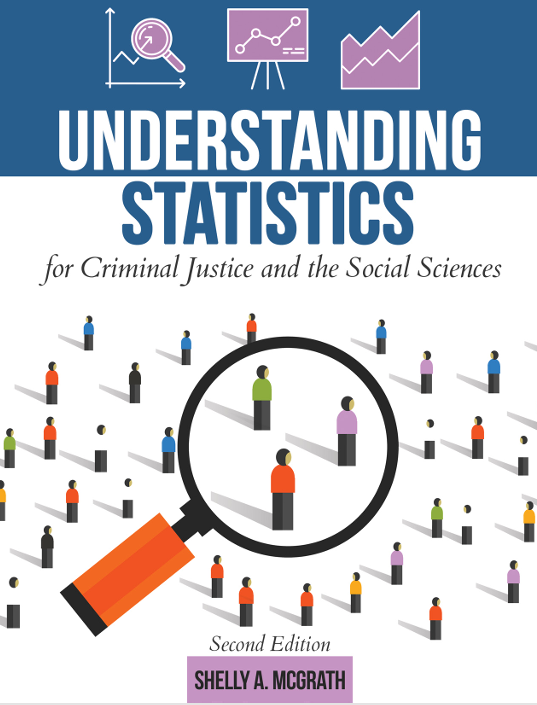
Understanding Statistics for Criminal Justice and the Social Sciences
Edition: 2
Copyright: 2026
Pages: 337
Choose Your Format
Choose Your Platform | Help Me Choose


Ebook Package
$86.00 USD
Oftentimes undergraduate students fear the statistics course and believe that because they are bad at math, the will not be able to understand the material.
Designed for the undergraduate level student, Understanding Statistics for Criminal Justice and the Social Sciences is written in a basic, easy to understand format. For students to understand the more complicated material in the book, they need to have an understanding of the material at the beginning. In statistics more complicated concepts work off of the less complicated concepts. If students do not understand the less complicated concepts, they will be lost for the rest of the semester. The basic concepts for each chapter are covered in a way that should make the understanding of them less complicated for students. After explaining the concept, detailed examples are provided in the chapter. These examples go step-by-step no matter how simple that step may seem. The chapter ends with key words and points that students should know. There are also practice problems for the students to complete at the end of the chapter to gauge whether they grasped the material.
Understanding Statistics for Criminal Justice and the Social Sciences empowers students to understand a subject matter that they do not necessarily think they can. By using this publication, students will understand the material and maybe leave the course not hating statistics.
Preface
About the Author
Part I: Basis of Statistics
Chapter 1: Introduction to Statistics
Chapter 2: Sampling
Part II: Descriptive Statistics
Chapter 3: Presenting Data with Tables and Graphs
Chapter 4: Measures of Central Tendency
Chapter 5: Measures of Variation
Part III: Bridging the Gap from Descriptive to Inferential Statistics
Chapter 6: Probability and Probability Distributions
Chapter 7: The Normal Distribution
Part IV: Inferential Statistics
Chapter 8: Hypothesis Testing One and Two-Tailed t-test
Chapter 9: Hypothesis Testing: Dependent t-Test, Z-Test, and Significance Test of Proportions
Chapter 10: Analysis of Variance (ANOVA)
Chapter 11: Chi-Square Test of Independence
Chapter 12: Bivariate Correlations and Linear Regression
Chapter 13: Multiple Regression and Other Types of Regression Models
Appendices:
Appendix A: Z Tables
Appendix B: T Tables
Appendix C: F Tables
Appendix D: Values of the Studentized Range Statistic, qk
Appendix E: X2 Tables
Appendix F: Pearson r Tables
Appendix G: Glossary
Shelly A. McGrath graduated from Saint Mary's College, South Bend, Indiana, with a B.A. in sociology and communications. She earned a M.A. in sociology and a M.A. in political science from Ball State University and her Ph.D. in sociology with an emphasis in criminology from Southern Illinois University Carbondale. She is an associate professor in the Department of Criminal Justice at the University of Alabama at Birmingham. Dr. McGrath's current research interests include domestic violence, fear of crime, animal abuse, and violent crime. She has published articles in the Journal of Interpersonal Violence, Deviant Behavior, Victims and Offenders, American Journal of Criminal Justice, and Aggression and Violent Behavior. She has also taught numerous courses in the department, including Crime and Criminality, Introductory Statistics, Research Methods in Criminal Justice, Corrections America: Overview, and Juvenile Delinquency.