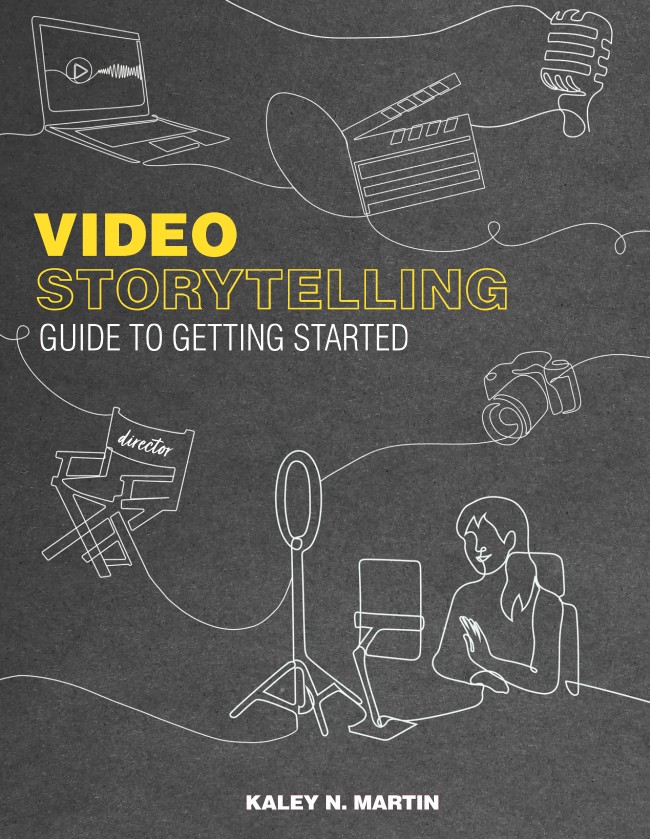
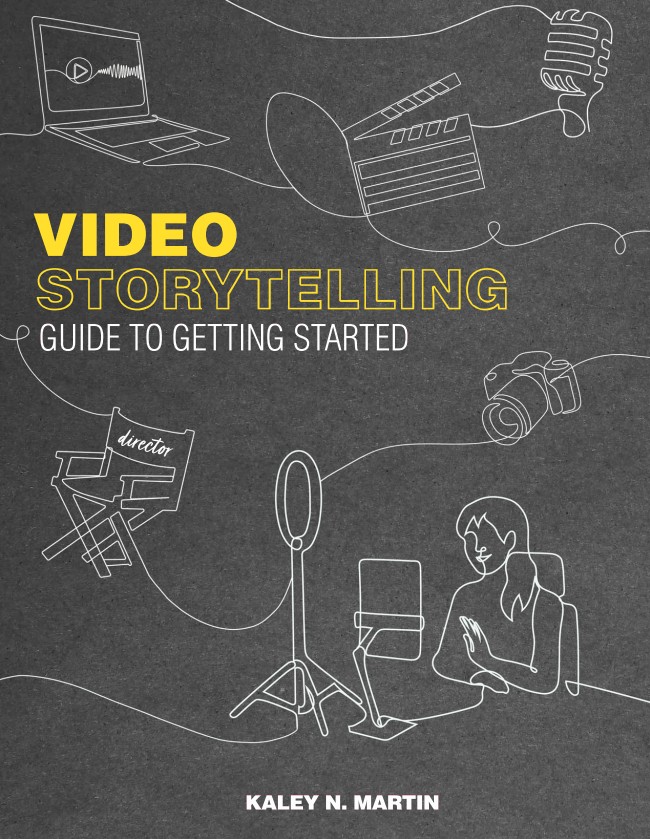
Video Storytelling: Guide to Getting Started
Edition: 2
Copyright: 2026
Pages: 182
Choose Your Format
Choose Your Platform | Help Me Choose


Video Storytelling: A Guide to Getting Started is designed for educators, professionals, and students who want to learn not only the technical skills of video production but also how to become adept storytellers. Structured across twelve chapters, the book covers everything from capturing strong footage, framing, lighting, and sound to post-production editing and industry-specific applications in journalism, corporate production, filmmaking, and social media. Its progression mirrors the workflow of a real production process (moving from camera fundamentals to shaping compelling stories) making it both practical and adaptable for classroom use.
Written with Students and Non-Majors in Mind
This book is particularly well-suited for instructors of mass communication, film, and media production courses who need an approachable yet comprehensive foundation for their students. It also works as a supplemental resource in any course with a video storytelling component. Written in a conversational, student-friendly tone, it demystifies complex technical concepts while grounding them in real-world context drawn from the author’s professional background in documentary, social, and corporate storytelling. It can serve as the primary text in an introductory video production course or as a companion resource where video creation enhances the curriculum.
Unique Features of the Text
Unlike many technical manuals, this book emphasizes why each element of production matters for storytelling, not just how to operate the camera or edit a sequence. By weaving together theory, practice, and industry insight, it equips instructors, students, and professionals with a text that both engages and prepares them for today’s diverse media landscape. The inclusion of discipline-specific chapters (sports, PR, digital filmmaking, and social media) makes it uniquely versatile, showing students how transferable skills in video storytelling can shape careers across fields. It’s not just a “getting started guide”, it’s a practical companion that reinforces foundational skills while inspiring students to see themselves as confident, creative storytellers.
About the Author
Introduction
Chapter One: Getting Good Video
Chapter Two: Learning to “See” the Frame
Chapter Three: Setting Up Good Stories
Chapter Four: Sound Off! (But Actually On)
Chapter Five: Light It Up!
Chapter Six: Support Yourself
Chapter Seven: Learning to Edit
Chapter Eight: Let’s Work in Journalism & Sports!
Chapter Nine: Let’s Work in Corporate Production & Public Relations!
Chapter Ten: Let’s Work in Digital Filmmaking!
Chapter Eleven: Let’s Work as Social Media Creators!
Chapter Twelve: Share Your Work

Dr. Kaley Martin has always been drawn to the power of storytelling, whether through a camera lens, a social media video, or another mass medium. Before entering academia, she spent nearly a decade as a creative video producer and storyteller, working across animation, documentary, film, social media, and corporate video production. Her work has been featured in national publications and earned prestigious industry accolades, including National Academy of Television Arts and Sciences Emmy Award, Telly Awards, and multiple American Advertising Awards (ADDYs). She has also been a featured speaker at international conferences, including the National Association of Broadcasters’ NAB Show in Las Vegas, as well as various academic conferences.
A proud University of Montevallo alumna, Dr. Martin earned her Master’s in Strategic Communication and Innovation from Texas Tech University, and a Ph.D. in Communication & Information Sciences, specializing in Media Sociology, from The University of Alabama. Her research explores the evolving landscape of content creators, content creation processes, and the challenges faced by women in filmmaking, particularly cinematographers.
Now an assistant professor of mass communication, she brings her passion for media, innovation, and storytelling into the classroom helping the next generation of storytellers shape the future of digital media across various mass mediums.
Video Storytelling: A Guide to Getting Started is designed for educators, professionals, and students who want to learn not only the technical skills of video production but also how to become adept storytellers. Structured across twelve chapters, the book covers everything from capturing strong footage, framing, lighting, and sound to post-production editing and industry-specific applications in journalism, corporate production, filmmaking, and social media. Its progression mirrors the workflow of a real production process (moving from camera fundamentals to shaping compelling stories) making it both practical and adaptable for classroom use.
Written with Students and Non-Majors in Mind
This book is particularly well-suited for instructors of mass communication, film, and media production courses who need an approachable yet comprehensive foundation for their students. It also works as a supplemental resource in any course with a video storytelling component. Written in a conversational, student-friendly tone, it demystifies complex technical concepts while grounding them in real-world context drawn from the author’s professional background in documentary, social, and corporate storytelling. It can serve as the primary text in an introductory video production course or as a companion resource where video creation enhances the curriculum.
Unique Features of the Text
Unlike many technical manuals, this book emphasizes why each element of production matters for storytelling, not just how to operate the camera or edit a sequence. By weaving together theory, practice, and industry insight, it equips instructors, students, and professionals with a text that both engages and prepares them for today’s diverse media landscape. The inclusion of discipline-specific chapters (sports, PR, digital filmmaking, and social media) makes it uniquely versatile, showing students how transferable skills in video storytelling can shape careers across fields. It’s not just a “getting started guide”, it’s a practical companion that reinforces foundational skills while inspiring students to see themselves as confident, creative storytellers.
About the Author
Introduction
Chapter One: Getting Good Video
Chapter Two: Learning to “See” the Frame
Chapter Three: Setting Up Good Stories
Chapter Four: Sound Off! (But Actually On)
Chapter Five: Light It Up!
Chapter Six: Support Yourself
Chapter Seven: Learning to Edit
Chapter Eight: Let’s Work in Journalism & Sports!
Chapter Nine: Let’s Work in Corporate Production & Public Relations!
Chapter Ten: Let’s Work in Digital Filmmaking!
Chapter Eleven: Let’s Work as Social Media Creators!
Chapter Twelve: Share Your Work
Dr. Kaley Martin has always been drawn to the power of storytelling, whether through a camera lens, a social media video, or another mass medium. Before entering academia, she spent nearly a decade as a creative video producer and storyteller, working across animation, documentary, film, social media, and corporate video production. Her work has been featured in national publications and earned prestigious industry accolades, including National Academy of Television Arts and Sciences Emmy Award, Telly Awards, and multiple American Advertising Awards (ADDYs). She has also been a featured speaker at international conferences, including the National Association of Broadcasters’ NAB Show in Las Vegas, as well as various academic conferences.
A proud University of Montevallo alumna, Dr. Martin earned her Master’s in Strategic Communication and Innovation from Texas Tech University, and a Ph.D. in Communication & Information Sciences, specializing in Media Sociology, from The University of Alabama. Her research explores the evolving landscape of content creators, content creation processes, and the challenges faced by women in filmmaking, particularly cinematographers.
Now an assistant professor of mass communication, she brings her passion for media, innovation, and storytelling into the classroom helping the next generation of storytellers shape the future of digital media across various mass mediums.