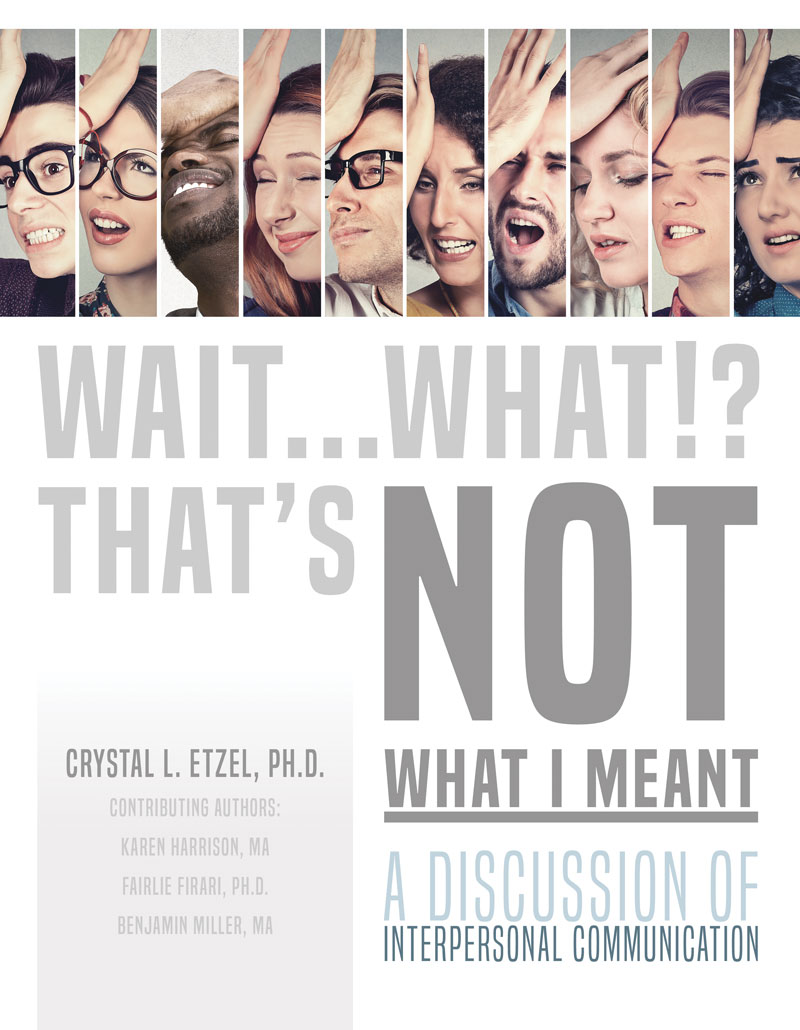
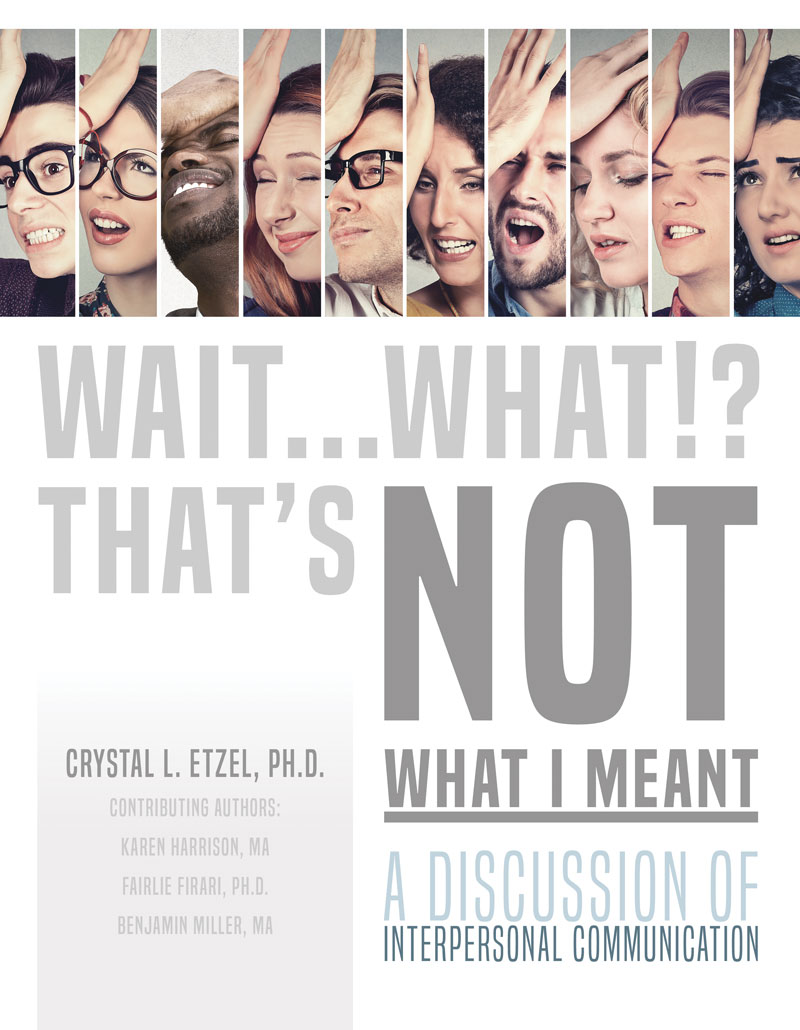
Wait. . .What!? That's Not What I Meant: A Discussion of Interpersonal Communication

Author(s): Crystal Etzel

Edition: 1

Copyright: 2017

Pages: 288

Choose Your Format

Ebook

$80.84 USD

ISBN 9781524945060

Details Electronic Delivery EBOOK 180 days

Combining a brisk bullet pointed format with the very best scholarship, “Wait. . .What!? That’s Not What I Meant” offers a fresh approach to the traditional topics covered in introductory Interpersonal Communication texts. Topics are covered in a bright, breezy style with plenty of pop culture references and explanatory visuals that enhance understanding.

The text takes a Socratic approach, asking questions rather than simply presenting information. This approach leaves the instructor free to fashion the material in a meaningful way for each individual class. Students will have a chance to use the text in class by engaging with the individual exercises, group projects, though experiments, debates and speaking opportunities that are embedded in each chapter

Chapter 1 “Our lives are defined by opportunities. Even the ones we miss.”

—Benjamin Button, The Curious Case of Benjamin Button

A Discussion of the Basics

Chapter 2 “What we’ve got here is a failure to communicate”

—The Captain, Cool Hand Luke

A Discussion of the Communication Model

Chapter 3 “I’m big! It’s the pictures that got small.”

—Norma Desmond, Sunset Blvd

A Discussion of Perception

Chapter 4 “I’m pretty sure there’s a lot more to life than being really, really, ridiculously good looking. And I plan on finding out what that is.”

—Derek Zoolander, Zoolander

A Discussion of Self-Concept

Chapter 5 “I don’t think that word means what you think it means.”

—Inigo Montoya, The Princess Bride

A Discussion of Verbal Communication

Chapter 6 “Yippie- Ki- yay.”

—John MaClane, Die Hard

A Discussion of Vocalics

Chapter 7 “Sixty percent of all human communication is nonverbal, body language; thirty percent is your tone. So that means that ninety percent of what you’re saying ain’t

coming out of your mouth. Of course she’s going to lie to you! She’s a nice person.

—Hitch

A Discussion of Nonverbal Communication

Chapter 8 “So listen, why don’t you give me a call when you start taking things a little more seriously.”

—The Joker, The Dark Knight

A Discussion of Listening

Chapter 9 “I’m gonna make him an offer he can’t refuse.”

—Don Vito Corleone, The Godfather

A Discussion of Conflict Management

Chapter 10 “I Love You.” “I Know”

—Princess Leia and Han Solo, The Empire Strikes Back

A Discussion of Relationship

Works Consulted

Crystal Etzel

Crystal Etzel is a professor of Communication at Onondaga Community College and the author of several textbooks on public speaking, interpersonal communication, and rhetoric, including TECHNE: The Ancient Art of Public Discourse for the 21st Century Speaker. She holds both a Ph.D. in Rhetoric and Public Address and a Master of Divinity (M.Div.), bringing together expertise in communication theory, classical rhetoric, and public speaking. Through her teaching and writing, Etzel emphasizes practical communication skills, ethical discourse, and the enduring relevance of classical rhetorical principles in modern public speaking.

Combining a brisk bullet pointed format with the very best scholarship, “Wait. . .What!? That’s Not What I Meant” offers a fresh approach to the traditional topics covered in introductory Interpersonal Communication texts. Topics are covered in a bright, breezy style with plenty of pop culture references and explanatory visuals that enhance understanding.

The text takes a Socratic approach, asking questions rather than simply presenting information. This approach leaves the instructor free to fashion the material in a meaningful way for each individual class. Students will have a chance to use the text in class by engaging with the individual exercises, group projects, though experiments, debates and speaking opportunities that are embedded in each chapter

Chapter 1 “Our lives are defined by opportunities. Even the ones we miss.”

—Benjamin Button, The Curious Case of Benjamin Button

A Discussion of the Basics

Chapter 2 “What we’ve got here is a failure to communicate”

—The Captain, Cool Hand Luke

A Discussion of the Communication Model

Chapter 3 “I’m big! It’s the pictures that got small.”

—Norma Desmond, Sunset Blvd

A Discussion of Perception

Chapter 4 “I’m pretty sure there’s a lot more to life than being really, really, ridiculously good looking. And I plan on finding out what that is.”

—Derek Zoolander, Zoolander

A Discussion of Self-Concept

Chapter 5 “I don’t think that word means what you think it means.”

—Inigo Montoya, The Princess Bride

A Discussion of Verbal Communication

Chapter 6 “Yippie- Ki- yay.”

—John MaClane, Die Hard

A Discussion of Vocalics

Chapter 7 “Sixty percent of all human communication is nonverbal, body language; thirty percent is your tone. So that means that ninety percent of what you’re saying ain’t

coming out of your mouth. Of course she’s going to lie to you! She’s a nice person.

—Hitch

A Discussion of Nonverbal Communication

Chapter 8 “So listen, why don’t you give me a call when you start taking things a little more seriously.”

—The Joker, The Dark Knight

A Discussion of Listening

Chapter 9 “I’m gonna make him an offer he can’t refuse.”

—Don Vito Corleone, The Godfather

A Discussion of Conflict Management

Chapter 10 “I Love You.” “I Know”

—Princess Leia and Han Solo, The Empire Strikes Back

A Discussion of Relationship

Works Consulted

Crystal Etzel

Crystal Etzel is a professor of Communication at Onondaga Community College and the author of several textbooks on public speaking, interpersonal communication, and rhetoric, including TECHNE: The Ancient Art of Public Discourse for the 21st Century Speaker. She holds both a Ph.D. in Rhetoric and Public Address and a Master of Divinity (M.Div.), bringing together expertise in communication theory, classical rhetoric, and public speaking. Through her teaching and writing, Etzel emphasizes practical communication skills, ethical discourse, and the enduring relevance of classical rhetorical principles in modern public speaking.