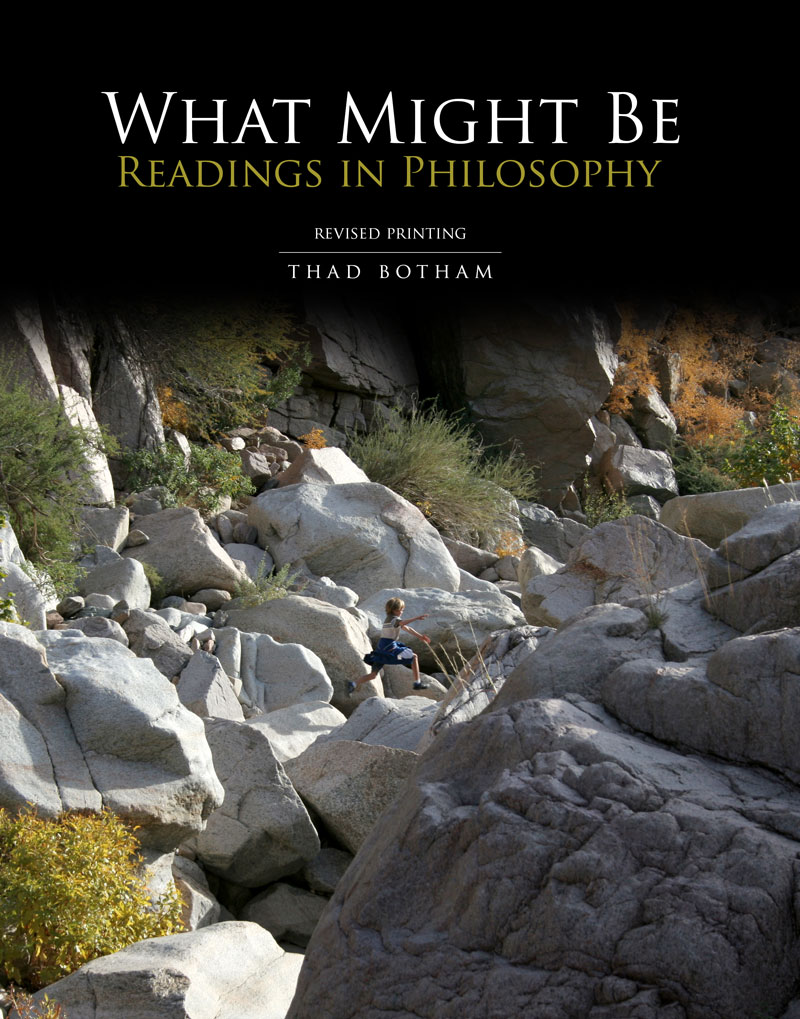
What Might Be: Readings in Philosophy

Author(s): Thad Botham

Edition: 2

Copyright: 2026

Pages: 384

Choose Your Format

Choose Your Platform | Help Me Choose

Ebook


This product is currently not available.

Ebook

$73.00 USD

ISBN 9798385137763

Details Electronic Delivery EBOOK 180 days
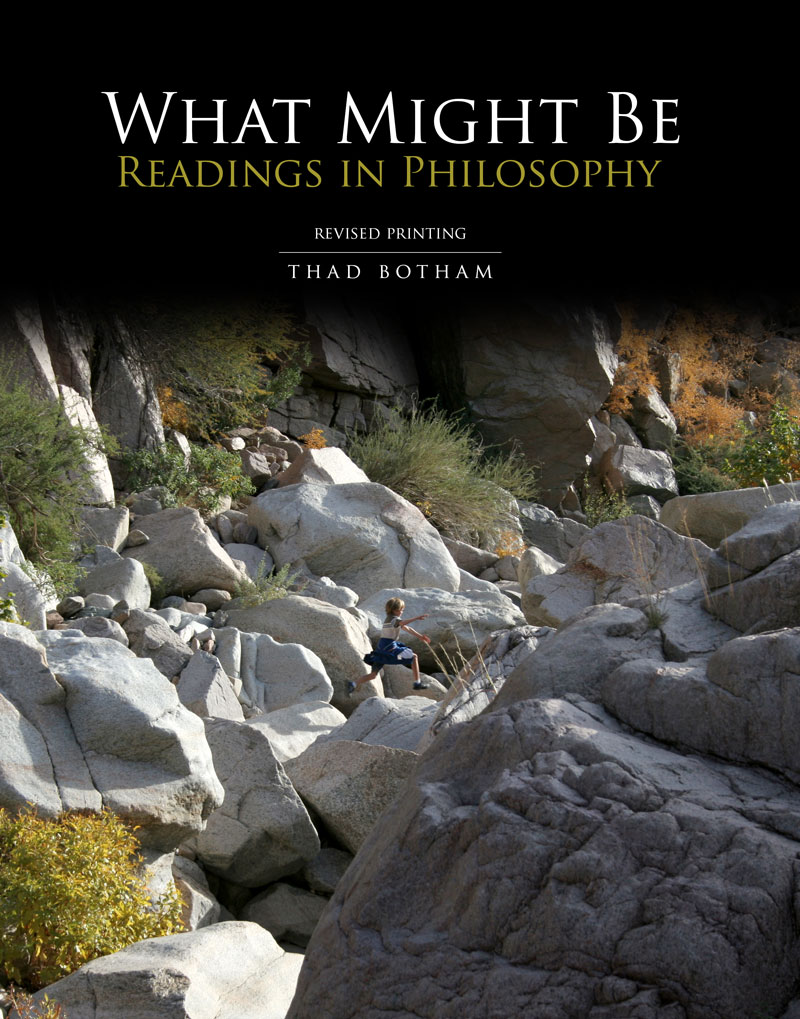
This book provides an introduction to the major branches of philosophy, guiding readers through fundamental questions about reality, knowledge, religion, the mind, free will, ethics, and science. Through a collection of classic and contemporary philosophical writings, the text introduces influential thinkers such as Anselm, Thomas Aquinas, René Descartes, David Hume, Aristotle, Immanuel Kant, John Stuart Mill, and others. Each section presents key philosophical arguments and encourages readers to examine different perspectives while developing critical thinking and logical reasoning skills.

Throughout the book, readers explore topics including logic and argumentation, the existence of God, the relationship between mind and body, free will versus determinism, moral decision-making, and theories of knowledge. The selected readings and accompanying introductions provide historical context while demonstrating how philosophical ideas continue to influence modern discussions about human nature, morality, science, and society. By analyzing competing viewpoints and constructing well-reasoned arguments, readers gain a deeper understanding of philosophy's role in addressing life's most fundamental questions.

I Introduction 
1 On the Study of Philosophy John Perry, Michael Bratman, and John Martin Fischer 

II Logic 
2 Short Arguments: Some General Rules Anthony Weston 
3 Deductive Arguments Anthony Weston 

III Philosophy of Religion 
4 Introduction: Exploring the Philosophy of Religion Thad Botham 
5 The Ontological Argument, from Proslogion Anselm of Canterbury 
6 On Behalf of the Fool Gaunilo, Monk of Marmoutier 
7 An Analysis of the Ontological Argument William Rowe 
8 The Five Ways, from Summa Theologica Thomas Aquinas 
9 The Kalam Cosmological Argument and the Anthropic Principle William Lane Craig 
10 The Problem of Evil Michael Peterson 
11 Evil and Omnipotence J. L. Mackie 
12 The Free Will Defense Alvin Plantinga 

IV Philosophy of Mind 
13 Introduction: Philosophy of Mind Thad Botham 
14 Meditations I and II (with Synopsis) René Descartes 
15 Materialism, Dualism, and the Conscious Self David Lund 
16 Against non-reductive physicalism Joshua Rasmussen 
17 The Case for Materialism David Papineau 
18 The Qualia Problem Frank Jackson 

V Free Will and Determinism 
19 Introduction: Free Will and Determinism Thad Botham 
20 The Illusion of Free Will Paul Holbach 
21 Of Liberty and Necessity David Hume 
22 Free Will: Ancient Dispute, New Themes Robert Kane 

VI Ethics 
23 Moral Reasoning Lewis Vaughn 
24 Cultural Relativism Harry Gensler 
25 Religion, Morality, and Conscience John Arthur 
26 The Nicomachean Ethics Aristotle 
27 Utilitarianism John Stuart Mill 
28 The Categorical Imperative Immanuel Kant 
29 Reflections of a Philosopher Thad Botham 

VII Epistemology and Philosophy of Science 
30 Introduction: Epistemology Thad Botham 
31 Problems with Knowledge Laurence BonJour 
32 Is Justified True Belief Knowledge? Edmund Gettier 
33 An Analysis of Knowledge James Cornman, Keith Lehrer, and George Pappas 
34 An Encounter with David Hume Wesley C. Salmon

Thad Botham

Dr. Thad Botham is published in epistemology and in metaphysics. Thad was a visiting assistant professor at Valparaiso University in 2006. He has taught at ASU since the fall of 2006. He has taught for Barrett, the Honors College at ASU, and is currently the faculty honors advisor for philosophy. Thad is a founding faculty member of the ASU's Master of Liberal Studies Program.

Thad has a penchant for high quality teaching that, pacé Socrates’s Meno, produces results. Fostering an environment where students feel safe, yet challenged, Thad equips students to master both evaluation and delivery of sound arguments for controversial claims. He nurtures the sense of community many consistently experience in his classroom. Thad enjoys refereeing manuscripts for top-tier philosophy journals such as Synthese, Analysis, Ergo, and Erkenntnis.

Thad's 2008 book, "Agent-Causation Revisited: Origination and Contemporary Theories of Free Will," reveals that experts in the secular free will literature neglect to take seriously the deeply seated intuition that acting freely requires being an ultimate originator of change in the world.  From his findings, Thad argues that a theory called agent-causation best fits both our intuitive commitments about free will as well as our scientific understanding about how the world works.

Thad's current research includes several works on progress. One engages a debate in the philosophy of religion between three theories that attempt to reconcile a creator with maximal control over creation, on the one hand, and creaturely free will, on the other hand. The three theories are Thomism, Molinism, and Open Theism. While studying at Notre Dame under several of the most authoritative minds on the issue, Thad has developed a conjecture that the last 30 years of debate, which includes thousands of professional contributions, rests on a big mistake. Thad’s research unearths early contributions that have apparently gone unnoticed and unappreciated for three decades. He aims to unpack his BIG IDEA that the three theories are not mutually exclusive candidates for addressing the reconciliation-problem.  If plausible, Thad's BIG IDEA would launch an entirely new research program in the philosophy of religion.

Thad enjoys doing so many different things with his gorgeous wife, Peggy Bell:  traveling, camping, canoeing, hiking, shooting photography, exploring, and a hundred other wonderful things.  His three children amaze him in how much they thrive and leave the world better than they found it.  Thad roasts his own coffee beans because, well, the coffee is better that way.  For fun, Thad builds large boomerangs from a 1912 Australian design, and they really do return.


This book provides an introduction to the major branches of philosophy, guiding readers through fundamental questions about reality, knowledge, religion, the mind, free will, ethics, and science. Through a collection of classic and contemporary philosophical writings, the text introduces influential thinkers such as Anselm, Thomas Aquinas, René Descartes, David Hume, Aristotle, Immanuel Kant, John Stuart Mill, and others. Each section presents key philosophical arguments and encourages readers to examine different perspectives while developing critical thinking and logical reasoning skills.

Throughout the book, readers explore topics including logic and argumentation, the existence of God, the relationship between mind and body, free will versus determinism, moral decision-making, and theories of knowledge. The selected readings and accompanying introductions provide historical context while demonstrating how philosophical ideas continue to influence modern discussions about human nature, morality, science, and society. By analyzing competing viewpoints and constructing well-reasoned arguments, readers gain a deeper understanding of philosophy's role in addressing life's most fundamental questions.

I Introduction 
1 On the Study of Philosophy John Perry, Michael Bratman, and John Martin Fischer 

II Logic 
2 Short Arguments: Some General Rules Anthony Weston 
3 Deductive Arguments Anthony Weston 

III Philosophy of Religion 
4 Introduction: Exploring the Philosophy of Religion Thad Botham 
5 The Ontological Argument, from Proslogion Anselm of Canterbury 
6 On Behalf of the Fool Gaunilo, Monk of Marmoutier 
7 An Analysis of the Ontological Argument William Rowe 
8 The Five Ways, from Summa Theologica Thomas Aquinas 
9 The Kalam Cosmological Argument and the Anthropic Principle William Lane Craig 
10 The Problem of Evil Michael Peterson 
11 Evil and Omnipotence J. L. Mackie 
12 The Free Will Defense Alvin Plantinga 

IV Philosophy of Mind 
13 Introduction: Philosophy of Mind Thad Botham 
14 Meditations I and II (with Synopsis) René Descartes 
15 Materialism, Dualism, and the Conscious Self David Lund 
16 Against non-reductive physicalism Joshua Rasmussen 
17 The Case for Materialism David Papineau 
18 The Qualia Problem Frank Jackson 

V Free Will and Determinism 
19 Introduction: Free Will and Determinism Thad Botham 
20 The Illusion of Free Will Paul Holbach 
21 Of Liberty and Necessity David Hume 
22 Free Will: Ancient Dispute, New Themes Robert Kane 

VI Ethics 
23 Moral Reasoning Lewis Vaughn 
24 Cultural Relativism Harry Gensler 
25 Religion, Morality, and Conscience John Arthur 
26 The Nicomachean Ethics Aristotle 
27 Utilitarianism John Stuart Mill 
28 The Categorical Imperative Immanuel Kant 
29 Reflections of a Philosopher Thad Botham 

VII Epistemology and Philosophy of Science 
30 Introduction: Epistemology Thad Botham 
31 Problems with Knowledge Laurence BonJour 
32 Is Justified True Belief Knowledge? Edmund Gettier 
33 An Analysis of Knowledge James Cornman, Keith Lehrer, and George Pappas 
34 An Encounter with David Hume Wesley C. Salmon

Thad Botham

Dr. Thad Botham is published in epistemology and in metaphysics. Thad was a visiting assistant professor at Valparaiso University in 2006. He has taught at ASU since the fall of 2006. He has taught for Barrett, the Honors College at ASU, and is currently the faculty honors advisor for philosophy. Thad is a founding faculty member of the ASU's Master of Liberal Studies Program.

Thad has a penchant for high quality teaching that, pacé Socrates’s Meno, produces results. Fostering an environment where students feel safe, yet challenged, Thad equips students to master both evaluation and delivery of sound arguments for controversial claims. He nurtures the sense of community many consistently experience in his classroom. Thad enjoys refereeing manuscripts for top-tier philosophy journals such as Synthese, Analysis, Ergo, and Erkenntnis.

Thad's 2008 book, "Agent-Causation Revisited: Origination and Contemporary Theories of Free Will," reveals that experts in the secular free will literature neglect to take seriously the deeply seated intuition that acting freely requires being an ultimate originator of change in the world.  From his findings, Thad argues that a theory called agent-causation best fits both our intuitive commitments about free will as well as our scientific understanding about how the world works.

Thad's current research includes several works on progress. One engages a debate in the philosophy of religion between three theories that attempt to reconcile a creator with maximal control over creation, on the one hand, and creaturely free will, on the other hand. The three theories are Thomism, Molinism, and Open Theism. While studying at Notre Dame under several of the most authoritative minds on the issue, Thad has developed a conjecture that the last 30 years of debate, which includes thousands of professional contributions, rests on a big mistake. Thad’s research unearths early contributions that have apparently gone unnoticed and unappreciated for three decades. He aims to unpack his BIG IDEA that the three theories are not mutually exclusive candidates for addressing the reconciliation-problem.  If plausible, Thad's BIG IDEA would launch an entirely new research program in the philosophy of religion.

Thad enjoys doing so many different things with his gorgeous wife, Peggy Bell:  traveling, camping, canoeing, hiking, shooting photography, exploring, and a hundred other wonderful things.  His three children amaze him in how much they thrive and leave the world better than they found it.  Thad roasts his own coffee beans because, well, the coffee is better that way.  For fun, Thad builds large boomerangs from a 1912 Australian design, and they really do return.